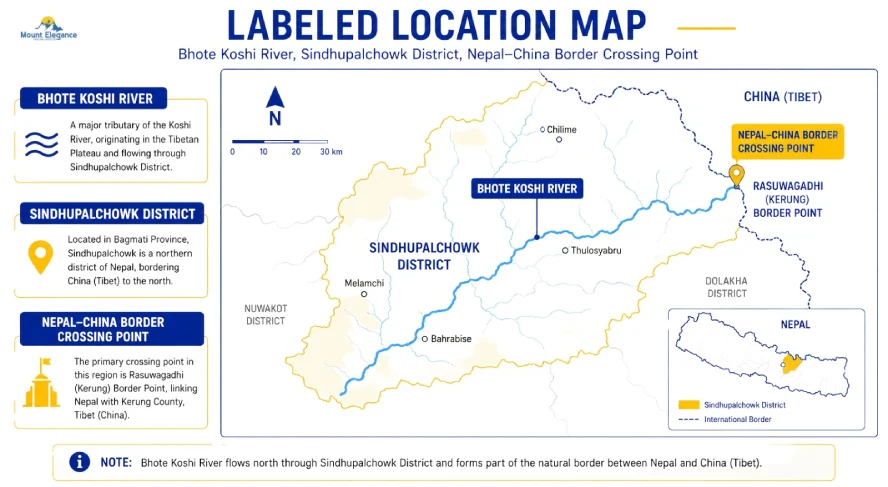
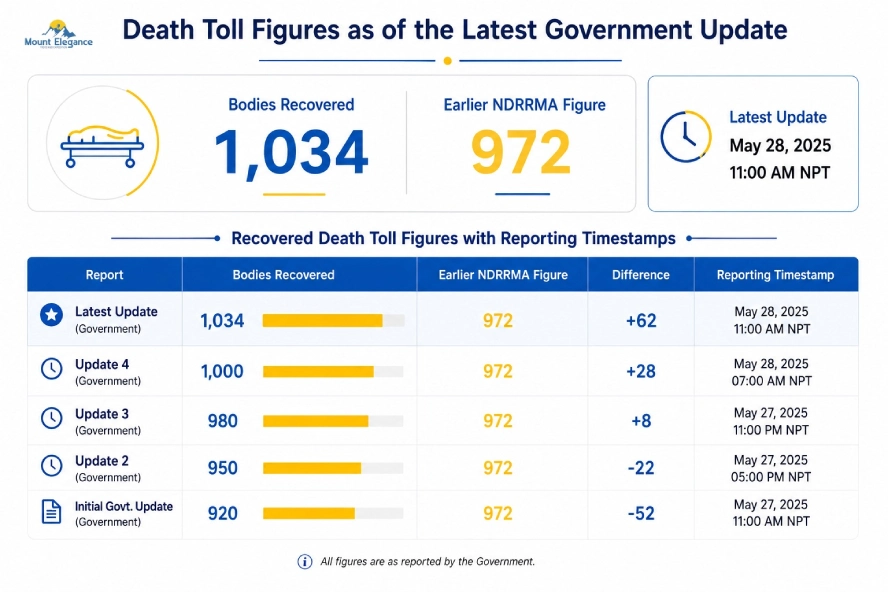
Flash floods on the Bhote Koshi River killed more than 390 people and left roughly 1400 people missing (28th Aug 2026) after a suspected glacial lake outburst struck the Nepal-China border on 26 August 2026. The disaster hit hardest in Nepal’s Rasuwa and Nuwakot districts with floodwaters surging through the Lhende Khola into the Bhote Koshi and Trishuli rivers. Nepal’s Ministry of Culture and Tourism reported hundreds of foreign tourists among the missing including dozens of Americans, Australians and Canadians spanning multiple nationalities. Nepal’s National Disaster Risk Reduction and Management Authority (NDRRMA) is coordinating rescue efforts alongside the army, though damaged roads and bridges are slowing search operations. For travelers this raises real questions about trail access infrastructure damage and safety near affected rivers in the coming trekking season.
What Happened in the Bhote Koshi Flood?
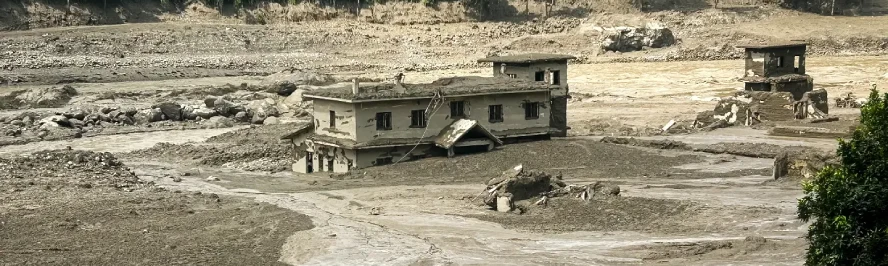
A flash flood struck the Bhote Koshi River in Rasuwa district, Nepal, on 26 August 2026. The disaster occurred squarely within Nepal’s monsoon season which typically runs from June to September and regularly triggers flooding and landslides across the Himalayan region. Authorities believe the flood was triggered by a glacial collapse near the Nepal-China border sending a sudden surge of water and debris downstream through the Lhende Khola into the Bhote Koshi River which then fed into the Trishuli River. Water levels reportedly rose dramatically within minutes giving residents little time to reach safety. The surge caused widespread displacement sweeping away homes and forcing entire communities from affected villages. Infrastructure damage was severe: dozens of bridges were destroyed, tens of kilometers of roads were washed out and hydropower facilities along the river were damaged cutting electricity supply in the region. The scale of destruction significantly hampered rescue and relief operations since damaged roads made it difficult for emergency teams to reach isolated communities. Nepal’s army mobilized helicopters to rescue stranded residents while officials on both sides of the border worked to assess the full extent of casualties and damage as the disaster continued to unfold.
How Many People Have Died in the Nepal Flood?
A flash flood struck the Bhote Koshi River in Rasuwa district northeast of Kathmandu, Nepal, on 26 August 2026. The surge originated high on the Tibetan side of the Nepal-Chaina border likely from a glacial or slope-related event above the gorge before racing downstream with little warning time for communities along the river. The flood swept through settlements before moving into the Trishuli River and triggering high alerts in several downstream distincts. The disaster struck during Nepal’s monsoon season which typically runs from June to September, a period when saturated slopes and swollen rivers make the region especially vulnerable to sudden high-volume water surges. The flood resulted in widespread displacement and extensive damage to houses, roads, bridges, hydropower facilities and other critical infrastructure. Confirmed damage included a border customs post, multiple bridges, a helipad, several hydropower installations and long sections of a major highway. Search and rescue operations, evacuations and relief efforts were launched immediately with security forces, disaster-management agencies and health services mobilized across the affected districts. The full scale of casualties and destruction was still being assessed in the days after the event with numbers changing quickly as rescue teams reached remote and hard-hit areas.
How Many People Are Missing?
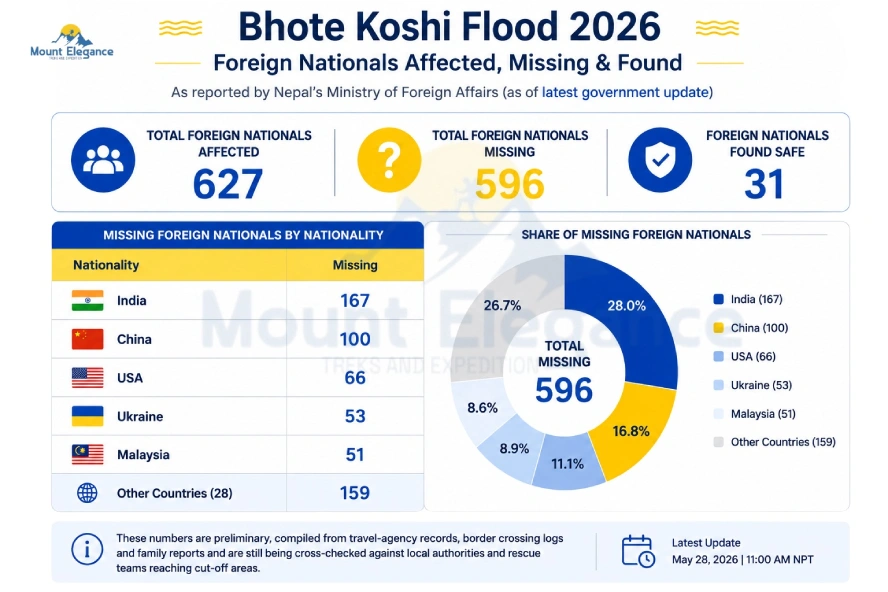
596 foreign nationals from 33 countries remain missing as of the latest Nepal government count. According to Nepal’s Ministry of Foreign Affairs a total of 627 foreign nationals were reported affected by the flood of whom 31 have since been confirmed found safe leaving 596 still unaccounted for. Nepal’s Tourism board figures show that India accounts for the largest single share of missing foreign nationals at 167, followed by - China, the United States, Ukraine and Malaysia. Officials have stressed that these numbers are preliminary, compiled from travel-agency records, border crossing logs and family reports and are still being cross-checked against local authorities and rescue teams reaching cut-off areas.
Source: Latest Updates on Flash Floods, 27 August 2026 Ministry Of Foreign Affairs
Which Countries' Nationals Are Missing?
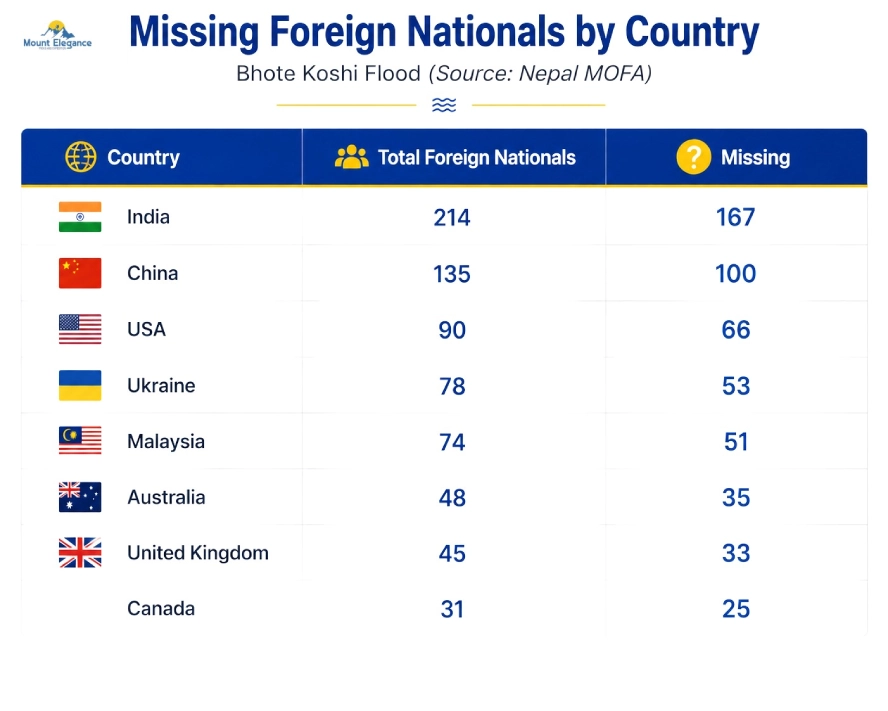
Nepal’s Ministry of Foreign Affairs lists missing foreign nationals from 33 countries, led by India, China and the United States. As of 28th August 2026 India has the largest contingent with 178 nationals affected and 167 still missing, followed by China at 100 missing. The United States reports 68 nationals affected of whom 66 remain missing, while Ukraine and Malaysia follow with 53 and 51 missing respectively Australia and the United Kingdom each have several dozen nationals unaccounted for, at 35 and 33, and Canada rounds out the largest groups with 25 missing. Smaller numbers have been reported from dozens of other countries across Asia, Europe and beyond. The full 33-country breakdown updated as verification countries is available from MOFA.
Source: Latest Updates on Flash Floods, 27 August 2026 Ministry Of Foreign Affairs
What Caused the Nepal-Tibet Flood?
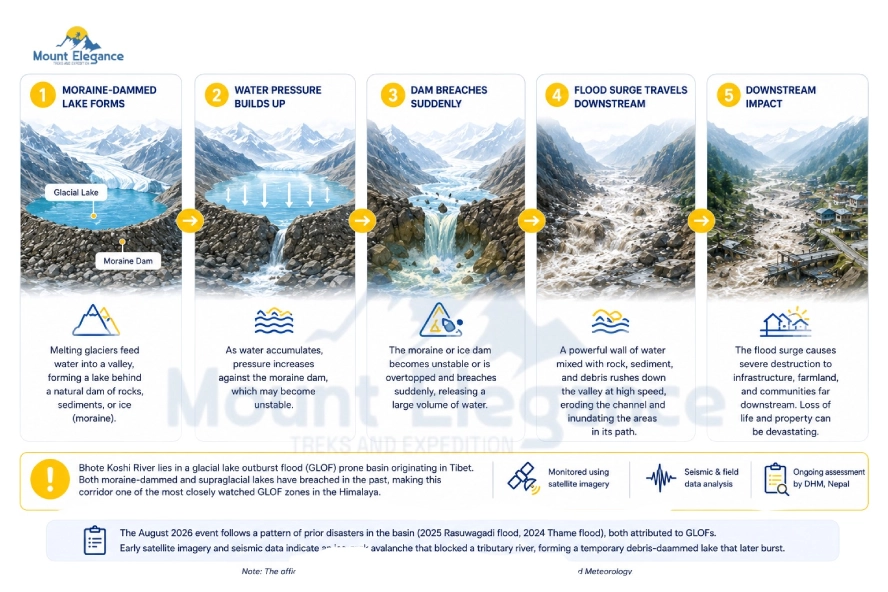
Nepal’s Bhote Koshi River sits in a basin reportedly hit by glacial lake outburst floods originating in Tibet. Also known as a GLOF this type of disaster happens when water suddenly bursts from a glacier-fed lake after the failure of a natural ice or moraine dam sending a surge of water, mud and debris downstream. The Bhote Koshi is part of wider Poiqu-Bhote Koshi-Sun koshi basins which straddle the Nepal-China border and draws meltwater from glacier high in the Tibet Autonomous Region of China. Both moraine-dammed and supraglacial lakes in this basin have breached before, making the corridor one of the more closely watched GLOF zones anywhere in Himalaya. The August 2026 event follows a pattern seen in prior disasters in the same basin including the 2025 Rasuwagadi flood and the 2024 Thame flood both attributed to glacial lake outbursts after field investigation. For the latest flood early satellite imagery and seismic data point toward an ice-rock avalanche that blocked a tributary river forming a temporary debris-dammed lake that then burst through a conventional pre-existing glacial lake outburst has not been ruled out. Officials have noted there was no significant rainfall in the area beforehand, reinforcing that the trigger was glacial or slope-related rather than a rainstorm. The official cause is still being confirmed by Nepal’s Department of Hydrology and Meteorology which says a full determination could take several more days of satellite and field analysis.
Source: Kathmandupost
Is This Basin Prone to Flooding? Past Bhote Koshi Floods
The Bhote Koshi/ Poiqu basin has had several glacial lake floods over the past ten years. Experts have long said this area is at high risk. A 2015 study in Mountain Research and Development named this basin as one of the most likely places for this kind of flood to happen. Recent events prove the point, from a lake burst in the Poiqu basin in 2016 to a deadly flood last year at Rasuwagadhi.
Event | Basin | Impact |
2016 Gongbatongsha Lake GLOF | Poiqu basin | Lake burst flood |
July 2025 Rasuwagadhi GLOF | Bhote Koshi/Lhende basin | 9 deaths, Friendship Bridge destroyed |
How Is Nepal Responding? Rescue and Relief Operations
Nepal's security forces, disaster-management agencies and health services have been fully mobilised for search, rescue and relief. The response is being coordinated centrally through the National Disaster Risk Reduction and Management Authority (NDRRMA), which is compiling situation reports and directing resources to the worst-hit districts.
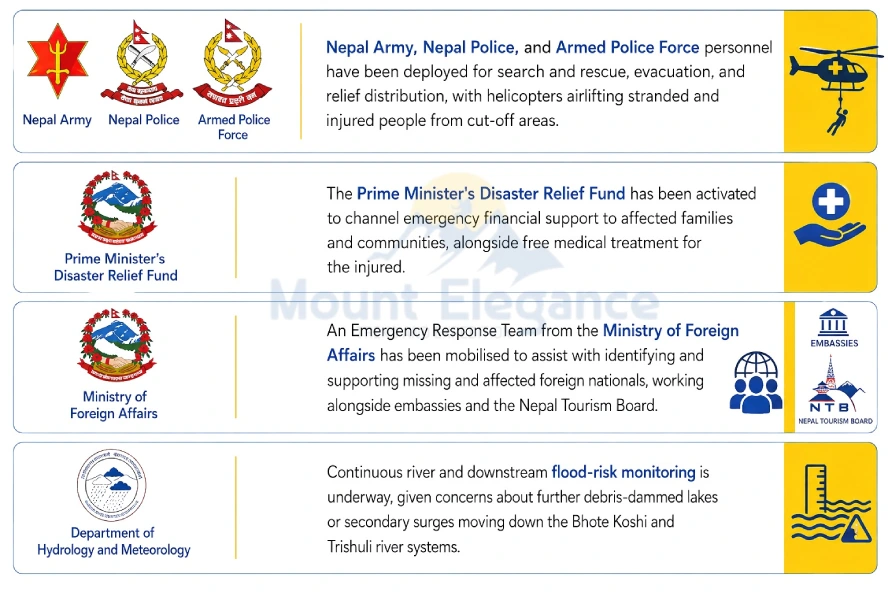
- Nepal Army, Nepal Police, and Armed Police Force personnel have been deployed for search and rescue, evacuation, and relief distribution, with helicopters airlifting stranded and injured people from cut-off areas.
- The Prime Minister's Disaster Relief Fund has been activated to channel emergency financial support to affected families and communities, alongside free medical treatment for the injured.
- An Emergency Response Team from the Ministry of Foreign Affairs has been mobilised to assist with identifying and supporting missing and affected foreign nationals, working alongside embassies and the Nepal Tourism Board.
- Continuous river and downstream flood-risk monitoring is underway, given concerns about further debris-dammed lakes or secondary surges moving down the Bhote Koshi and Trishuli river systems.
Officials have described the operation as involving all available national resources, with search, rescue, and relief work expected to continue for an extended period given the scale of destruction and the number of people still unaccounted for.
How Can Affected Families Get Help or Report a Missing Person?
- Nepal's Ministry of Foreign Affairs has opened an emergency hotline service for foreign nationals affected by the flood. Families looking for missing relatives or needing emergency help can contact the emergency team through WhatsApp or via phone at +977-9744441227 or +977-9744441228 between 7am and 10pm NPT or e-mail at [email protected].
- Families can also report cases byemail at [email protected]by providing clear details such as the missing person’s full name, nationality as well as last known location and any available contact information.
- Those outside Nepal can approach the nearest Nepali diplomatic mission including an embassy or consulate for assistance and guidance on the appropriate next steps.
- People who want to support flood-affected communities can donate through the Prime Minister Disaster Relief Fund. Contributions can help support emergency response - rescue and relief activities.
- Families should use official channels when reporting a missing person and avoid relying on unverified posts or information circulating on social media.Get proper information through verified sites for your safety.
How Can People Donate or Help?
- Contributions to Nepal's flood relief effort can be made through the Prime Minister's Disaster Relief Fund. Donations can be submitted through the official portal pmdrf.nchl.com.np to support emergency response and relief activities.
The Prime Minister's Disaster Relief Fund
- The government is still assessing the situation and will communicate specific requirements and priority areas through official channels as more information becomes available.
- The immediate priority is - search, rescue, evacuation and relief for people stranded or displaced by flooding and related emergencies.
- Individuals, organisations and donors should follow official guidance when offering financial or other assistance, helping ensure resources reach affected communities safely and efficiently.
- Before donating through other appeals verify the source and use recognised government channels wherever possible to reduce the risk of scams or misdirected funds.
Is It Safe to Trek or Travel in Nepal Right Now?
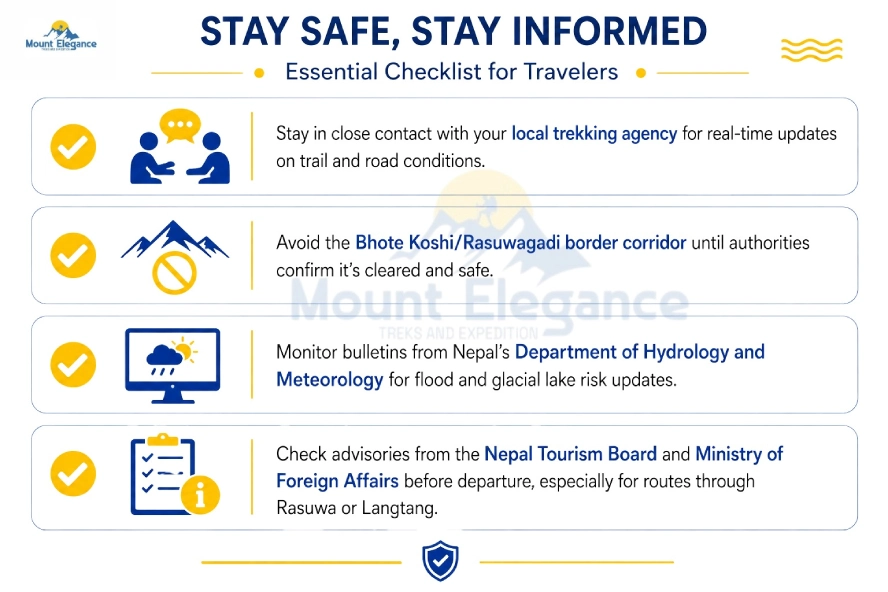
The flood has not closed Nepal's main trekking regions but it has cut road and river-crossing links near the Nepal-China border. The damage is concentrated along the Bhote Koshi corridor and the Rasuwagadhi border crossing, where bridges, highway sections, and the border post itself were destroyed or badly damaged. This is separate from the Araniko Highway and the Sindhupalchowk-Tibet border crossing further east at Kodari/Tatopani, which are not part of the area hit by this flood and remain a distinct route into Tibet.
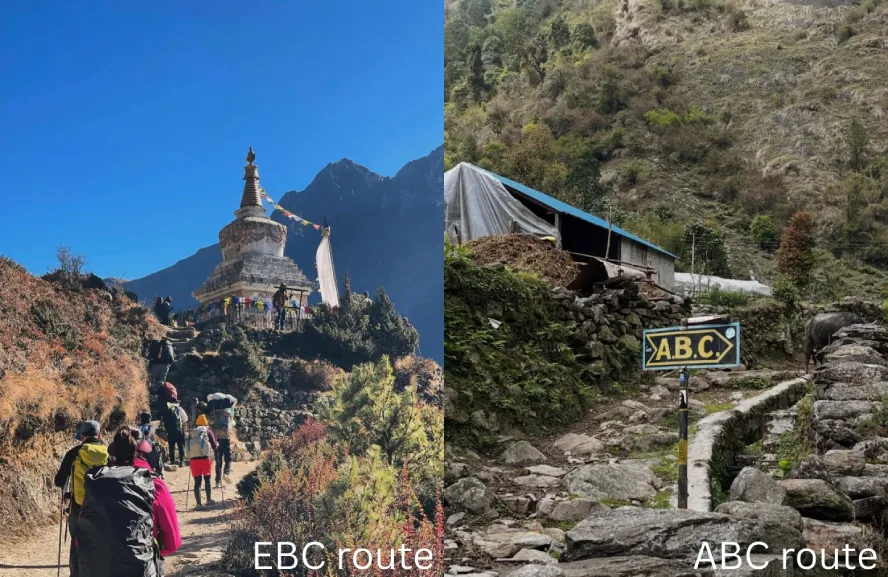
So far there are no reported closures on the Everest Base Camp or Annapurna Circuit routes as a result of this event, and trekking in those regions is continuing largely as normal. The affected zone lies mainly in Rasuwa, Nuwakot, Dhading, and neighboring districts, which include access points for Langtang region treks, so travelers with plans in that specific area should expect disruption and check current conditions before heading out. The Nepal Tourism Board is monitoring the situation and working to verify the safety and whereabouts of travelers who were in or passing through the affected corridor.
It's worth keeping in mind that this isn't the first time flooding has disrupted trekking in Nepal: past glacial lake outburst floods and monsoon storms have triggered temporary trail closures on the Annapurna, Manaslu, and Langtang circuits in previous years. Given how quickly conditions are changing, anyone planning to trek or travel in Nepal soon should check official updates from the Nepal Tourism Board and local authorities close to their departure date, particularly for anything routed through Rasuwa or the Langtang area.
What Should Trekkers and Tour Operators Do Now?
Trekkers and tour operators should confirm route status directly with local agents before travel near the affected border area.
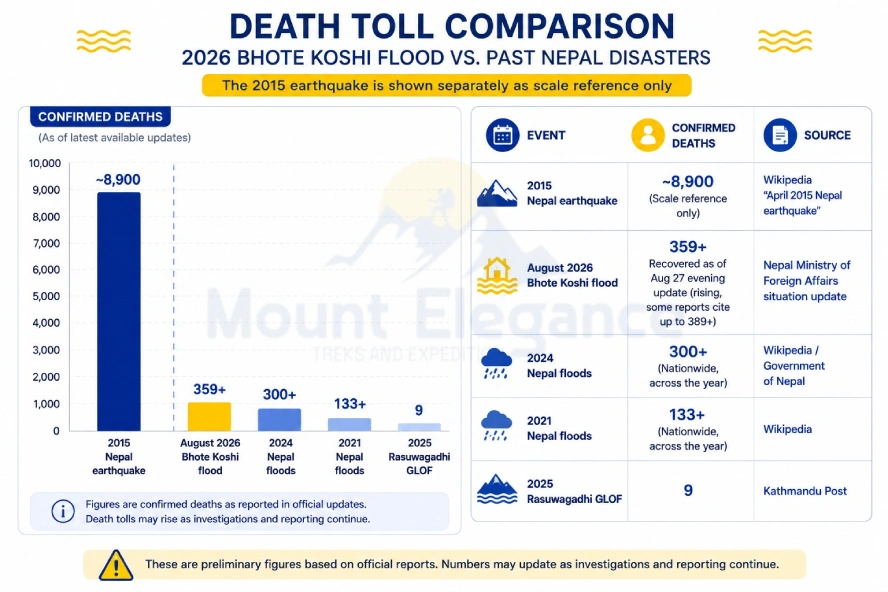
How Does This Compare to Past Nepal Floods?
Event | Confirmed deaths | Source |
2015 Nepal earthquake | ~8,900 | |
August 2026 Bhote Koshi flood | 359 recovered as of Aug 27 evening update (rising, some reports cite up to 389+) | |
2024 Nepal floods | 300+ (nationwide, across the year) | Wikipedia / Government of Nepal |
2021 Nepal floods | 133+ (nationwide, across the year) | |
2025 Rasuwagadhi GLOF | 9 |
Frequently Asked Questions (FAQs)
An ice-rock avalanche struck a tributary of the Bhote Koshi River on the Tibetan side, blocking it and forming a temporary lake that burst. A glacial lake outburst may also have contributed; officials are still confirming the exact cause.
As of the latest count, 596 foreign nationals from 33 countries remain missing, alongside many Nepali nationals. Total missing figures (including locals) have been reported as high as 1,000+ in some updates, and are still being verified.
No reported closures affect the Everest Base Camp or Annapurna Circuit routes. The flood damage is concentrated in Rasuwa, Nuwakot, and Dhading districts, near the Bhote Koshi corridor and Langtang region.
Contact the Nepal Tourism Board, your embassy in Kathmandu, or your trekking/tour agency directly. Nepal's Ministry of Foreign Affairs is compiling and updating official missing-persons lists by nationality.
Established organizations like the Nepal Red Cross Society and CARE Nepal are coordinating relief efforts. Check their official websites directly for verified donation channels rather than unsolicited links or appeals.