 Best Seller
Everest Base Camp Trek 14 Days
Duration
14 days
Acoomodation
Hotels, Tea houses
Maximum Guests
40
Highest Altitude
5,545m/ 18,192ft
Best Season
Mar-May & Sep-Nov
Start/End Point
Kathmandu
EVEREST BASE CAMP TREK QUICK FACTS
- Duration: 14 Days
- Trek Region : Everest Region,Nepal
- Maximum Altitude: Kala Patthar, 5545 meter
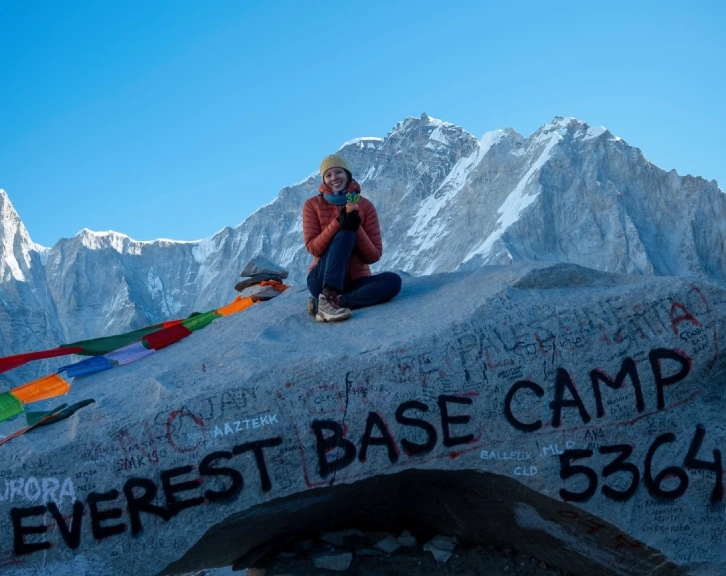
- Everest Base Camp Altitude: 5364 meter
- Starting Point: Lukla
- Ending point: Lukla
- Trek Distance: Around 130km round trip
- Difficulty Level: Moderate to challenging
- Best Seasons: Spring and Autumn
- Accommodation: Tea house and small lodges
- Main Village : Lukla,Phakding,Namche Bazar,Tengboche,Dingboche,Gorakshep
- Main Views: Mt.Everest ,Lhotse,Nuptse,Ama Dablam,Pumori
- Permits:Sagarmatha National Park Permits and Khumbu Pasang Lhamu Permit
- Main Risk : Altitude sickness
- Suitable For: Fit beginners and experienced trekkers
Everest Base Camp Trip Overview
Everest Base Camp trek is truly one of the most thrilling experiences in the Himalayas when it comes to exploring the tallest mountain on Earth, Mount Everest. You start this incredible journey from the capital city, Kathmandu, taking a flight to the breathtakingly pretty little village of Lukla, followed by the famous raging river known as 'Dudh Kosi' or “River of Milk”. You'll travel through Phakding & Monjo and finally settle down for the night in this very lively town, which also acts as a gateway to the Everest named “Namche Bazaar”. This unique trek will take you to the magic viewpoint of the majestic valley of Khumbu, surrounded by the mighty Himalayan ranges forming part of the famed region of Everest, where we are blessed to witness our world’s highest peak right under us! Each and every footstep during this trek will be reminiscent of those taken up towards heaven itself, situated right in the middle of the Himalayas.
Everest Base Camp Trek 14 Days goes deeper into the Sagarmatha National Park. Here you get to see some of the best and most beautiful forests with species of Pine, Rhododendrons & Magnolia trees, passing over many exciting suspension bridges built across the deep gorges. This journey takes you on an amazing trek to experience the magical view of the magnificent Khumbu Valley amidst the famed Everest Region, home to the world's highest mountain Peak, where every step feels like the steps to heaven in the heart of the Himalayas.
Everest Base Camp Trek brings a lot of cultural interaction with the local people, especially the famous Sherpa culture that has flourished for centuries within the hallowed Himalaya range. On your way towards the basecamp you'll also have opportunities to visit several traditional Sherpa villages with their own unique traditions in the form of many ancient Buddhist monuments, prayer Flags and monasteries
Everest Base Camp Trek gives you some great chances to meet the locals as you pass through scenic places such as Kyangjuma, Namche Bazaar, Khumjung, Syangboche, Tengboche, Pangboche, Dingboche, and Pheriche. Along the way, you can enjoy the beauty here along with their hospitality while following the legendary footprints of Sir Edmund Hillary. The trek further climbs high beyond the tree line and reaches dramatic Alpine Wilds full of rugged Glacial Moraines, Snow Peaks & huge Glaciers. And then we start an acclimatization hike around Chhukung for amazing scenery before the trails reach Gorak Shep, which is our last settlement near the Everest Base Camp. The upper valley here offers great views of the famous Changri Glacier, where you can enjoy the beautiful sight of the mountains along with the view of Nagarjuna Peak (Nagarzhang Peak), before the trek culminates with a magnificent sunrise from Kala Patthar (sunrise viewpoint of Mount Everest, Lhotse, Nuptse, & Pumori).
Everest Base Camp Trekking Highlights
- You will Start your journey to Mount Everest and enjoy an unforgettable adventure with the Everest Base Camp Trek in the Sagarmatha region.
- Flights to Lukla offer you the best view of a thrilling mountain landing above the Himalayas.
- You will Explore Himalayan beauty like Forests,wildlife, rivers and UNESCO in Sagarmatha National park.
- Namche Bazar provides you rest, hiking and mountain views in the sherpa capital for acclimatization.
- The Tengboche monastery is the oldest monastery and people believe its the spiritual heart of the Everest region.
- The Khumbu Glacier and the Khumbu icefall represent unforgatable experience of the Himalayas,
- Beautiful sunrise view from Nangkartshang peak of Mount Everest and it feels peaceful and surreal.
- The rhododendron forest in the spring season creates a colourful trail and a fresh mountain fragrance.
- Sherpa villages and traditions offer local hospitality, food, dress and lifestyle of Buddhist.
- You get views of Mount Everest, Ama Dablam, Lhotse, Nuptse, Thamserku and Cho Oyu.
- Tea houses provide warm meals, simple rooms and trekker-friendly mountain comfort.
- The suspension bridges over the Dudh koshi river make the trek adventurous and photogenic.
- Hotel Everest view offers a luxury view point experience along with an acclimatization hike.
Where Mount Everest Located?
Everest is located on the border of Nepal and China’s Tibet independent Region in the Mahalangur Himal subrange of the Himalayas In Nepal. Mount Everest named after Sir George Everest and who served as the British surveyor. Mount Everest is also known as Sagarmatha in Nepal, which means “Goddess of the Sky” since it stands at the height of 8848 metres. Chomolungma is Mount Everest's Tibetan name and literally translates as “Holy Mother” connected from the Mount.
Everest is part of the larger mountain also known as the Qomolangma area, This area has high mountains like Nuptse and Lhotse. Nepal has two more great Himalayas as well, one is kanchanjunga, which is located in eastern of Nepal and another one is dhaulagiri which located in western of Nepal.
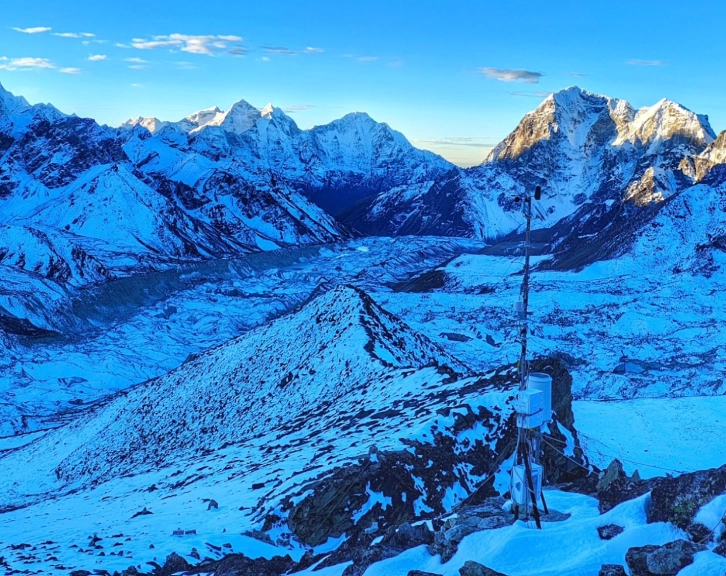
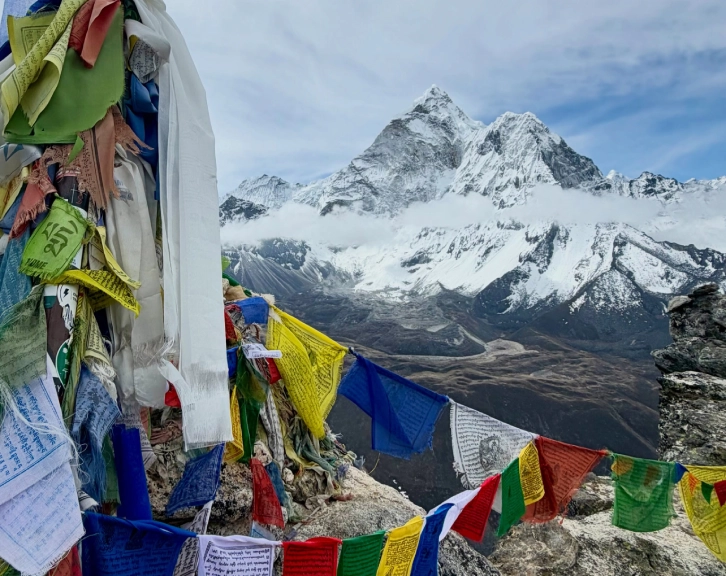
Mountain view from Kala Patthar
Due to the High Altitude and the low oxygen level in the Everest Region make it challenging for trekkers to climb the kala patthar. At Sunrise the top of Everest glows into Orange and Pink.It becomes the most memorable and emotional moment of the treks. If you enjoy photography,mountains views and personal achievement then the kala patthar is the most visited viewpoint of Everest Base Camp Trek.
Why Choose Mount Elegance Trek for EBC Trek
- Mount elegance trek makes your Everest Base Camp Trek safe,easy and memorable with his local expertise and personalized service.
- Our team does not only provide a guest guide,Although we provide full support with route, altitude , culture and emergency planning.
- Our experienced Everest guides know the trek routes, weather pattern ,tea houses and acclimatization very well.
- With guaranteed departures ,your trip starts on the fixed date even if the group is small.
- You can rent a sleepy bag and down jacket, so you don't need to buy the expensive trekking gears.
- We provide 24/7 support including guide communication, evacuation coordination and insurance assistance.
- Our easy booking system makes your trip inquiry , confirmation, payment and pre trek guidance simple and fast.
Notes
Lukla Flight and Cancellation:
The flight to Lukla is one of the most exciting parts of EBC trek as lukla is the main gateway to the Everest region so depending on the season and flight rules, flights usually leave from Kathmandu or Ramechhap. The weather in the mountains changes quickly, so Lukla flights can be delayed or cancelled as the flight schedule cannot be fixed due to the weather conditions . This happens more often during the monsoon and winter seasons because of foggy weather, rain, snow, or poor visibility. It is a good idea to keep one or two extra days in your travel plan for safer side,this gives you enough time if your flight is delayed. If flights are cancelled for several days, you can choose to take a helicopter, but this costs extra. When you book your trek with Mount Elegance Treks and Expedition, we take care of everything, we keep track of flight updates and weather conditions, and inform you about any changes on schedule from time to time, and help you find the best solution so your trip goes as smoothly as possible.
Everest Base Camp Trek Itinerary
Download ItineraryOn your arrival in Kathmandu, you will be welcomed by the Mount Elegance Trek representative and assisted in transferring to your accommodation. Our representative will be holding a Mount Elegance Trek name sign that will be visible for easy identification for you.
After check-in, we will meet either at our office or in the hotel lobby to complete a brief about your Everest Base Camp Trek. Each participant of the trek will have a complete itinerary with walking details, how many altitudes to gain, how to prepare for some of the required safety measures while trekking, and the opportunity to ask any questions they may have / need to have answered.
Maximum Altitude: Kathmandu (1,400 m/4,600 ft)
Drive Duration: 30-45 minutes
We will have a meeting at the hotel after your arrival. All the necessary documents like: insurance, passport, photos will be checked and necessary Gear list and all other recommendation will be provided by our company staff. Remaining due of your trip is also settled on this day. In the evening you can buy or rent remaining gear for your trekking.
You’ll be transferred at an early time in the morning to the domestic airport and then fly over a scenic view of the mountains towards Lukla/Tenzing-Hillary Airport. Once you land safely, our trekking crew will welcome you warmly, marking the formal beginning of your journey toward Everest’s Base Camp.
On this Day, you’ll gradually trek via breathtaking views of some beautiful Sherpa villages, pine forests, and finally into the valley of the Dudh Koshi River.
Our Trek Guide will maintain a slow pace as always to help you get acclimated and have great comfort during the day. This will provide you with a taste of Himalayan treks amidst nature's most awesome backdrop.
After taking around a 4–5 hour walk from Lukla, we'll reach the next point, 'Phakding'. This is also called a peaceful village on the banks of a river. We will spend an overnight here at one of its comfortable tea houses.
Maximum Altitude: Phakding (2,610 m/8,563 ft)
Meal: Breakfast, Lunch & Dinner
Trek Duration: 3-4 hours
Flight Duration: 25-30 minutes
Due to high traffic in Kathmandu airport you may need to travel early morning bus/Jeep to Ramechhap airport for about 4-5 hours then take off for Lukla. There is unpredictable Himalayan weather so expect delay and cancelation of flight for a day or more. Helicopter booking can give you better chances of reach Lukla faster and without traveling to Ramechhap airport. Heli booking should be informed before arriving with additional charge of about $500 per person.
We head off after breakfast toward Namche Bazaar, the gateway to the Everest region. Following along the banks of the Dudh Koshi River, you’ll cross several suspension bridges, including the famous Hillary Bridge. As you get closer to Namche, the journey also brings you into Sagarmatha National Park with stops for checking permits and more dramatic scenery.
Throughout the trek, your trekking guide will keep an eye on your walking speed throughout this day’s trek to ensure you properly acclimate to the ever-increasing elevation. This means the final push up to the town of Namche can be pretty steep, but you will also have some distant views of the mighty Everest and other nearby peaks too.
Maximum Altitude: Namche Bazaar (3,440 m / 11,283 ft)
Meal: Breakfast, Lunch & Dinner
Trek Duration: 5-6 hours
Today's plan is pretty much about acclimatizing ourselves here in Namche Bazaar.
So after our breakfast in the morning, we are going to have this small trek up to Everest View Hotel, which happens to be one of the finest viewpoints of the Khumbu region of Nepal. From here, you can witness breathtaking views of Mt. Everest, Ama Dablam, Thamserku & many other mountains around. Along the way, our little hike would also ensure that we get used to the high-altitude environment while staying physically active too.
Once we're back in Namche, you can spend your time freely walking around the local marketplace, having something to eat at local bakeries, interacting with the Sherpa community, and much more. During this entire period, our guides will also monitor your health status and offer some valuable altitude safety tips to make sure that you have a safe continuation of the Everest Base Camp Trek.
Maximum Altitude: Namche Bazaar (3,440 m / 11,283 ft)
Meal: Breakfast, Lunch & Dinner
We will start trekking from Namche Bazaar today as we walk on this beautiful
combination of uphill, downhill, & ridge-line trails towards Tengboche. To begin, we will walk uphill for a while, then enjoy a nice and easy well-defined trail towards Kyangjuma, enjoying stunning views of the Dudh Koshi Valley. From here, you will have clear views of Ama Dablam, Everest, and Tengboche Hill in the distance.
After lunch at Phunki Tenga, it's time for the day's final climb. From here, we will be entering a lush green forest section & hiking steadily upwards all the way to Tengboche, which is about an ascent of approximately 600 meters. While going upward towards Tengboche, we might get to visit the famous Tengboche Monastery, attend its prayer ceremonies, and enjoy some breathtaking views of Everest, Ama Dablam, Thamserku, and the surrounding peaks. Overnight stay at a teahouse.
Maximum Altitude: Tengboche (3,860 m / 12,664 ft)
Meal: Breakfast, Lunch & Dinner
Trek Duration: 5-6 hours
Today's trek takes us deeper into the valley heading towards another awesome destination that is Dingboche. After having breakfast in Tengboche, today's journey starts off walking on the forest trails.
While going down, we'll first pass through Deboche and cross over the Imja Khola River before continuing through Pangboche and starting to climb higher. As we move upward, we enter the alpine areas characterized by less tree coverage, where you can spot some amazing mountain views like the famous Ama Dablam standing high above all other mountains. As this is an uphill trek, we'll take several short breaks here and there throughout the entire trip to ensure everyone stays hydrated enough and gets well rested wherever necessary.
Finally, we will reach our destination, Dingboche in the afternoon. There, we'll assist you in checking in at the lodge while giving great insights regarding how best to spend your upcoming days acclimatizing.
Maximum Altitude: Dingboche (4,410 m / 14,470 ft)
Meal: Breakfast, Lunch & Dinner
Trek Duration: 6-7 hours
Today you will go for today's main highlight, your guided hike (also known as an 'acclimatization hike') to Chhukung Valley which is followed by dazzling views of Island peak and their surrounding glaciers.
This hike is very useful because you need to let your body adjust to lower oxygen levels gradually. Throughout, our guide keeps checking on us during the whole walk, ensuring that everything goes smoothly. Also, he teaches us how to stay safe at high altitudes properly.
Afterward, we come back to Dingboche today, where we can relax a bit and see around the village. There's a lot to see and do here which might keep you busy for quite some time. Before leaving Dingboche again tomorrow, we'll give ourselves a health check-up and review our current status.
A well-planned acclimatization day ensures that you’ll be better prepared to tackle the high altitudes involved during your Everest Base Camp trek, resulting in a safe & successful experience.
Maximum Altitude: Nangkartshang Peak (5,083m/ 16676ft)
Meal: Breakfast, Lunch & Dinner
Trek Duration: Optional hike (3–4 hours)
After breakfast, we will head towards higher elevations to reach Lobuche. Along the way, the path takes us across a beautiful alpine landscape & also crosses several monuments dedicated to the climbers that had lost their lives while exploring this mighty mountain, Mount Everest.
Also, with increasing elevation, you'll experience a decreasing oxygen level, so your guide will ensure your journey at a slower speed. From here, the route gets very rocky and treacherous! So better keep on your toes for the entire journey here, as these parts are known for being very challenging.
But do not worry because during the entire journey you can watch how close you're getting to some beautiful mountains such as Nuptse. So after some really nice trekking experiences, you finally make it to Lobuche! Once there, all you need to do is relax in one of the most comfortable teahouses and have some super delicious food that restores your energy. From there, our team will prepare you for your most important day of the trek, reaching Everest Base Camp.
Maximum Altitude: Lobuche (4,940 m / 16,207 ft)
Meal: Breakfast, Lunch & Dinner
Trek Duration: 5-6 hours
We will be starting our day with breakfast and heading off to trek from Lobuche to Gorak Shep. Gorak Shep is the last settlement before reaching Everest Base Camp. This will be one of the highlights of your Everest Base Camp Trek today. We are going on a rocky trail with lots of glaciers as well. Our expert guides will take care of everything to ensure that you reach safely.
After having a short rest, we head towards the Everest Base Camp crossing over the Khumbu Glacier moraine. Once we get there, it's sure to become an emotional moment where you can have a closer look at the environment around the world's highest peak. You may spend some time here if you wish. Then we will return to Gorak Shep for our overnight stay tonight. Our guide makes every effort to keep track of your pace & monitor your safety during these treks while providing full assistance throughout such challenges.
Maximum Altitude: Everest Base Camp (5,364 m / 17,598 ft)
Meal: Breakfast, Lunch & Dinner
Trek Duration: 6-7 hours
Tips to avoid altitude illness, Maintain slow and steady pacing for the hike. Carry hydration packs or water bottles to climb EBC and Kala Patthar to keep yourself hydrated. Any symptoms such as headaches, nausea, dizziness, etc should be immediately informed to the trekking guide.
We start early in the morning for our pre-dawn hike to Kala Patthar, which is the most famed viewpoint of the Everest Base Camp Trek. There, you will see a breathtaking view of sunrise across Mount Everest and its nearby mountains including Nuptse. Afterward, we will spend some time watching the majestic views from the Kala Patthar point before heading down to have breakfast at Gorak Shep, followed by continuing trekking downwards to Pangboche. Throughout, our guides manage the whole process of going down carefully so that there is minimum stress on your knees and you can enjoy the trekking without causing harm to yourself.
As we go lower and lower, the trails become easier than the previous ones because now we get more oxygen compared to when we were up high on the mountains. Along the journey through the scenic lands and the settlements made by the locals (Sherpas), we reach our next destination called Pangboche. It’s an amazing place that has all the natural beauty of the Himalayas around. We will be staying overnight in this peaceful little village in a local teahouse, enjoying the warmth of the people and their hospitality.
Maximum Altitude: Kala Patthar (5,545 m/18,192 ft)
Meal: Breakfast, Lunch & Dinner
Trek Duration: 6-7 hours
Use proper knee and ankle protection during descent down hill puts a lot of pressure on your knees.
After breakfast, we will start descending from Pangboche to Namche Bazaar. Today's walk is a bit longer than the previous day, but as we are walking at low altitudes now, this will be more comfortable for us.
Along the way, we will retrace our steps through the scenic trails, passing through the famous Tengboche Monastery, Deboche, Phunki Tenga, and Kyangjuma towards Namche Bazaar and enjoy the lovely forest suspension bridge, along with the last view of Himalayan mountain peaks.
You can enjoy all these things again in reverse while going down, which might be very interesting for you. Once you reach here, relax and enjoy the night by staying overnight in a very comfortable teahouse restaurant.
Maximum Altitude: Namche Bazaar (3,440 m / 11,283 ft)
Meal: Breakfast, Lunch & Dinner
Trek Duration: 5-6 hours
We start off our final trekking day after breakfast by walking along this familiar trail towards Lukla once again. Along the way, the trail passes through some of the most beautiful Sherpa Villages including Jorsale, Monjo, Benkar, Toktok, Phakding, Ghat & Thado Koshi. Our walk will also be accompanied by the peacefulness and serenity of the surroundings of Dudh Koshi River.
Most of the walk will take place either downhill or on gentle and flat paths, but eventually over its last stretch, which takes only 1-2 hrs. Once we finally get there, we'll do any required exit formalities for Sagarmatha National Park & Khumbu Rural Municipality.
Afterward, we'll spend an evening celebrating the successful trek, thanking all the amazing Sherpas & porters, and then have another awesome overnight stay in one of the coziest local teahouses around.
Maximum Altitude: Lukla (2,860 m/ 9,383 ft)
Meal: Breakfast, Lunch & Dinner
Trek Duration: 6-7 hours
If the weather allows us, we shall catch our flight back to Kathmandu from Lukla this day, which marks the end of our amazing journey of the Everest Base Camp Trek. During the 30-minute scenery flight, we might get another chance to see all those beautiful snow-capped mountains, deep valleys, picture-postcard villages, etc., that made our trek memorable.
However, Lukla flights, being highly weather-dependent, sometimes may face delay/cancellation due to bad weather conditions.
Our representatives will welcome you upon reaching the destination (Kathmandu) and drop you off at the hotel, where you can afterwards take a warm bath and rest after, to celebrate the success of your unforgettable Himalayan experience.
Maximum Altitude: Kathmandu (1,400 m/ 4,600 ft)
Meal: Breakfast & Dinner
Flight Duration: 25-30 minutes
Our Mount Elegance Trek team will help you go through the transfer to Tribhuvan International Airport for your onward journey on this last day of the trip. To start, after having a delicious breakfast, we will see you off smoothly with all your luggage and make all final arrangements to give you a comfortable and relaxing journey home.
This concludes the unforgettable Everest Base Camp trek, which you will cherish for a lifetime with lots of memorable moments of mountains, Sherpa culture, etc. Thanks once again for going with us and choosing our services.
We hope to have the opportunity to serve you again and take you to another Himalayan adventure. Wishing you safe and healthy journeys always. Have a nice time, and till then, say "Farewell" from our whole Mount Elegance Trek Team.
Maximum Altitude: Kathmandu (1,400 m/4,600 ft)
Meal: Breakfast
Drive Duration: 30 to 45 minutes
Looking at other options?
Compare this trip with our other itineraries.
EBC Heli 12 Days
- Day 1 Kathmandu Arrival (1,400m) - 30 to 45 minutes drive. Overnight stay at the 3 star hotel in Kathmandu.
- Day 2 Fly to Lukla (2,860m) & Trek To Phakding (2,610m)- 25 to 30 minute flight & 3-4 hour trek . Overnight stay at a Tea house in Phakding.
- Day 3 Trek from Phakding to Namche Bazar (3,440m)- 5 to 6 hour trek. Overnight stay at the tea house in Namche Bazar.
- Day 4 Acclimatization day at Namche Bazar (3,440m). Overnight stay at the tea house in Namche bazar.
- Day 5 Trek from Namche Bazar To Tengboche (3,860m) - 5 to 6 hours. Overnight stay at the tea house in Tengboche.
- Day 6 Trek from Tengboche to Dingboche (4,410m) -6 to 7 hours. Overnight stay at the tea house in Dingboche.
- Day 7 Acclimatization day at Dingboche (4,410m) - 6 to 7 hours (Optional hike to Nangkartshang Peak (5,083m). Overnight stay at the tea house in Dingboche.
- Day 8 Trek from Digboche to Lobuche (4,940m) - 5 to 6 hours. Overnight stay at the tea house in Lobuche.
- Day 9 Trek Lobuche To Gorakshep (5,164m) & Hike to Everest Base Camp (5,364m) - 6 to 7 hours. Overnight stay at the tea house in Gorakshep.
- Day 10 Hike Kala Pathar(5,545m) & Fly back from Gorakshep to Lukla by Helicopter- 3 to 4 hours hike & 30-35 minutes heli ride. Overnight stay at the tea house in Lukla.
- Day 11 Flight from Lukla to Kathmandu (1,400m) - 25 to 30 minutes. Overnight stay at the 3 star hotel in Kathmandu.
- Day 12 Departure from Kathmandu- 35 to 45 minutes. Breakfast included.
EBC Gokyo 17 Days
- Day 1 Kathmandu Arrival (1,400m) - 30 to 45 minutes drive. Overnight stay at the 3 star hotel in Kathmandu.
- Day 2 Fly to Lukla (2,860m) & Trek To Phakding (2,610m)- 25 to 30 minute flight & 3-4 hour trek . Overnight stay at a Tea house in Phakding.
- Day 3 Trek from Phakding to Namche Bazar (3,440m)- 5 to 6 hour trek. Overnight stay at the tea house in Namche Bazar.
- Day 4 Acclimatization day at Namche Bazar (3,440m). Overnight stay at the tea house in Namche bazar.
- Day 5 Trek from Namche Bazar To Dole (4,038m) - 7 to 8 hours. Overnight stay at the tea house in Dole.
- Day 6 Trek from Dole to Machhermo (4,470m) - 4 to 5 hours. Overnight stay at the tea house in Machhermo.
- Day 7 Trek from Machhermo to Gokyo (4,800m) - 4 to 5 hours. Overnight stay at the tea house in Gokyo.
- Day 8 Cimb Gokyo Ri (5,357m) & Explore Gokyo Lake - 5 to 6 hours. Overnight stay at the tea house in Gokyo.
- Day 9 Trek from Gokyo to Thagnak (4,700m) - 5 to 6 hours. Overnight stay at the tea house in Thagnak.
- Day 10 Cross Cho La PAss (5,420m) & Trek to Dzongla (4,830m)- 7 to 8 hours. Overnight stay at the tea house in Dzongla.
- Day 11 Trek from Dzongla to Lobuche (4,940m) - 4 to 5 hours. Overnight stay at the tea house in Lobuche.
- Day 12 Trek Lobuche To Gorakshep (5,164m) & Hike to Everest Base Camp (5,364m) - 6 to 7 hours. Overnight stay at the tea house in Gorakshep.
- Day 13 Climb Kala Pathar(5,545m) & Trek back to Pheriche- 6 to 7 hours Overnight stay at the tea house in Pheriche.
- Day 14 Trek Pheriche To Namche Bazar (3,440m)- 5 to 6 hours. Overnight stay at the tea house in Namche Bazar.
- Day 15 Trek Namche Bazar To Lukla (2,860m)- 6 to 7 hours. Overnight stay at the tea house in Lukla.
- Day 16 Flight from Lukla to Kathmandu (1,400m) - 25 to 30 minutes. Overnight stay at the 3 star hotel in Kathmandu.
- Day 17 Departure from Kathmandu- 35 to 45 minutes. Breakfast included.
Everest Base Camp Trek Package Include and Exclude
Trip Includes:
Accommodation
- Twin-sharing/double accommodation in a 3-star hotel for 2 nights in Kathmandu including breakfast (Private room accommodation can be organized at an extra cost).
- Sharing guesthouse accommodation during the trek for 11 nights in Everest Region.
Meals & Drinking Water
- All your standard meals during the trek (13 Breakfasts, 11 Lunches and 11 Dinners)
- Fresh seasonal fruits each day after dinner during the trek.
- A farewell dinner on the last night in Nepal.
- Purified drinking water during the trek using Water Filter or water purification tablets.
Transportation & Flight
- All (international and domestic) airport transfers on a tourist vehicle.
- Round-trip airfare between Kathmandu/Manthali and Lukla.
- Kathmandu – Manthali – Kathmandu transportation by shared tourist vehicle.
Guide and Staff
- Experienced, first-aid trained, government licensed, English speaking, and locally recruited Mount Elegance trekking guide (2 guides for group size more than 8 people).
- Porters during the trek for carrying luggage (1 porter for every 2 clients).
- Wages, accommodation, meals, gear, insurance and medications for all staff.
Everest Base Camp Trek Permits
- Sagarmatha (Everest) National Park Permit.
- Pasang Lhamu Rural Municipality fee.
- TIMS (Trekkers’ Information Management System) card.
Equipment and Takeaways
- 1 Mount Elegance duffel bag and Sleeping Bag (Should be returned after trek Completion)
- Mount Elegance Complimentary Tshirt, Cap and Route Map.
- A comprehensive first aid kit, including an Oximeter to check pulse and oxygen levels daily in the mountains.
- Trip completion certificate.
Administrative & Taxes
- All administrative expenses and government taxes.
Trip Excludes:
- Lunch and dinner in Kathmandu.
- International flight fare and airport departure tax.
- Nepal Entry Visa (Visa can be acquired easily after your arrival at Tribhuvan International Airport in Kathmandu with a fee of USD 30 for 15 days visa, USD 50 for 30 days visa and USD 125 for 90 days visa).
- Travel insurance along with high-altitude emergency evacuation coverage.
- Any beverages including bottled and boiled water.
- Tips to trekking staff and drivers.
- Personal trekking gear and equipment.
- Any expenses other than the Price Include section.
Departures
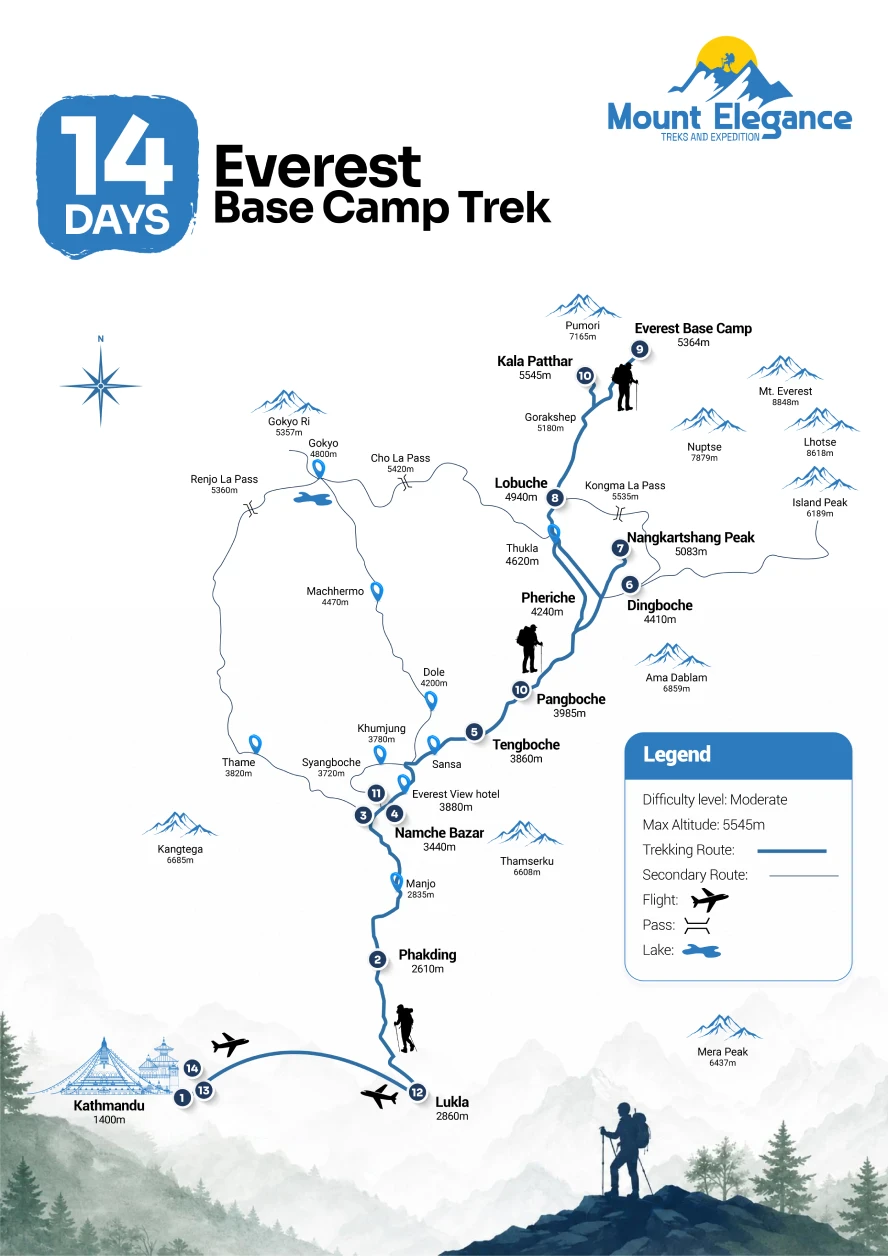
Map
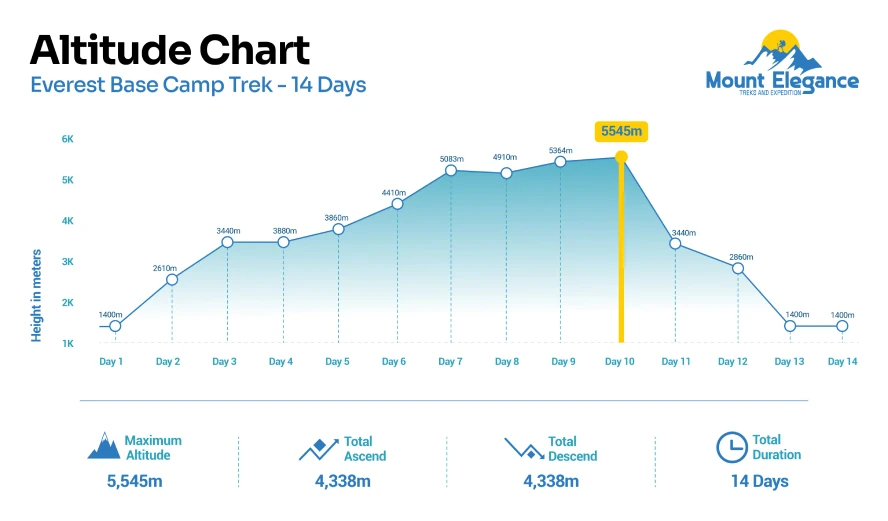
Altitude Chart
EBC Trek Packing List
Example of How to pack all Essential Items for Trek
Everest Base Camp Packing list includes these seven categories, which require your particular attention during your preparation: Clothing Layers, Footwear, Backpack and storage,Technical and Trekking Gear, Health and First Aid, Personal Items and Extras & Documents and Cash. At last we have attached Final Tips to make your packing easy.
Overall, our main goal here should be to stay Warm, Dry, Comfortable & Prepared For All Kinds of Weather at high altitudes!
Here's our complete packing checklist categorized below:
Clothing (Layering System)
- Trekking Shirts: 3–4 lightweight,long-sleeve shirts for sun and dust protection on the EBC trail.
- Base Layer: 2–3 pairs of thermal tops and bottoms (high-grade synthetic).
- Trekking Pants: 2 pairs of stretchable and comfortable trekking pants.
- Insulation Layer: 1 warm fleece jacket or lightweight down sweater.
- Underwear: 5–6 pairs of sports underwear.
- Hard Shell: 1 breathable waterproof jacket and pants for wind, rain, or alpine snow.
Footwear
- Trekking Boots: 1 pair of ankle-supportive and water-resistant hiking boots.
- Camp Shoes: 1 pair of lightweight Sports sandals for relaxing in the teahouses.
- Gaiters: 1 pair of breathable, waterproof gaiters to seal out snow.
- Socks: 3–4 pairs of thick merino wool trekking socks and 2 pairs of thin liner socks.
Backpack and Storage
- Daypack: 1 technical 25L–30L daypack (carried by the guest) for layers, raincoat, water, camera, regular medicine, clothes for a day and snacks.
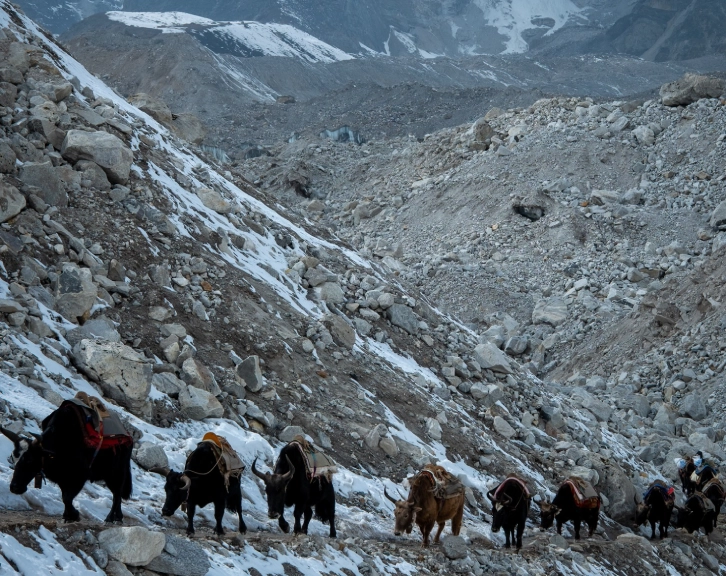
- Main Duffel Bag: 1 heavy-duty, weather-resistant 90L–120L duffel bag (to be carried by porters/yaks and will be provided by the company).
- Dry Bags: A collection of lightweight waterproof dry sacks to segregate and protect electronics and clothing. (It can be kept at duffel bag)
Technical and Trekking Gear
- Sleeping Bag: 1 Weather four-season sleeping bag rated down to at least -10°C (crucial for comfort at Everest Base Camp which will be provided by the company).
- Trekking Poles: 1 pair of adjustable trekking poles with snow baskets.
- Water Storage: Insulated 1-liter Nalgene bottles (must handle boiling water) and thermal bottle jackets to prevent freezing.
- Headlamp: 1 LED headlamp with extra lithium batteries (essential for the midnight and low-light areas).
- Glasses: 1 pair of high-protection UV Sunglasses.
Health and First Aid
- Altitude & Illness Medication: Diamox for altitude acclimatization, a course of broad-spectrum antibiotics, and anti-diarrheals.(some medicine items will be carried by guide)
- Blister & Wound Care: Comprehensive blister kits (Compeed/Moleskin), athletic tape, sterile gauze, and elastic bandages.
- Water Purification: Purification tablets(standard filters can freeze and crack at high camps).
- Personal Pharmacy: Rehydration salts (ORS), Ibuprofen/Paracetamol, cough lozenges (to combat the dry "Khumbu cough"), and personal prescriptions.
Note: Guide will also carry necessary first aid.
Personal Items and Extras
- Power Bank: 2 high-capacity (15,000mAh) heavy-duty power banks.
- Sun Protection: SPF 50+ broad-spectrum sunscreen and dedicated SPF zinc lip balm.
- Sanitation: Multiple packs of pocket tissues, wet wipes, and high-alcohol hand sanitizer.
- High-Altitude Snacks: Energy gels, protein bars & chocolate, it will be helpful during break of walking and taken as snacks.
Documents and Cash
- Identity & Visas: Original passport valid for 6+ months past travel dates, plus physical paper copies. Visa on arrival and which will be paid in cash.
- Insurance Certificate: Printed proof of comprehensive travel insurance covering search, rescue, heli-evacuation, and technical climbing up to 5,600 meters.
- Permit: Sagarmatha (Everest) National Park Permit, Pasang Lhamu Rural Municipality fee.
- Photos: 2 recent passport-sized photos for local permits and regional SIM cards.
- Cash: Carry nepalese rupee during trek while in trekking card might not be accepted to get some souvenir or other snacks. You can exchange to nepali Currency after arriving in Kathmandu.
Final Tips
- Strict Weight Limits: Keep your main duffel bag under 15 kg (33 lbs) to strictly comply with the lukla flights and the porter will also carry 15 kg max per person.
- Freeze Prevention: Store your phone, camera batteries, headlamp, and power banks inside your inner jacket pockets during the day, and at a warm place at night to prevent freezing temperatures from killing the battery life.
Everest Base Camp Trek Cost – All Hidden Cost
The cost of the Everest Base Camp Trek includes your trek package, Lukla flights, permits, visa, guide, porter, food, and accommodation. Below, we explain each cost in simple detail.
Solo Vs Group Cost
A solo trek costs more because you pay everything yourself. A group trek costs less because everyone shares the expenses. If you want more freedom, choose a solo trek. If you want to save money, a group trek is a better option.
Lukla Flight Cost
The Lukla flight costs around USD $220-250 one-way. Alternatively, you can plan to spend an extra USD $440-$500 for a round-trip flight to trek. Also note that this is one of the most expensive flights of your trek.
This is because the Price might differ Based On Seasons Weather And Availability. It's a Scenic 30 Minute Mountain Flight That will take you from Kathmandu Valley to Lukla Airport.
Everest Trek Permits Cost
To get started with the Everest Base Camp Trek, you must obtain two mandatory permits which are:
- Sagarmatha National Park Entry Permit (UNESCO World Heritage Park): NPR 3,000 per person for international trekkers, NPR 1000 for Indian Nationals, and NPR 100 for Nepalese citizens.
- Khumbu Pasang Lhamu Rural Municipality Permit: USD 20 per person per week for the first 4 weeks and USD 25 per person per week beyond 4 weeks.
Nepal Visa Cost
Nepal offers tourist visas for 15, 30, or 90 days. For the Everest Base Camp Trek, a 30-day visa is the best choice because it gives you enough time for the trek, arrival, rest days, and possible flight delays.
Porter and Guide Cost
The price of a porter & guide during Everest Trekking is USD 30-35/day for a licensed guide and USD 20-30 per day for a porter. So, for a 14-day trek, the total would be around USD 750 - USD 1000, depending on the group size & the kind of services they want.
A guide makes sure that your trip stays safe through the difficult terrain by taking proper navigation. Meanwhile, a porter takes your baggage, which will help you enjoy your journey easily without worrying about carrying all things with you.
Food and Water Cost
Trekkers should be ready to spend about USD 25-40 on food and water per day. The food offers dal bhatt, mixed noodles, soups, etc. The price of bottled water changes based on the altitude from USD 2-5. The cost should be higher in cases where the water is being carried higher and higher on the mountain.
Accommodation and Teahouses Cost
Tea houses offer accommodation along the Everest Trail, ranging from USD 5-15/night with basic yet comfortable rooms. Beyond lodging, meals can be ordered at these eateries, with shared dining spaces available across tea house lodges. On top of that, extra fees include USD 3-6 for a hot shower, USD 2-5/device to charge your gadgets & USD 3-8/day for WiFi usage; prices increase at higher elevations.
Travel Insurance Cost
Travel insurance is important for the Everest Base Camp Trek. It should cover high-altitude trekking, helicopter rescue, medical expenses, flight cancellations, and trip delays.
Everest Base Camp Trek Packages and Inclusions
Everest Base Camp Trek packages include airport transfers, a hotel in Kathmandu, Lukla flights, permits, a guide, porter support, teahouse accommodation, meals during the trek, government taxes, and a farewell dinner. Some packages also include a sleeping bag, down jacket, duffel bag, trekking map, and emergency support.
Every package is different. Budget packages include basic services, while standard and premium packages offer more comfort and extra facilities. Before booking, always check what is included and what is not.
Everest Base Camp Trek Package by Duration
The Everest Base Camp trek duration is 15 days for the standard route, and it covers a total of 130 km (80 miles) round trip from Lukla. The hike involves 5–7 hours per day walking hours, and the rest stops will be at villages like Phakding, Namche Bazaar, Tengboche, Dingboche, and Gorak Shep. The best part about Everest Base Camp trek 15 days Itinerary is that it includes 2 acclimatization days (Namche Bazaar + Dingboche), so even beginner hikers can safely adjust to the Everest region's high altitude.
Best Time To Trek Everest Base Camp Trail
The best season to visit the Everest Base Camp Trek in Nepal is from Spring (March – May) & Autumn ( September – November ). During these times of year, you will get great weather, nice views of the mountains, and the best time for Trekking.
In fact, trekking conditions in Everest Base Camp are perfect during that period of the year, and you can also see very good scenic beauty.
Here is the monthly breakdown given below.
Everest Base Camp Trek in May
May is a good time for the Everest Base Camp Trek. The weather is warm, but the trail is busy. Start your walk early because clouds often come in the afternoon.
Everest Base Camp Trek in December
December is very cold. There are fewer trekkers, so the trail is quiet. Wear warm clothes and bring a good sleeping bag.
Everest Base Camp Trek in September
September is the beginning of an early-autumn month where the monsoon season slowly comes to an end and starts to improve the breathtaking visibility. Some parts of the trail may still be wet or muddy. By late September, the weather becomes much stable, the skies are clearer and trekking conditions improve better.
Everest Base Camp Trek Altitude and Risk
Everest Base Camp sits at an altitude of 5,364 meters (17,598 feet) above sea level with the trek's highest point at Kala Patthar, 5,545 m.
The adventure kicks off at Lukla (Start) at 2,860 m (9,383ft) in the Everest region. As we know, higher altitudes have less oxygen levels, thus causing some health risks for our body. At such places, chances of getting affected by 'acute altitude sickness' (AMS) are also very common. Some of the acute altitude sickness symptoms are headache, nausea and vomiting, dizziness, fatigue and shortness of breath. But don't worry; if you want to make this trip safe, then just follow the tips on how to deal with altitude sickness while doing an Everest Base Camp trek, like following proper acclimation protocols, walking at a slow pace, staying hydrated and taking proper rest at rest stops. Also follow essential tips to cope with altitude sickness.
Altitude Sickness and Acclimatization
AMS occurs when the body adjusts too slowly to high altitude. Headache, nausea, dizziness and weakness are the common symptoms. To ensure proper acclimatization, trekkers should follow the theory of “climb high, sleep low” , take regular rest days, stay hydrated, maintain a slow pace, take medicine as prescribed and monitor their symptoms daily.
Emergency Evacuation
Severe headache, confusion, shortness of breathing, blue lip, poor balance or consciousness are all warning signs. In an emergency, evacuation may require an immediate descent, supplemental oxygen, a Gamow bag or helicopter rescue.Before starting the trek it is very important to confirm your travel insurance, emergency contacts and rescue coverage.
Flight Cancellation
Flights to Lukla are highly weather-dependent, so delays and cancellation are very common. Flights are frequently postponed due to cloud, strong wind, rain or poor visibility. It is a smart decision to include one or two buffer days in your trekking itinerary. During the peak trekking season, you must prepare a plan for a transfer through Manthali(Ramechhap).
Everest Base Camp Trek Distance
The Everest Base Camp Trek covers approximately 130 km (80 miles) round trip from Lukla about 65 km (40 miles) one way. The daily walking distance is usually 8 to 15 km, but pace remains slow due to the high altitude. As a whole distance is manageable; however, the high elevation and repeated uphill and downhill portion make the trek physically challenging.
Everest Base Camp Trek Difficulties
Everest Base Camp trek is moderately to strictly challenging as far as its high altitude and daily walking hours (5-7 hrs) are concerned. In particular, the biggest risk is altitude sickness that many experience on this journey.
Therefore, it's very important to prepare yourself well with hydration & acclimatization before going to such a high altitude.
Is Everest Base Camp Trek suitable for Beginners?
Everest Base Camp Trek is suitable for fit beginners, if the fit trekkers properly follow the plan of proper training, packing and acclimatization. In this trek there was no involvement of technical climbing, but it is very important to be mentally prepared for the high altitude, cold weather, long walking hours and the simple lifestyle of basic tea houses.
Fitness and Training for Everest Base Camp Trek
First off all focusing on walking, hiking, stairs climbing, cardio and leg strength training before 8 - 12 weeks is useful in EBC Trek. Practice walking uphill with a backpack to mimic trekking conditions. The goal is not speed, but to build the ability to walk slowly, steadily and comfortably for long durations.
How Does Sherpa Culture Shape Life in the Everest Region?
Sherpas are Himalayan communities who live in the villages of the Everest region. Their lives are deeply connected to monasteries, chortens, mani walls, prayer flags and Buddhist traditions. Festivals such as Mani Rimdu and traditional puja blessings reflect their deep respect for the mountains. Visitors should respect prayer flags, pass mani walls on the left side, and follow local customs and transitions politely.
How Many Sherpa Villages Are There During EBC Trek?
There are many sherpa villages in Nepal; but along the Everest Base Camp (EBC) route, Namche Bazar known as the Sherpa Capital along with Lukla, Tengboche, Pangboche and Dingboche are the most Sherpa villages.
Here are detail list of Sherpa Villages in Nepal given below:
1.Lukla
Lukla is the gateway village of the Everest Base Camp Trek where Tenzing- Hillary Airport is located. The trekking route officially begins from here. The village provides lodges, gear shops, bakeries and trekking agencies. Lukla is famous for its warm sherpa hospitality and the excitement for the mountain adventure journey.
2. Pakding
Phakding is a peaceful Sherpa village which is located near the Dudh Koshi River. Usually the first day of the trek from Lukla ends here. The village offers homely tea houses, prayer wheels, small monasteries and a peaceful charm environment with the soothing sound of the river.
3. Monjo
Monjo is an important village located beside the entrance to the Sagarmatha National Park. Permits are checked here and trekkers are officially entered in the National Park zone. The village offers beautiful views of dense green forests, traditional stone houses and the true mountain lifestyle. Monjo can also act as an acclimatization- friendly stop at a lower altitude.
4. Jorsalle
Jorsalle is a small settlement located in the Dudh Koshi River Valley after Monjo. Trekkers often stop here for lunch or a short rest before the climb to Namche Bazar. The village is known for its dense forests, suspension bridges and peaceful tea houses. From here, the uphill route to Namche Bazar starts.
5. Namche Bazar
Namche Bazar is known as the Sherpa Capital. It is the trading, cultural and acclimatization hub of the Everest region. The town offers bakeries, museums, shops, lodges, cafes and stunning mountain viewpoints. Trekkers usually spend a rest day here to allow their bodies to acclimatize to the high altitude before continuing their trip.
6. Khumjung
Khumjung is a traditional Sherpa village located above Namche. It is known for its stone houses, school, monastery and peaceful field. One of the most important landmarks of the village is Hillary School. Trekkers can enjoy the stunning views of Ama Dablam, Thamserku and the surrounding mountains from Khumjung. It is an excellent place to experience and understand the true Sherpa way of life.
7. Khunde
Khunde is a quiet Sherpa village located beside Khumjung. It is famous for the Hillary Hospital, which offers important medical support to local communities and trekkers. The village is famous for its traditional stone houses, colourful prayer flags and mountain farming style. Khunde offers a peaceful cultural experience and special stop for trekkers exploring the Everest Zone.
8. Tengboche
Tengboche is the spiritual heart of the Everest region. Tengboche monastery is located here,where monks, prayers and Buddhist rituals provide trekkers a deeply peaceful experience. Panoramic views of Ama Dablam, Mount Everest, Lhotse and Nuptse make this village one of the most unforgettable highlights of the trek.
9. Deboche
Deboche is a peaceful village located in the forest area down from Tengboche. It is surrounded by rhododendron and pine trees highlighting a calm atmosphere with quiet lodges. Trekkers continue the trail through Deboche after visiting the Tengboche Monastery.The village offers a gentle blend of spiritual and natural beauty.
10. Pangboche
Pangboche is known as the oldest Sherpa Village of the Everest trail. The village offers the close breathtaking views of ancient monastery, traditional houses and Ama Dablam. Sherpa history and Buddhist Culture are strongly reflected here. Before entering the high- altitude zone, Pangboche was an important culture.
11. Dingboche
Dingboche is a most beautiful Sherpa settlement located in the wide Imja Valley. Trekkers usually spend an acclimatization day here and hike toward Nangkartshang Peak. The village is famous for its stone walls, potato fields and stunning high-mountain views. The scenery of Lhotse, Ama Dablam and the Island peak area is especially impressive from Dingboche.
12. Chhukung
Chhukung is a small high-altitude settlement located in a side valley from Dingboche. It is a popular base for Island Peak climbing, the Chhukung Ri hike and exploring the Imja valley.
The village provides simple tea houses and raw mountain scenery. For adventure trekkers, Chhukung is an exciting extension point of the Everest region.
Read Before Booking Everest Base Camp Trek
What accommodation is available on Everest Base Camp Trek?
Everest Base Camp Trek accommodation consists mainly of tea houses and mountain lodges located along the Khumbu trekking route in Nepal. Tea houses provide basic rooms, shared dining areas, local meals, electricity access and limited internet facilities for trekkers throughout the Everest region.
The trekking route from Lukla to Everest Base Camp includes accommodation stops at Phakding, Namche Bazaar, Tengboche, Dingboche, Lobuche and Gorak Shep. Lower-altitude villages such as Namche Bazaar provide better accommodation facilities because of their developed tourism infrastructure, while higher-altitude settlements have fewer facilities due to remote Himalayan conditions.
What facilities are available in Everest Base Camp Trek accommodation?
Tea houses on the Everest Base Camp Trek generally provide:
- Private or shared rooms depending on availability
- Twin beds with mattresses and blankets
- Shared bathrooms in most locations
- Dining rooms for meals
- Charging facilities with additional fees
- WiFi service in selected villages
- Hot showers at additional costs
Accommodation facilities become more basic above Dingboche because altitude, transportation limitations and weather conditions affect available resources.
What food is available on Everest Base Camp Trek?
Everest Base Camp Trek provides Nepali cuisine, Tibetan-influenced meals and international dishes through tea houses along the trekking route. Food availability depends on altitude, transportation access and local tea house facilities.
Popular meals available during the trek include:
- Dal Bhat (rice, lentils, vegetables and curry)
- Momos (Nepali dumplings)
- Thukpa (Tibetan noodle soup)
- Noodles
- Pasta
- Pizza
- Pancakes
- Eggs
- Soups
Dal Bhat is one of the common trekking meals in Nepal because it provides carbohydrates, protein and vegetables required during long walking days.
How does food availability change with altitude?
Food options become more limited at higher elevations such as Lobuche and Gorak Shep because transportation depends on local supply chains and seasonal conditions.
Lower-altitude villages such as Lukla and Namche Bazaar offer more diverse food choices compared to higher Himalayan settlements.
What is the age limit for Everest Base Camp Trek?
Everest Base Camp Trek does not have an official age restriction, but physical fitness, altitude adaptation and medical condition determine trek suitability.
The trek reaches Everest Base Camp at an altitude of 5,364 meters, where lower oxygen levels increase physical demands.
Can children join Everest Base Camp Trek?
Children can participate in Everest Base Camp Trek when they have appropriate fitness, preparation and supervision. Families usually consider shorter trekking days and gradual altitude gain for younger trekkers.
Can older people complete Everest Base Camp Trek?
Older trekkers can complete the trek when they maintain good cardiovascular fitness, follow acclimatization practices and receive medical clearance when required.
Important factors include:
- Previous trekking experience
- Physical endurance
- Altitude tolerance
- Health condition
- Acclimatization schedule
How does the flight to Lukla work for Everest Base Camp Trek?
The Lukla flight connects Kathmandu Valley with Tenzing-Hillary Airport, the main gateway for Everest Base Camp Trek in the Khumbu region of Nepal.
Tenzing-Hillary Airport is located in Lukla at approximately 2,860 meters above sea level. The flight duration from Kathmandu to Lukla is usually around 30–40 minutes.
Which airports operate Lukla flights?
Lukla flights operate from:
- Kathmandu International Airport during normal operations
- Ramechhap Airport during peak trekking seasons when flight schedules are transferred
The Kathmandu–Lukla flight provides access to the starting point of the Everest Base Camp Trek.
Why are Lukla flights delayed?
Lukla flight schedules are affected by:
- Himalayan weather conditions
- Cloud visibility
- Wind conditions
- Airport operating restrictions
Weather-related delays are common because Lukla Airport operates in a mountainous environment.
Can you extend your trip after Everest Base Camp Trek?
Trekkers can extend Everest Base Camp Trek with cultural tours, wildlife experiences and other Himalayan destinations in Nepal.
Popular post-trek extensions include:
Destination | Main Attraction |
Kathmandu Valley | UNESCO World Heritage Sites and cultural landmarks |
Pokhara | Lakes, mountain views and adventure activities |
Chitwan National Park | Wildlife safari and jungle activities |
Nagarkot | Himalayan sunrise views |
Many trekkers combine Everest Base Camp Trek with Nepal sightseeing because the trekking route focuses mainly on Himalayan landscapes and does not cover Nepal’s cultural and wildlife destinations.
How much weight can a porter carry on Everest Base Camp Trek?
A porter on Everest Base Camp Trek generally carries around 20–25 kilograms of trekking equipment and personal baggage depending on trekking arrangements.
Porters are important members of Nepal’s trekking support system. They transport luggage between villages, allowing trekkers to walk with lighter day packs.
What does a porter carry during Everest Base Camp Trek?
Porters commonly carry:
- Trekking bags
- Sleeping equipment
- Group supplies
- Personal belongings of trekkers
Responsible trekking practices include maintaining reasonable loads and ensuring proper working conditions for trekking staff.
What is the tipping culture on Everest Base Camp Trek?
Tipping in Nepal trekking is a common practice used to appreciate the services provided by guides, porters and support staff.
Tipping is not a fixed government requirement but represents recognition of service quality in Nepal’s trekking industry.
Who receives tips during Everest Base Camp Trek?
Trekking tips are generally provided to:
- Trekking guides
- Assistant guides
- Porters
- Support staff
The amount depends on:
- Trek duration
- Group size
- Service quality
- Trekking difficulty
Longer treks and larger groups usually involve higher overall tipping amounts because more staff members support the journey.
What is the helicopter upgrade option for Everest Base Camp Trek?
The Everest Base Camp helicopter upgrade replaces part of the trekking return journey with a helicopter flight from the Everest region to Kathmandu or nearby locations.
The helicopter option is commonly used after reaching destinations such as Gorak Shep or the Everest Base Camp area.
Why do trekkers choose a helicopter upgrade?
The helicopter upgrade provides:
- Faster return journey
- Aerial views of Himalayan peaks
- Reduced walking time after reaching Everest Base Camp
A helicopter return also depends on:
- Weather conditions
- Flight availability
- Safety regulations
Popular helicopter routes include flights around:
- Everest Base Camp
- Kala Patthar viewpoint
- Gorak Shep
- Lukla


FAQs
General Information
The Everest Base Camp Trek is moderately challenging as it requires good fitness, several days of hiking, and proper acclimatization to handle the high altitude safely.
The best time to trek to Everest Base Camp is during spring (March to May) and autumn (September to November). These seasons offer clear mountain views, stable weather, and comfortable trekking conditions with good visibility.
The Everest Base Camp Trek typically costs USD 1,000 to USD 1,500 per person, depending on the itinerary, guide services, accommodation, permits, meals, and transportation included in the package.
Yes, beginners can do the Everest Base Camp Trek if they are reasonably fit, prepare well, and follow a proper itinerary with enough acclimatization days. A guided trek is highly recommended for first-time trekkers.
Preparation and Fitness
You should have a good level of fitness for the Everest Base Camp Trek. Regular cardio, leg-strength exercises, and the ability to hike 5 to 7 hours a day will help you complete the trek comfortably.
Prepare for high altitude by training before the trek, ascending gradually, staying hydrated, eating well, and following acclimatization days. Avoid rushing, listen to your body, and inform your guide immediately if you develop symptoms of altitude sickness.
No, previous trekking experience is not required as beginners can complete the Everest Base Camp Trek with good physical fitness, proper preparation, and a well-planned itinerary that includes enough acclimatization days.
Carry essential trekking gear, including layered clothing, a warm down jacket, waterproof boots, a sleeping bag, trekking poles, gloves, a hat, sunglasses, a headlamp, a water bottle, sunscreen, and a basic first-aid kit. Proper gear ensures comfort and safety throughout the trek.
Health and Safety
Acute Mountain Sickness is caused by high altitude. Prevent it by ascending slowly, staying hydrated, taking acclimatization days, eating well, and reporting symptoms like headache or dizziness immediately.
Yes, altitude sickness is a serious risk on the Everest Base Camp Trek. Following a proper acclimatization schedule, staying hydrated, and recognizing symptoms early greatly reduce the risk.
Yes, but with caution drink only purified or boiled water, and avoid meat at higher altitudes, as it may not be fresh. Vegetarian meals are generally the safer choice during the trek.
If someone becomes seriously sick or injured, the guide arranges emergency evacuation, usually by helicopter if weather permits. Comprehensive travel insurance that covers high-altitude helicopter rescue is strongly recommended.
Permits
For the Everest Base Camp Trek, you need the Khumbu Pasang Lhamu Rural Municipality Permit and the Sagarmatha National Park Entry Permit. Together, they cost about NPR 6,000 for most foreign trekkers.
No, a TIMS Card is not required for the Everest Base Camp Trek. Trekkers only need the Sagarmatha National Park Entry Permit and the Khumbu Pasang Lhamu Rural Municipality Permit.
You can get the Sagarmatha National Park Entry Permit in Kathmandu or at the park entrance in Monjo, and the Khumbu Pasang Lhamu Rural Municipality Permit in Lukla or Monjo before starting the trek.
To obtain the trekking permits, you need a valid passport, passport-sized photos (if required), and your Nepal visa. If trekking with an agency, they usually arrange the permits for you
Insurance and Visa
Yes, travel insurance is highly recommended for the Everest Base Camp Trek. It should cover high-altitude trekking, emergency medical treatment, and helicopter evacuation.
A 30 day Nepal tourist visa is the best choice for the Everest Base Camp Trek, as it provides enough time for the trek and allows flexibility for weather-related delays.
A Nepal tourist visa costs USD 30 for 15 days, USD 50 for 30 days, and USD 120 for 90 days. Most Everest Base Camp trekkers choose the 30 day visa.
Your travel insurance should include high-altitude trekking coverage , emergency helicopter evacuation, medical expenses, trip cancellation, and lost or delayed baggage
Guides and Support
Yes, hiring a guide is required for most trekkers under current regulations, while a porter is optional but highly recommended to carry your backpack and make the trek more comfortable.
Everest Base Camp guides typically carry a first-aid kit, pulse oximeter, emergency communication device, basic medicines, and emergency contact information to help manage health issues and coordinate assistance if needed.
A porter typically carries 30kg usually shared between two trekkers. Most trekking companies recommend each trekker pack 12 to 13 kg for the porter's load.
No, guide and porter tips are usually not included in the Everest Base Camp Trek package. Tipping is optional but appreciated as a way to recognize their hard work and service.
Accommodation
Accommodation on the Everest Base Camp Trek is mainly in teahouses, offering simple rooms with twin beds, shared bathrooms, and warm dining areas. Facilities become more basic as you gain altitude.
Yes, you can charge your phone and other devices at most teahouses along the Everest Base Camp Trek. Charging is usually available for an extra fee, especially at higher altitudes.
If teahouses are fully booked, your guide or trekking agency will usually arrange accommodation at another nearby lodge. Booking early during the peak trekking seasons helps avoid this issue.
Yes, bringing your own sleeping bag is recommended. Although teahouses provide blankets, a warm sleeping bag offers extra comfort and protection against the cold, especially at higher altitudes.