 Best Seller


Island Peak Climbing in Nepal
Island Peak Climbing is a challenging 6,189-meter climb in Nepal. It combines trekking - acclimatization, glacier travel, rope climbing and a steep summit climb with good fitness, proper equipment, technical skills, experienced guides, permits, insurance and safe weather conditions are important.
Duration
18 days
Acoomodation
Tea House & Tent
Maximum Guests
40
Highest Altitude
6,189m/20,305ft
Best Season
Mar-May & Sep-Nov
Start/End Point
Kathmandu
Island Peak Climbing is a 6,189 meters (20,305 ft) trekking-peak expedition in Nepal’s Khumbu region, also known by its original name Imja Tse. Set within Sagarmatha National park in the Everest region, it’s classified as a Group B trekking peak by the Nepal Mountaineer Association with a technical difficulty rated PD+ on the alpine grading scale. Climbers typically attempt it during the spring (March-May) or autumn (September-November) seasons when weather and visibility are most stable.
The climb usually runs as part of a 15-18 day itinerary. Often combined with the Everest Base Camp trek for acclimatization before the summit push. Most climbers take it on as a guided expedition with Sherpa support given the technical sections involving - fixed ropes, a headwall and glacier travel near the top.
Island Peak Climbing Overview
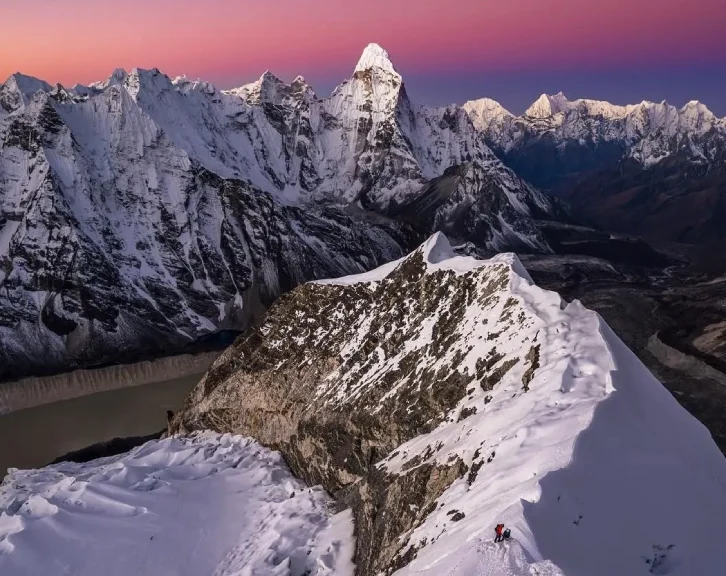
Island Peak Climbing is a guided ascent of Imja Tse, a peak in Nepal’s eastern Khumbu region. The mountain was originally known by its Sherpa name Imja Tse, but it got the name “Island Peak” in 1953 for members of the British Everest expedition team. They gave it this name because when viewed from Dingboche the peak looks like a small island rising out of a wide sea of ice and glaciers. In 1983, the original name Imja Tse was officially restored so both names are used today.
Island Peak is classified as a trekking peak by the Nepal Mountaineering Association (NMA), which makes it a good bridge between simple trekking and more technical mountaineering. The peak was first climbed in 1953 as part of Everest training climb, when a team reached its southwest summit. The main summit was not reached until 1956 when Swiss climber Hans-Rudolf Von Gunten completed the full ascent. Island Peak sits inside Sagarmatha National Park in Nepal’s Solukhumbu district close to some of the highest mountains on Earth.
Island Peak Location and Map
Island Peak sits in the Khumbu region of eastern Nepal inside Sagarmatha National Park in the Solukhumbu district. It belongs to the Khumbu Himal - a mountain range that forms part of the larger Himalayas and geologically the peak is an extension of the Lhotse Shar ridge. Its exact coordinates are27°55'15"N, 86°56'07"E, placing it in one of the most dramatic mountain settings in the world.
The peak lies close to the Chhukung Valley and the village of Dingboche with Lhotse and Ama Dablam rising nearby giving climbers sweeping views throughout the approach. This location surrounded by some of the tallest peaks on Earth is part of what makes the climb so visually rewarding.
Most climbers reach Island Peak by flying from Kathmandu to Luka - a short flight of around 30 to 40 minutes covering roughly 140 Km (87 miles). From Lukla the route continues on foot through Namche Bazaar and up to Chhukung before reaching Island Peak Base Camp. This approach entirely on trekking trails with no road access typically takes several days and doubles as the acclimatization period needed before the climb.
Island Peak Height and Elevation
Island Peak stands at 6189 meters (20305 ft) above sea level though some surveys cite a slightly lower figure of 6165m (20226 ft). Its prominence is 475m meaning that’s how much it rises above the surrounding terrain.
Climbers set up Base Camp at Pareshaya Gyab sitting between 5087m and 5100m before moving up to High Camp at around 5600m ahead of the summit push. For comparison this puts Island Peak’s Base Camp slightly lower than Everest Base Camp (5364m), while High Camp sits close to the elevation of Kala Patthar (5644m) - popular viewpoint on the Everest Base Camp trek. This gradual gain in elevation gives climbers a sense of just how high the surrounding Khumbu terrain already sits before the technical climbing even begins.
Island Peak Climbing Difficulty Level
Island Peak stands at 6189 meters (20305 ft) above sea level though some surveys cite a slightly lower figure of 6165 m (20226 ft). Its prominence is 475m meaning that’s how much it rises above the surrounding terrain.
Island Peak is graded PD+ (Peu Difficile+) on the Alpine grading system, sometimes also listed as a 2B difficulty climb. This places it firmly between a standard trek and a full high-altitude expedition making it a common step for climbers looking to move beyond trekking without jumping straight into a 8000m peak.
The technical crux of the climb is the final 150 meter (450ft) headwall just before the summit. This section is a mix of ice and rock angled at roughly 45 to 50 degrees and climbers ascend it using fixed ropes and jumars rather than free climbing. Before reaching the headwall the route also crosses a glacier which involves navigating crevasses and using fixed-rope sections of safety. Once past the headwall climbers face a narrow exposed summit ridge with steep drops on either side requiring careful footing and full concentration in the final stretch to the top.
Prior mountaineering experience is not mandatory to attempt Island Peak, which is part of why it draws so many first-time high-altitude climbers. That said, some familiarity with crampons and an ice axe is strongly recommended, since climbers use both extensively on summit day, often with limited time to learn on the mountain itself. Most expeditions include a training day at Base Camp to cover these skills before the climb.
Overall, Island Peak sits in a useful middle ground: harder and more technical than the Everest Base Camp trek, but far less demanding and far shorter in duration than a full-scale 8,000m expedition.
Is Island Peak Dangerous?
Island Peak carries a low but real fatality rate of under 2% with estimates typically falling between 1% and 2%. According to the Himalayan Database fewer than 20 deaths have been recorded on the peak across several decades of climbing, a relatively small number given how many climbers attempt it each year.
The leading cause of death on Island Peak is Acute Mountain Sickness (AMS) that progresses into more serious conditions like HAPE (High Altitude Pulmonary Edema) or HACE (High Altitude Cerebral Edema), both of which can turn fatal without a quick descent. Secondary risks include falls on the summit headwall and falls into crevasses while crossing the glacier, particularly in poor visibility or icy conditions.
Despite these risks, Island Peak sees a large number of successful climbers each season, with 600 to 900 or more reaching the summit during peak spring and autumn windows. Climbing with a qualified guide, using fixed ropes on the headwall, and following a proper acclimatization schedule all reduce the risk substantially, which is a major reason most climbers choose a guided expedition rather than attempting the peak independently.
Best Season to Climb Island Peak
Spring and autumn are the two recommended seasons for Island Peak Climbing. These periods offer better weather with clearer mountain views and more suitable climbing conditions. Winter and summer climbs are possible but they require more preparation because of colder weather - changing conditions and fewer climbers on the route.
Season | Period | Conditions | Approx. Permit Cost |
Spring | Mid-March to May | Warmer temperatures, generally stable weather, and more reliable snow conditions. A popular period for Island Peak climbing. | USD 250–350 |
Autumn | Mid-September to November | Clearer skies, excellent mountain visibility, and stable conditions, although temperatures are colder than in spring. | USD 125–175 |
Winter / Summer | December–February / June–August | Climbing is possible but conditions can be more challenging. Winter is very cold, while summer brings wetter and less predictable weather. Fewer climbers visit during these periods. | USD 70–125 |
Monsoon | June–August | Generally avoided because of rain, cloud cover, poor visibility, and more difficult travel conditions. | USD 70–125 |
Best choice: Spring is ideal for warmer climbing conditions and stable snow, while autumn is often preferred for clearer skies and excellent visibility. Permit fees can vary by season and current Nepal government regulations - so climbers should confirm the latest rates before booking.
Island Peak Climbing Route
The standard Island Peak Climbing route runs from Lukla through Chhukung to the summit ridge. The journey combines a classic Everest-region trek with acclimatization days before reaching the Island Peak climbing area.
- Kathmandu → Lukla: Take a scenic flight from Kathmandu to Lukla as the main gateway to the Everest region. From Lukla begin trekking toward the Khumbu Valley.
- Lukla → Phakding → Namche Bazaar: Trek through Phakding and continue toward Namche Bazaar as this section gradually gains elevation and provides the first major mountain views.
- Namche → Tengboche → Dingboche: Continue through Tengboche known for its famous monastery before heading toward Dingboche for further acclimatization.
- Dingboche → Chhukung: Trek to Chhukung, a small mountain settlement and the main staging point for Island Peak.
- Chhukung → Island Peak Base Camp (Pareshaya Gyab): Follow the trail toward Island Peak Base Camp where climbers prepare for the technical section of the expedition.
- Base Camp → High Camp → Summit: Move to High Camp and make the summit attempt usually starting early as the route involves glacier travel with steep snow and ice and climbing equipment before reaching the summit ridge and top.
- Optional Everest-region detour: Depending on the itinerary climbers can add Everest Base Camp, Kala Patthar or Kongma La before or after the Island Peak climb. These additions require extra days and careful acclimatization.
Island Peak Base Camp
Island Peak Base Camp sits at approximately 5087 to 5100 meters at Pareshaya Gyab - below the main climbing route. The camp usually provides tented accommodation with cooks and kitchen staff preparing meals for climbers. A pre-climb training day is normally included to practice using crampons - ice axes, ropes and basic climbing techniques. Some itineraries also use High Camp at around 5600 - meters to shorten summit day. The summit push usually begins between 12 midnight and 3 am allowing climbers to reach the summit early and descend before conditions worsen.
Notes
Lukla Flight and Cancellation:
The flight to Lukla is one of the most exciting parts of EBC trek as lukla is the main gateway to the Everest region so depending on the season and flight rules, flights usually leave from Kathmandu or Ramechhap. The weather in the mountains changes quickly, so Lukla flights can be delayed or cancelled as the flight schedule cannot be fixed due to the weather conditions . This happens more often during the monsoon and winter seasons because of foggy weather, rain, snow, or poor visibility. It is a good idea to keep one or two extra days in your travel plan for safer side,this gives you enough time if your flight is delayed. If flights are cancelled for several days, you can choose to take a helicopter, but this costs extra. When you book your trek with Mount Elegance Treks and Expedition, we take care of everything, we keep track of flight updates and weather conditions, and inform you about any changes on schedule from time to time, and help you find the best solution so your trip goes as smoothly as possible.
Island Peak Climbing Itinerary
Download ItineraryThe journey begins with arrival in Kathmandu, landing on to the land of Himalayas at Tribhuvan International Airport. Our representative will greet you at the airport and transfer you to your hotel at Thamel about a 25 to 30 minutes drive depending on the traffic. Depending on your arrival time you may have a chance to explore the vibrant streets of Thamel - a popular hub known for its gear shops, restaurants and lively markets. Pre-trip meetings will be held either in the company office or your hotel lobby, our team will contact you for the meeting.
Maximum Altitude: Kathmandu (1,400m/4,600ft)
Drive Duration: 30-45 minutes
Hotels in Kathmandu included in this package are 3 stars. Upgrade or changes will cost extra and should be informed before arriving or during booking.
Trek briefs will be scheduled according to your flight time in your hotel lobby, carrying essential documents such as copies of valid passports and visa, two passport sized photos for applying the permits.
Today you will spend a day packed with sightseeing cultural heritages around the Kathmandu valley and preparing for the trek ahead. Visit UNESCO World Heritage Sites like - Pashupatinath Temple, Boudhanath Stupa or Swayambhunath (the monkey temple). In the afternoon, Later you can rent or buy any last-minute climbing gear before departure.
Maximum Altitude: Kathmandu (1,400 m/4,600 ft)
Meal: Breakfast
Drive Duration: 3-4 hours
A short scenic flight takes you from Kathmandu to Lukla, famous Lukla airport (Tenzing-hillary airport) with its sloped short runway begins your adventurous journey. From here trekking begins leaving Lukla behind you head downwards for an easy 3 hours walk down to Phakding following the Dudh Koshi river through the pine forests and small Sherpa settlements.
Maximum Altitude: Phakding (2,610m/8,563ft)
Meal: Breakfast, Lunch & Dinner
Trek Duration: 4-5 hours
Flight Duration: 25-30 minutes
Today’s trek climbs steadily through forest and crosses several suspension bridges over the Dudh Koshi River before a steep final ascent into Namche Bazaar. Among many, Hillary bridges is a popular steel cable suspension bridge covered in bells and garlands - famous twin bridge parallel crossing the cliff. Namche, a bustling Sherpa trading hub set in a natural amphitheater - is the gateway to the Everest region and takes roughly about 5 to 6 hours of hike to reach Namche.
Maximum Altitude: Namche Bazaar (3,440m/11,283ft)
Meal: Breakfast, Lunch & Dinner
Trek Duration: 5-6 hours
Namche a crucial strategic acclimatization stop to help your body adapt to the higher altitude and less oxygen. Most climbers take a short hike and descend up to the Everest View Hotel or the Sagarmatha National Park visitor center for an early view of Everest. This also follows the mountaineering principle of Climb high, sleep low before getting to the even higher altitude continuing the ascent deeper into Khumbu region.
Maximum Altitude: Namche Bazaar (3,440m/11,283ft)
Meal: Breakfast, Lunch & Dinner
The trail descends through rhododendron forest before climbing to Tengboche, home to the largest and most famous monastery in Khumbu region. On clear days this stretch offers a stunning background of Ama Dablam, Everest and Nuptse. The walk takes about 5 to 6 hours of uphill, downhill and ridge-line trails to reach Tengboche.
Maximum Altitude: Tengboche (3,860m/12,664ft)
Meal: Breakfast, Lunch & Dinner
Trek Duration: 5-6 hours
Leaving the last of the treeline behind the trail opens into the higher, drier terrain as you pass through Pangbouche and enter the Imja valley toward Dingbouche. This 5 to 6 hours of trekking marked a noticeable shift from green forest to grey barren landscape as you hike to Dingboche.
Maximum Altitude: Dingboche (4,410m / 14,470ft)
Meal: Breakfast, Lunch & Dinner
Trek Duration: 6-7 hours
A second very much needed acclimatization stop is at Dingboche rest day before pushing higher. Many climbers hike up Nangkartshang Peak for panoramic views of Makalu, Ama Dablam and the surrounding Khumbu peaks, gaining valuable altitude exposure before descending back to Dingbouche to sleep.
Maximum Altitude: Nangkartshang Peak (5,083m/ 16676ft)
Meal: Breakfast, Lunch & Dinner
Trek Duration: Optional hike (3–4 hours)
Any symptoms of altitude sickness such as headache, dizziness, nausea should be immediately informed to your trekking guide.
Today the trail passes Thukla and the Memorial chortens honoring climbers who died on Everest, a sobering and reflective stop. From there the path climbs along the Khumbu Glacier’s edge to lukla - a small settlement serving trekkers heading toward Base Camp. As you climb higher you will feel the air get thinner and start to feel the altitude. About 5 to 6 hours of slow and steady climb will bring you to Lobuche.
Maximum Altitude: Lobuche (4,940m/16,207ft)
Meal: Breakfast, Lunch & Dinner
Trek Duration: 5-6 hours
A long rewarding walking day begins across the Khumbu Glacier to reach Everest Base Camp with close-up views of the Khumbu Icefall. Soaking in the incredible views as the dawn breaks trekkers will begin to descend toward Gorakshep - last settlement before Base Camp for the night's stay.
Maximum Altitude: Everest Base Camp (5,364m/ 17,598ft)
Meal: Breakfast, Lunch & Dinner
Trek Duration: 6-7 hours
During ascend when you will reach Gorakshep, you will leave your bags at the teahouses and carry on with only essentials to hike to Everest Base Camp and afterwards return back to Gorakshep for night stay.
Today the day starts early at 4:00 AM as you strap yourself in your trekking gear and under the head lamp you begin climbing the cold frozen path for Kala Pathar but it rewards climbers with the best close up views of Everest’s summit as the dawn breaks. After soaking the views, trekkers start descending to Gorak Shep the route crosses over to the Chhukung Valley, a shift toward the Island Peak approach route.
Maximum Altitude: Kala Patthar (5,545m /18,192ft)
Meal: Breakfast, Lunch & Dinner
Trek Duration: 6-7 hours
From Chhukung, the trail climbs steadily toward Island Peak Base Camp, Set at the foot of the mountain. This is where climbers prepare gear review climbing techniques with their guides and rest ahead of the summit attempt. This point marks the technical part of this trip as you will be beginning the summit of a mountain.
Maximum Altitude: Island Peak Base Camp (5,200m/ 17,060ft)
Meal: Breakfast, Lunch & Dinner
Accommodation: Tent Camp
Trek Duration: 5-6 hours
Summit day begins in the early hours, often around midnight or 1am, to reach the top before afternoon winds pick up. Climbers rope up and cross the glacier, navigating crevasses with the help of fixed lines, before tackling the steep 150-meter ice and rock headwall using jumars and fixed ropes. The final push along the narrow summit ridge rewards climbers with sweeping views of Lhotse, Makalu, and Everest. After summiting, the team descends the same route back to Base Camp for a well-earned rest.
Maximum Altitude: Island Peak (6,189m /20,305ft)
Meal: Breakfast, Lunch & Dinner
Accommodation: Tent Camp
Trek Duration: 8-10 hours
Summit day involves crossing above 6000 meters elevation, placing climbers in extreme-altitude territory where oxygen levels are dangerously low. Watch closely for signs of altitude sickness - confusion, breathlessness at rest or loss of coordination - and inform your guide immediately if symptoms appear as descent takes priority over reaching the summit.
With the summit behind you, the trek turns downhill. Retracing the route through Chhukung and Dingboche, the trail descends into thicker, more oxygen-rich air, offering welcome relief after days at extreme altitude. Pangboche, home to one of the Khumbu's oldest monasteries, makes for a peaceful overnight stop. The walk takes roughly 5-6 hours, and many climbers describe this stretch as noticeably easier, both physically and mentally, now that the technical climbing is complete.
Altitude: Pangboche (3,930m /12,894ft)
Meal: Breakfast, Lunch & Dinner
Trek Duration: 5-6 hours
The descent continues through familiar territory, passing back through Tengboche's forested trails toward Namche Bazaar. After the thin air of Base Camp and the summit push, this lower elevation feels comparatively comfortable. Namche's bakeries, bars, and teahouses offer a fitting spot to unwind, and many climbing groups mark their successful summit with a celebratory dinner here before the final stretch back to Lukla the following day.
Altitude: Namche Bazaar (3,440m/11,283ft)
Meal: Breakfast, Lunch & Dinner
Trek Duration: 6-7 hours
The final trekking day retraces the route back down through Phakding to Lukla, closing the loop that began nearly two weeks earlier. It’s typically a longer day covering familiar ground at a quicker pace since altitude is no longer a concern. Many climbers use the walk to reflect on the expedition from the long acclimatization days to summit night before reaching Lukla for a final overnight stay ahead of the flight to Kathmandu.
Altitude: Lukla (2,860 m/ 9,383 ft)
Meal: Breakfast, Lunch & Dinner
Trek Duration: 6-7 hours
An early morning flight from Lukla returns climbers to Kathmandu, depending on weather as flights here are often affected by morning winds. Back in the city, the rest of the day is free. Many use the time to shower properly for the first time in weeks, explore Thamel's shops for souvenirs, or enjoy a celebratory meal marking the successful completion of the Island Peak climb.
Altitude: Kathmandu (1,400 m/ 4,600 ft)
Meal: Breakfast & Dinner
Flight Duration: 25-30 minutes
The final day involves a scheduled transfer to Tribhuvan International Airport for departure. Depending on flight timing there may be a few free hours beforehand for last-minute shopping, sightseeing or simply relaxing before the journey home. This marks the official end of the Island Peak climbing expedition though for many, it’s just the start of planning the next Himalayan adventure.
Altitude: Kathmandu (1,400 m/ 4,600 ft)
Meal: Breakfast
Drive Duration: 30-40 minutes
Looking at other options?
Compare this trip with our other itineraries.
Mera Peak 12 Days
- Day 1 Flight to Lukla & Trek to Chutanga (3,430m)- 25 to 30 minutes flight & 4-5 hour hike. Overnight stay at tea houses in Chutanga.
- Day 2 Trek from Chutanga to Thuli kharka/chatra (3900m) la via zwatra la pass (4610m)- 6 to 7hrs hike. Overnight stay at tea houses in Thuli Kharka/Chatra la.
- Day 3 Trek from Thuli Kharka to Kothe (3691m) - 5 to 7hrs hike. Overnight stay in a traditional lodge at Kothe.
- Day 4 Trek from Kothe to Thaknak (3600m)- 4 to 5hrs hike. Overnight stay at Thaknak in a teahouse.
- Day 5 Trek from Thaknak to Khare(5,045m)- 4 to 5hrs hike. Overnight stay at khare in a teahouse.
- Day 6 Acclimatization day at Khare (5,045m). Overnight stay at khare in a teahouse.
- Day 7 Trek from Khare To High Camp (5780m)- 4 to 6hrs hike. Overnight stay at a high camp in a tent.
- Day 8 Submit Mera Peak(6476m) and return from high camp to Khare- 10 to 10hrs hike. Overnight stay at khare in the teahouse.
- Day 9 Trek from Khare to Kotha(3691m)-4 to 5hrs hike.over night stay at teahouse in kotha.
- Day 10 Trek from Kotha to Thuli Kharka/Chatra la(4600m)- 6 to 7hrs hike. Overnight stay at Thuli Kharka in the teahouse.
- Day 11 Trek from Thuli Kharka to Lukla(2860m)- 7 to 8hrs hike. Overnight stay at lukla in the teahouse.
- Day 12 Fly back from Lukla to Kathmandu (1,400m)- 25-30 min Flight.
Lobuche Peak 15 Days
- Day 1 Fly to Lukla (2,860m) & Trek To Phakding (2,610m)- 25 to 30 minute flight & 3-4 hour trek . Overnight stay at a Tea house in Phakding.
- Day 2 Trek from Phakding to Namche Bazar (3,440m)- 5 to 6 hour trek. Overnight stay at the tea house in Namche Bazar
- Day 3 Acclimatization day at Namche Bazar (3,440m). Overnight stay at the tea house in Namche bazar.
- Day 4 Trek from Namche Bazar To Tengboche (3,860m) - 5 to 6 hours. Overnight stay at the tea house in Tengboche.
- Day 5 Trek from Tengboche to Dingboche (4,410m) -6 to 7 hours. Overnight stay at the tea house in Dingboche.
- Day 6 Acclimatization day at Dingboche (4,410m) - 6 to 7 hours (Optional hike to Nangkartshang Peak (5,083m). Overnight stay at the tea house in Dingboche.
- Day 7 Trek from Digboche to Lobuche (4,940m) - 5 to 6 hours. Overnight stay at the tea house in Lobuche.
- Day 8 Trek Lobuche To Gorakshep (5,164m) & Hike to Everest Base Camp (5,364m) - 6 to 7 hours. Overnight stay at the tea house in Gorakshep.
- Day 9 Climb Kala Pathar(5,545m) & Descend to Lobuche Base camp (4,950m)- 6 to 7 hours Overnight stay at the tea house in Lobuche Base Camp.
- Day 10 Trek Lobuche Base Camp To Lobuche High Camp (5,400m)- 3 to 4 hours. Overnight stay at the Tent in Lobuche High Camp.
- Day 11 Submit Lobuche East (6,119m) & Back to Base Camp - 8 to 10 hours. Overnight stay at the tea house in Lobuche Base Camp.
- Day 12 Trek Lobuche Base Camp To Pangboche (3,985m) - 5 to 6 hours. Overnight stay at the tea house in Pangboche.
- Day 13 Trek Pangboche to Namche Bazar (3,440m) - 5 to 6 hours. Overnight stay at the tea house in Namche Bazar.
- Day 14 Trek Namche Bazar To Lukla (2,860m)- 6 to 7 hours. Overnight stay at the tea house in Lukla.
- Day 15
What's Included in the Island Peak Climbing Package
Trip Includes:
Accommodation
- Twin-sharing/double accommodation in a 3-star hotel for 3 nights in Kathmandu including breakfast (Private room accommodation can be organized at an extra cost).
- Sharing guesthouse accommodation during the trek for 12 nights in Everest Region.
- Tented camp accommodation and all meals during the 2 night stay at Island Peak Base Camp, where climbers can expect shared twin-share tents,
Camp Facilities: Fully equipped dining tents, kitchen gear, dining tables, chairs, and toilet tents for basic mountain comfort.
Meals & Drinking Water
- All your standard meals during the trek (17 Breakfasts, 15 Lunches and 15 Dinners)
- Fresh seasonal fruits each day after dinner during the trek.
- A farewell dinner on the last night in Nepal.
- Purified drinking water during the trek using Water Filter or water purification tablets.
Transportation & Flight
- International and Domestic airport transfers on a tourist vehicle.
- Round-trip airfare between Kathmandu/Manthali and Lukla.
- Kathmandu – Manthali – Kathmandu transportation by shared tourist vehicle.
Guide and Staff
- Experienced, first-aid trained, government licensed, English speaking, and locally recruited Mount Elegance trekking guide (2 guides for group size more than 8 people).
- Climbing Sherpa guide for Island peak submission from Chukhung, 1 Climbing sherpa guide for 2 trekkers and sherpa increases according to group size.
- Porters during the trek for carrying luggage (1 porter for every 2 clients).
- Wages, accommodation, meals, gear, insurance and medications for all staff.
Island Peak Climbing Permits
- Island peak Climbing permit.
- Sagarmatha National Park Permit.
- Pasang Lhamu Rural Municipality fee.
- TIMS (Trekkers’ Information Management System) card.
Equipment and Takeaways
- 1 Mount Elegance duffel bag and Sleeping Bag (Should be returned after trek Completion)
- Climbing equipment (Ice hammer,climbing rope, ice screw and snow bar)
- Mount Elegance Complimentary Tshirt, Cap and Route Map.
- A comprehensive first aid kit, including an Oximeter to check pulse and oxygen levels daily in the mountains.
- Trip completion certificate.
Administrative & Taxes
- All administrative expenses and government taxes.
Trip Excludes:
- Lunch and Dinner in Kathmandu.
- Entry fee in different historical sites in Kathmandu during sightseeing.
- International flight fare and airport departure tax.
- Nepal Entry Visa (Visa can be acquired easily after your arrival at Tribhuvan International Airport in Kathmandu with a fee of USD 30 for 15 days visa, USD 50 for 30 days visa, and USD 125 for 90 days visa).
- Travel insurance with high-altitude emergency evacuation coverage.
- Any beverages, including bottled and boiled water.
- Tips to trekking staff and drivers.
- Personal trekking gear and equipment.
- Any expenses other than the Price Include section.
Departure Dates
Island Peak Climbing Equipment List
Check this comprehensive trekking and climbing checklist for your Island Peak climbing, All necessary equipments are mentioned below where some equipment like: Sleeping Bag, Duffel bag, climbing equipments will be provided by company and are also mentioned below:
Clothing (Layering System)
- Base Layer: 2–3 pairs of thermal tops and bottoms (high-grade synthetic).
- Trekking Shirts: 3–4 lightweight, breathable long-sleeve shirts for sun and dust protection on the EBC Island trail.
- Trekking Pants: 2 pairs of stretchable, quick-dry trekking pants.
- Insulation Layer: 1 high-loft fleece jacket or lightweight down sweater.
- Outer Layer (Heavy Insulation): 1 expedition-weight, windproof, waterproof down jacket with a hood (essential for the freezing Island Peak Base Camp and summit night).
Note: you can rent a down Jacket from the company for $50 total.
- Hard Shell: 1 breathable waterproof jacket and pants to withstand wind, rain, or alpine snow.
- Underwear: 5–6 pairs of moisture-wicking sports underwear.
Footwear
- Trekking Boots: 1 pair of ankle-supportive, water-resistant hiking boots.
- Mountaineering Boots: 1 pair of double climbing boots (insulated, rated for 6,000m, and fully compatible with automatic/semi-automatic crampons).
Note: These can be rented in Namchee or Kathmandu if needed.
- Camp Shoes: 1 pair of lightweight sports sandals for relaxing in the teahouses.
- Socks: 3–4 pairs of thick merino wool trekking socks, 2 pairs of heavy expedition climbing socks, and 2 pairs of thin liner socks.
- Gaiters: 1 pair of breathable, waterproof gaiters to seal out snow and scree.
Backpack and Storage
- Main Duffel Bag: 1 heavy-duty, weather-resistant 90L–120L duffel bag (to be carried by porters/yaks and will be provided by the company).
- Daypack: 1 technical 35L–45L daypack with a rain cover, ice axe loops, and a supportive hip belt (for carrying layers, water, camera, medicine, snacks, clothes for a day and climbing hardware on summit day). Day bag packs will be carried by guests.
- Dry Bags: A collection of lightweight waterproof dry sacks to segregate and protect electronics and clothing.
Technical and Trekking Gear
- Climbing Hardware: 1 climbing harness, 1 Jumar (ascender), 1 descender (figure-8 or ATC guide), 2 locking carabiners, 2 non-locking carabiners, and a dynamic prusik loop/leash, Provided by the company.
- Crampons & Ice Axe: 1 pair of steel climbing crampons fitted perfectly to your mountaineering boots, and 1 standard mountaineering ice axe with a leash, Provided by the company.
- Sleeping Bag: 1 extreme-weather four-season sleeping bag rated down to at least -20°C / -4°F (crucial for comfort at Island Peak Base Camp and it will be provided by the company).
- Trekking Poles: 1 pair of adjustable trekking poles with snow baskets.
- Headlamp: 1 high-lumen LED headlamp with extra lithium batteries (essential for the midnight summit push).
- Water Storage: 2 wide-mouth, insulated 1-liter Nalgene bottles (must handle boiling water) and thermal bottle jackets to prevent freezing.
- Glacier Glasses: 1 pair of high-protection UV category 4 glacier glasses with side shields.
Health and First Aid
- Altitude & Illness Medication: Diamox (Acetazolamide) for altitude acclimatization, a course of broad-spectrum antibiotics, and anti-diarrheals (Imodium).
- Water Purification: Purification tablets or chlorine dioxide drops (standard filters can freeze and crack at high camps).
- Blister & Trauma Care: Comprehensive blister kits (Compeed/Moleskin), athletic tape, sterile gauze, and elastic bandages.
- Personal Pharmacy: Rehydration salts (ORS), Ibuprofen/Paracetamol, cough lozenges (to combat the dry "Khumbu cough"), and personal prescriptions.
Personal Items and Extras
- Sun Protection: SPF 50+ broad-spectrum sunscreen and dedicated SPF zinc lip balm.
- Sanitation: Multiple packs of pocket tissues, wet wipes (for camp showers), and high-alcohol hand sanitizer.
- Power Bank: 2 high-capacity (20,000mAh) heavy-duty power banks.
- High-Altitude Snacks: Energy gels, protein bars, chocolate, and electrolyte powders to stimulate appetite at extreme elevations.
Documents and Cash
- Identity & Visas: Original passport valid for 6+ months past travel dates, plus physical paper copies. For a Nepal visa you will pay cash after arriving in Nepal.
- Permits: Valid TIMS card, Sagarmatha National Park entry permit, Khumbu Pasang Lhamu Rural Municipality entry permit, and the official NMA Island peak climbing permit.
- Insurance Certificate: Printed proof of comprehensive travel and mountaineering insurance covering search, rescue, heli-evacuation, and technical climbing up to 6,300 meters.
- Photos: 2-3 recent passport-sized photos for local permits and regional SIM cards.
- Cash: Carry nepalese rupee during trek while credit card might not be accepted to get some souvenir or other snacks. You can exchange to nepali Currency after arriving in Kathmandu.
Final Tips
- Strict Weight Limits: Keep your main duffel bag under 15 kg (33 lbs) to strictly comply with the twin-otter domestic flight weight allowances for the Lukla flight and porter will also carry 15 kg max per person.
- Freeze Prevention: Store your phone, camera batteries, headlamp, and power banks inside your inner jacket pockets during the day, and at the bottom of your sleeping bag at night to prevent freezing temperatures from killing the battery life.
Island Peak Base Camp
Island Peak Climbing costs between USD 2000 and USD 2800 per person for a fully guided package depending on the level of service, group size, accommodation and climbing support you choose. The total cost can vary because budget trips focus on shared services while premium packages provide more personal attention and better accommodation.
Package Tier | Approx. Cost Per Person | What You Get |
Budget | USD 1800 - USD 2400 | Shared teahouse accommodation, group guide, basic climbing support, standard meals, permits, and porter services. This option is suitable for climbers looking for a more affordable experience while still receiving professional guidance. |
Standard | USD 2000 - USD 2800 | Semi-private arrangements, full permit support, experienced guide and climbing Sherpa, accommodation, meals, porter support, and essential logistics. This is a good balance between comfort, personal attention, and cost. |
Premium | USD 2500 - USD 3500 | Private climbing Sherpa, greater flexibility, single-room accommodation where available, personalized climbing support, and upgraded services. This option is best for climbers who prefer privacy and a more comfortable, personalized experience. |
Island Peak Climbing with Everest Base Camp Trek
Island Peak Climbing is commonly combined with the Everest Base Camp Trek in a single expedition creating a longer journey that allows trekkers to acclimatize naturally before attempting the summit as the Everest Base Camp route doubles as the acclimatization phase for Island Peak -gradually taking you to higher elevations while visiting major highlights along the way. A typical combined itinerary runs for 18 days and includes Everest Base Camp - Kala Patthar and Kongma La Pass before continuing toward Island Peak Base Camp and the climbing section. Combining both adventures in one booking can also be more cost- and time-efficient than arranging separate trips as transport, guides, permits, accommodation and logistics can be organized together. View our Island Peak Climbing with Everest Base Camp Trek package for current pricing and departure dates. The combined trek demands more physical effort than Island Peak alone because of the longer duration, greater trekking distance, high-altitude passes and summit climb. Good fitness with proper acclimatization and preparation are important for completing the full expedition comfortably and safely.
Acclimatization Process for Island Peak
Acclimatization for Island Peak follows a staged ascent through Namche - Dingboche and Chhukung giving the body time to adjust to decreasing oxygen levels as altitude increases. A common approach is the “climb high - sleep low” strategy where climbers hike to a higher elevation during the day and return to a lower elevation to sleep. This helps the body gradually adapt without gaining altitude too quickly.
Rest and acclimatization days are usually planned at Namche Bazaar (3,440m) and Dingboche (4,410m). From these villages short hikes to higher viewpoints provide additional altitude exposure while allowing climbers to return to the same accommodation. The journey then continues to Chhukung (4,730m) where further adaptation takes place before heading toward Island Peak Base Camp.
Staying well hydrated, eating regularly, getting enough rest and maintaining a gradual ascent rate are important parts of acclimatization. Climbers should also watch for Acute Mountain Sickness (AMS)symptoms including -
headache, nausea, dizziness, unusual fatigue and loss of appetite. Mild symptoms should not be ignored or treated by simply pushing higher. If symptoms worsen or serious signs such as confusion - difficulty walking or breathing problems develop descent is the primary treatment. The climbing schedule should always allow flexibility for acclimatization and changing health conditions.
Required Fitness Level for Island Peak Climbing
Island Peak Climbing requires strong cardiovascular endurance and multi-day trekking stamina to handle long approaches, steep ascents and demanding summit-day conditions - whereas a structured fitness program helps reduce fatigue and improves your ability to perform safely at altitude.
- Allow 4–6 months of dedicated training before the climb so, Begin with general fitness and gradually increase workout intensity, duration - elevation gain and pack weight as your climbing date approaches.
- Focus on cardio, leg strength and loaded-pack hiking, Running, cycling, stair climbing and uphill walking can build cardiovascular capacity - while squats, lunges, step-ups and calf raises strengthen the muscles needed for steep terrain.
- Build the ability to sustain 6–12 hour trekking and climbing days. Include progressively longer weekend hikes ideally on consecutive days - while carrying a backpack similar to your expected trekking load.
- Prior high-altitude trekking experience is helpful but not mandatory. Experience with long Himalayan treks can make the physical and altitude-related demands more familiar but consistent preparation can help first-time climbers develop the required endurance.
- Use practical training pace benchmarks. Aim to comfortably maintain a brisk uphill walking pace for 60–90 minutes without excessive fatigue and complete 5–7 hours of loaded hiking while maintaining steady energy and recovery.
- Add core and balance conditioning for glacier travel. Planks, side planks, single-leg exercises and controlled balance drills can improve stability when walking on uneven, icy or snow-covered terrain with climbing equipment.
Technical Climbing Skills Required
Island Peak Climbing requires basic crampon, ice-axe and fixed-rope skills. Climbers should understand and practice the following techniques before attempting the summit:
- Crampon walking technique
Learn how to walk safely on snow and ice while wearing crampons as proper foot placement helps prevent slipping and protects the legs from injury.
- Ice-axe use and self-arrest
Learn how to hold and use an ice axe correctly this is Self-arrest which an important technique for stopping yourself if you slip on snow or ice.
- Jumaring
Climbers need to know how to use a jumar or ascender to safely move upward on fixed ropes - especially on steep sections.
- Rappelling / abseiling
Learn how to descend safely using a fixed rope, harness and rappel device.
- Harness and carabiner handling
Climbers should be comfortable wearing a climbing harness and correctly attaching carabiners, ropes and other safety equipment.
- Glacier travel and crevasse awareness
Basic knowledge of glacier movement - hidden crevasses and safe travel on snow and ice is important for avoiding hazards.
- Pre-summit training
A training session is provided at Base Camp by experienced climbing Sherpas. This session helps climbers practice essential techniques and understand how to use the climbing equipment before the summit attempt.
Summit Day and Summit Difficulty
Summit day on Island Peak begins between midnight and 3am and takes 10 to 12 hours round trip. The early start is necessary to reach the summit before the weather and snow conditions become more difficult later in the day. Climbers first travel across glacier terrain, where they may encounter crevasses and use ladders or fixed ropes on technical sections. As the route becomes - steeper, climbers use crampons, ice axes, harnesses and ascenders to move safely.
The main technical challenge is the 150-meter final headwall, which is one of the most demanding sections of the climb. Climbers ascend this steep snow and ice slope using fixed ropes and climbing equipment. After the headwall as the route continues toward a narrow summit ridge - which can be exposed and may have cornices. Care and good rope technique are especially important here. The complete summit attempt can take around 10–12 hours - depending on weather, snow conditions, fitness and the pace of the group. Climbers must also make sensible turnaround-time decisions. If progress is too slow or conditions become unsafe, returning safely should take priority over reaching the summit. From the summit, climbers can enjoy impressive Himalayan views including Everest, Lhotse, Nuptse and Ama Dablam. These views are a major reward after the long and physically demanding summit day.
Permits Required for Island Peak Climbing
Island Peak Climbing requires three permits: an NMA climbing permit a Sagarmatha National Park entry permit and a Khumbu Pasang Lhamu Rural Municipality permit. Climbers also need the required trekking documentation and permits are normally arranged through a licensed Nepalese trekking agency.
Permit / Requirement | Approximate Cost | Purpose / Notes |
NMA Island Peak climbing permit | USD 250–350 (spring) USD 125–175 (autumn) USD 70–125 (winter/summer) | Required for climbing Island Peak. The fee changes according to the season. |
Sagarmatha National Park entry permit | USD 20–30 (NPR 3,000) | Required for entering Sagarmatha National Park and trekking through the Everest region. |
Khumbu Pasang Lhamu Rural Municipality permit | USD 20 | Local permit required for trekking in the Khumbu area. |
TIMS card | Varies | Required for the trekking portion, depending on the current trekking regulations and route. |
Refundable garbage deposit | Up to USD 500 | A deposit may be required for climbing groups and is refundable when the required waste-management conditions are met. |
Permit processing | — | Climbing permits are issued and processed through a licensed Nepalese trekking agency. |
Guide and Sherpa Support
A licensed climbing guide and Sherpa team are mandatory for Island Peak Climbing. A qualified, NMA-registered Sirdar or climbing guide leads the expedition and helps manage the group throughout the climb. The climbing Sherpa team provides important technical support including fixing and checking ropes on steep sections and helping manage safety decisions during summit day. The guide-to-climber ratio depends on the expedition operator, group size and level of support required. Smaller groups usually allow guides to provide closer attention to each climber - especially during technical sections and the summit push. Before the climb climbers receive pre-climb technical training at Base Camp. This session allows them to practice using - crampons, ice axes, harnesses, ascenders, carabiners and fixed ropes before moving onto more difficult terrain.
Porter support is also available for carrying trekking equipment and personal loads between camps. This allows climbers to conserve energy for the technical climbing sections and summit attempt. For experienced support throughout the expedition meet our certified Island Peak climbing guides and Sherpa team and learn how they can help make your climb safer, organized and more enjoyable.
Accommodation During the Expedition
Island Peak Climbing accommodation combines teahouse lodges on the trek with tented camping at Base Camp. From Lukla to Chhukung climbers normally stay in local teahouses or mountain lodges. These provide - basic rooms, meals - dining areas and shared facilities making them a comfortable option during the trekking portion of the journey. At Island Peak Base Camp and High Camp - accommodation changes to tented camping.
Food and Nutrition During the Climb
Meals during Island Peak Climbing shift from teahouse menus to high-calorie camp meals near Base Camp. During the trekking sections three meals daily are included usually with options such as - rice, noodles, pasta, soup, vegetables, eggs and other simple local or international dishes. As the route reaches higher elevations meals focus more on high-carbohydrate and high-calorie foods to provide energy for long trekking and climbing days. Fresh food becomes more limited above Dingboche climbers should expect simpler meal choices at higher camps.
Safe drinking water is available through boiled or treated water. Climbers should maintain good hydration with around 3–4 liters of fluid per day, depending on activity - weather and individual needs. For summit day carrying personal snacks is recommended. Energy bars, chocolate, dried fruit, nuts or other lightweight snacks can provide quick energy during the long climb when regular meals are not available.
Island Peak Climbing Safety Risks
The main safety risks on Island Peak are altitude sickness - crevasse falls and headwall falls. Climbers should understand these risks and follow the advice of their climbing guides throughout the expedition.
- Acute Mountain Sickness (AMS): High altitude can cause headache, nausea, tiredness, dizziness and loss of appetite. More serious conditions including HAPE and HACE can become life-threatening and require immediate descent.
- Crevasse falls: Crevasses can occur along the glacier approach. Climbers must follow the marked route, stay properly roped when required and remain alert for hidden cracks in the ice.
- Headwall falls: The steep 150-meter headwall is a major technical section. Falls may happen because of equipment problems - poor technique, fatigue or exhaustion so climbers must use fixed ropes and climbing equipment correctly.
- Sudden weather changes: Strong winds, snow, cloud and rapidly changing conditions can make the summit ridge dangerous. Climbers should be prepared to turn back when conditions deteriorate.
- Summit fever: The desire to reach the summit can cause climbers to ignore fatigue, weather or time limits. Good turnaround-time decisions are essential and returning safely should always be more important than reaching the summit
Emergency Support and Evacuation
Emergency support for Island Peak Climbing includes helicopter evacuation coordinated by the guide team. If a serious illness, injury or other emergency occurs, helicopter rescue may be available from Base Camp and along the trekking route depending on weather - location, aircraft availability and local operating conditions. The guide team coordinates the emergency response, helping assess the situation - contact the appropriate rescue provider and arrange evacuation when necessary. Communication is especially important in remote mountain areas - so the expedition may use a satellite phone or other communication backup when normal mobile networks are unavailable.
Climbers should arrange pre-approved evacuation and trekking insurance before starting the expedition. Insurance should specifically cover high-altitude trekking and climbing, helicopter evacuation and the maximum altitude reached on Island Peak. Climbers should also understand the policy conditions and exclusions before departure. Our expedition includes 24/7 emergency support coordination, giving climbers access to experienced staff who can help manage emergencies and coordinate with guides - rescue providers and insurance companies when required.
Travel Insurance Requirements
Island Peak Climbing requires travel insurance that covers high-altitude helicopter evacuation up to 6200 meters. The policy should include helicopter rescue and medical evacuation, as rescue at high altitude can be expensive and may be needed in an emergency. Climbers should make sure their insurance provides coverage to at least 6,200 meters - which gives appropriate altitude protection for an Island Peak expedition. Before purchasing a policy - carefully check the exclusions. Some standard travel insurance policies do not cover mountaineering, climbing - fixed-rope sections or other technical climbing activities. A suitable policy should also provide useful protection for the wider trip. Recommended coverage may include trip cancellation or interruption - lost or damaged climbing gear, baggage problems and emergency medical expenses.
Climbers should carry proof of their insurance during the expedition. Insurance documentation may be requested before climbing permits are issued, so it is important to arrange suitable coverage before travelling to Nepal. Always check the policy wording, altitude limits, activity definitions and evacuation conditions carefully to make sure Island Peak climbing is fully covered.
Island Peak vs Everest Base Camp Trek
Island Peak Climbing adds a technical summit to the standard Everest Base Camp Trek. The main difference is that the EBC Trek focuses on high-altitude trekking while Island Peak combines trekking with a technical mountain climb.
Feature | Everest Base Camp Trek | Island Peak Climbing |
Main activity | Trekking only, with no technical climbing | Trekking plus a technical summit climb |
Maximum altitude | Up to 5,644 m at Kala Patthar | 6,189 m at Island Peak summit |
Typical duration | Around 12–14 days | Around 15–18 days |
Technical skills | Basic trekking skills are generally sufficient | Requires crampon, ice-axe, fixed-rope, ascending, and rappelling skills |
Climbing equipment | Standard trekking gear | Requires additional climbing equipment such as crampons, ice axe, harness, helmet, ascender, and climbing rope |
Permits | Trekking permits and required local/national park permits | Trekking permits plus the required NMA Island Peak climbing permit |
Summit difficulty | No technical summit section | Includes glacier travel, fixed ropes, a steep headwall, and an exposed summit ridge |
Trip option | EBC trek can be completed on its own | Can be combined with the EBC Trek in one package |
A combined Island Peak and EBC package allows climbers to experience the classic Everest Base Camp route while also attempting a 6,189-meter Himalayan summit. This option takes longer and requires additional preparation, equipment - permits and technical climbing skills compared with the standard EBC Trek.
Island Peak vs Mera Peak
Island peak is more challanging and technical than mera peak, while mera is higher and physically harder as both are populare trekking peak in nepal which can be suitable for first time peak climbers when attempted with experienced guides and proper prepration.
Feature | Island Peak | Mera Peak |
Elevation | 6,189 m | 6,476 m |
Difficulty | PD+ / 2B; more technical | PD; generally less technical |
Climbing terrain | Glacier sections, crevasses, fixed ropes, and a technical headwall | Mostly continuous snow slopes with fewer technical sections |
Main challenge | Technical climbing skills and the steep final headwall | Higher altitude and the physical demands of a longer climb |
Approach | Shorter and follows the well-established Everest trail | Longer and more remote approach through the Hinku Valley |
Infrastructure | Better trekking infrastructure, with more established lodges and services along the approach | More remote, with fewer facilities on parts of the approach |
First-time climbers | Suitable with guide support and basic technical training | Suitable with guide support and good acclimatization |
Typical success rate | Often reported above 85–95% with reputable operators | Often reported above 85–95% with reputable operators |
Island Peak is a good choice for climbers who want more technical experience including fixed-rope climbing and steep snow or ice. Mera Peak is better suited to those looking for a higher summit with a longer and more physically demanding approach but generally less technical climbing whereas the Actual success rates vary by season, weather, acclimatization, fitness and operator standards, so published percentages should be treated as approximate rather than guaranteed.
Who Should Climb Island Peak?
Island Peak Climbing suits both first-time trekking peak climbers and experienced mountaineers building toward higher summits. It can be beginner-friendly with proper guide support as climbers receive technical training at Base Camp before attempting the more difficult sections. This training helps beginners learn how to use - crampons, ice axes, harnesses, ascenders and fixed ropes safely. No previous technical mountaineering experience is mandatory but climbers should be prepared to learn basic climbing skills and follow their guide's instructions carefully. Good acclimatization is also important because the summit reaches 6189 meters. For experienced climbers - Island Peak can be a useful progression step toward more demanding objectives such as Ama Dablam, Lobuche Peak or eventually higher 8000-meter expeditions. It provides valuable experience with high-altitude conditions, glacier travel, fixed ropes and summit-day routines.
However - Island Peak should not be underestimated as climbers needs strong physical fitness with good endurance and confidence on steep or exposed terrain. A positive attitude with proper preparation and the ability to make safe decision are equally important for a successful climb.
Is Island Peak Suitable for Beginners?
Island Peak Climbing is suitable for beginners with strong fitness and a guided Base Camp training session. No prior climbing experience is mandatory making the peak an achievable introduction to Himalayan trekking-peak climbing for well-prepared beginners. Climbers should be comfortable with long walking days that have steep terrain with high-altitude conditions. A pre-summit training session at Base Camp provides practical instruction in crampon walking, rope handling, ascender use, ice-axe techniques and other basic climbing skills. This allows beginners to become familiar with their equipment before the summit attempt. As a recommendation climbers should have some multi-day high-altitude trekking experience. Experience at altitude helps them understand how their body responds to reduced oxygen and prepares them for the physical demands of summit day.
For complete first-timers with no trekking or mountain experience taking a basic mountaineering course before the expedition is strongly recommended. Good fitness, proper acclimatization with the support of experienced guides and a cautious approach are essential for climbing Island Peak safely.
Is Island Peak Suitable for Experienced Climbers?
Yes, Island Peak is suitable for experienced climbers as experienced climbers use Island Peak as a training and acclimatization climb before attempting higher peaks. Its 6,189-meter summit provides a useful opportunity to test - fitness, endurance and climbing techniques in a real high-altitude environment. The climb can be used as preparation for objectives such as Ama Dablam, Lobuche East, and larger 7000–8000–meter peaks. Climbers can practice important skills including crampon movement, fixed-rope climbing, ascending with a jumar, rappelling and moving safely on steep snow and glacier terrain.
Island Peak also requires less time and logistical commitment than Denali or Aconcagua because this makes it a practical option for experienced mountaineers who want to refresh their technical skills without committing to a long expedition , although it is a short climb Island Peak still provides meaningful exposure to altitude, a cold environment with steep terrain and summit pressure. Experienced climbers can use the expedition to assess their preparation and identify areas that need improvement before taking on more demanding Himalaya objectives.
What Determines Summit Success on Island Peak?
Summit success on Island Peak depends on weather, acclimatization, fitness and guide decision-making. A successful summit attempt requires several conditions to work together and reaching the top should never be prioritized over safety.
- Weather stability on summit day: Clear conditions, manageable winds and good visibility can make the climb safer and easier with Strong winds - heavy snowfall, poor visibility or rapidly changing weather may require a delay or retreat.
- Acclimatization schedule: Following the planned acclimatization schedule gives the body time to adjust to high altitude. Climbers should report symptoms of altitude sickness early and follow their guide's advice about rest or descent.
- Physical conditioning: Good cardiovascular fitness, leg strength and endurance are important for the long summit day. Climbers should also be comfortable carrying a small personal pack over steep and demanding terrain.
- Guide and Sherpa decisions: Experienced guides and Sherpas assess weather, route conditions, climber fatigue, and available time. Their turnaround-time decisions can be critical when conditions become unsafe.
- Reported success rates: Some reputable operators commonly cite Island Peak success rates of above 85–95%, but these figures vary by season - weather, route conditions, preparation and operator as they should not be treated as a guarantee.
Environmental Responsibility on Island Peak
Island Peak Climbing operators follow Sagarmatha National Park conservation rules and a refundable garbage deposit system. A refundable garbage deposit around USD 500 may be required by the Nepal Mountaineering Association (NMA) to encourage climbing groups to manage and remove their waste responsibly. Climbers and expedition teams should follow Leave No Trace practices throughout the route - especiallyon the glacier, Base Camp and High Camp. This includes carrying out rubbish by avoiding unnecessary damage to the natural environment and keeping camping areas clean. Environmental responsibility also includes proper Sherpa and porter welfare standards.
Responsible operators should provide fair wages, suitable equipment, adequate food, safe working conditions and appropriate insurance or support for their mountain staff. Because Island Peak lies within the Sagarmatha National Park protected area, climbers must follow park regulations and local conservation requirements. Respecting these rules helps protect the fragile Himalayan environment and supports responsible tourism for future climbers and local communities.
How to Book Your Island Peak Climbing Expedition
Booking an Island Peak Climbing expedition requires a deposit - passport details and proof of travel insurance. The booking process can be completed in a few simple steps:
Choose your departure date: Select a suitable climbing season - usually spring or autumn, based on your preferred travel dates and availability. Check our available Island Peak departure dates and choose your preferred trip.
Submit your documents: Provide a clear passport copy and required passport-size photos so the operator can prepare permits, reservations and other necessary arrangements.
Pay the booking deposit: A booking deposit is required to confirm your place on the expedition. Secure your Island Peak climbing departure by paying the required deposit.
Confirm travel insurance: Make sure your insurance covers high-altitude trekking and climbing, medical treatment and helicopter evacuation at the required altitude. Submit proof of valid coverage before departure.
Receive your preparation checklist: After booking, you should receive a pre-departure gear and training checklist covering clothing, climbing equipment - fitness preparation and essential documents. Get your Island Peak preparation checklist and start training early.
Pay the final balance: The remaining trip cost is normally paid before departure, according to the operator's booking terms. Complete your final balance payment and prepare for your Island Peak adventure.


FAQs
General Information
Island Peak climbing is an exciting Himalayan mountaineering adventure in Nepal that combines trekking through the Everest region with technical climbing skills to reach the 6189 meter summit.
Island Peak Climbing costs roughly USD 2800, depending on the services included. A typical itinerary takes 18 covering Kathmandu, Lukla, Namche, Dingboche, Chhukung, Base Camp, the summit and return.
Island Peak Climbing from Chhukung is a technical mountaineering route where climbers trek from Chhukung to Island Peak Base Camp, train on glaciers, then summit the 6,189-meter peak before descending.
A 15-day Island Peak itinerary covers Kathmandu, Lukla, Namche, Tengboche, Dingboche, Chhukung, Base Camp, climbing training, the 6,189-meter summit, and return to Lukla.
Island Peak Climbing with EBC combines the Everest Base Camp Trek with a technical ascent of Island Peak (6,189 m) allowing trekkers to experience EBC before climbing one of Nepal’s popular trekking peaks.
An Island Peak Climbing map shows the trekking route from Lukla to Chhukung and Island Peak Base Camp, key villages, elevations, acclimatization stops, the climbing route and the summit location.
Short Island Peak Climbing is a shortened Himalayan expedition, usually lasting around 13 days, combining the Everest-region trek, acclimatization, climbing training, and a summit attempt of 6,189-meter Island Peak.
Island Peak Climbing usually takes 12 days, including trekking, acclimatization, climbing training, the summit attempt, and return. The summit climb itself typically takes 10 - 12 hours from Base Camp or High Camp.
Island and Lobuche Peak Climbing combines ascents of Island Peak (6,189 m) and Lobuche East (6,119 m) with trekking through the Everest region, offering two technical Himalayan climbing experiences in one expedition.
Mera and Island Peak Climbing combines ascents of Mera Peak (6,476 m) and Island Peak (6,189 m), linking two Himalayan summits with trekking, acclimatization, and technical climbing in Nepal.
Island Peak, also known as Imja Tse, stands at 6,189 meters (20,305 feet) above sea level in Nepal’s Everest region. It is one of Nepal’s most popular trekking peaks.
The Island Peak climbing route typically follows Lukla → Phakding → Namche Bazaar → Tengboche → Dingboche → Chhukung → Island Peak Base Camp → High Camp → summit (6,189 m), then descends via the same region.
Preparation and Fitness
Island Peak climbing is moderately to highly difficult, requiring good fitness, altitude acclimatization, glacier travel, crampon skills, rope techniques, and confidence on steep snow and ice terrain.
Preparation involves cardiovascular training, strength workouts, endurance hikes, altitude awareness, gear preparation, basic mountaineering practice, and developing mental resilience for demanding summit conditions.
Beginners should train for 8–12 weeks with regular hiking, stair climbing, strength exercises, cardio workouts and longer weekend walks carrying a backpack.
Previous high-altitude trekking experience is helpful, especially trips above 4,000 meters. Familiarity with long hiking days, steep terrain, and altitude improves confidence.
Learn basic crampon walking, ice-axe use, rope techniques, ascending fixed lines, rappelling, glacier travel and safe movement on steep snow and ice.
Pack layered clothing, trekking boots, climbing boots, helmet, harness, crampons, ice axe, sleeping bag, gloves, sunglasses, headlamp, water bottles, toiletries, and personal medicines.
Essential climbing gear includes crampons, mountaineering boots, harness, helmet, ice axe, ascender, carabiners, climbing rope, warm clothing, gloves, goggles, and headlamp.
Use properly fitting mountaineering boots compatible with crampons. They should provide warmth, ankle support, waterproofing, and enough room for comfortable movement during summit day.
You can usually rent technical equipment such as climbing boots, crampons, harness, helmet, ice axe, ascender, sleeping bag and down jacket in Kathmandu.
A practical system uses three main layers: moisture-wicking base, insulating middle layer and waterproof outer shell, with additional warm layers for summit day.
Start early, eat a good breakfast, drink regularly, move steadily, follow your guide, protect exposed skin, check equipment, and turn back if conditions become unsafe.
Health and Safety
Acclimatize gradually by spending rest days at higher elevations, walking slowly, staying hydrated, sleeping adequately, and avoiding rapid altitude gains whenever possible.
Supplemental oxygen is not normally required for healthy climbers, but guides may carry emergency oxygen for serious altitude problems or unexpected medical situations.
A climbing helmet should be worn during technical sections, particularly where rockfall, falling ice, or slips could cause head injuries.
Success rates vary between seasons, weather, route conditions, acclimatization, fitness, and operators, so no single percentage accurately represents every Island Peak expedition.
Monsoon brings clouds, rain, wet trails, poor visibility, and possible flight disruptions. Island Peak climbing is generally less favorable during Nepal’s June–September monsoon.
Winter brings extreme cold, strong winds, shorter daylight, icy routes, and higher frostbite risk. Prepare with expedition-grade clothing, reliable equipment, and experienced guides.
April usually offers favorable spring conditions, clearer mornings, moderate temperatures and generally good climbing opportunities, although afternoon clouds and changing mountain weather remain possible.
Permits
Island Peak requires a Nepal mountaineering climbing permit, along with the applicable Sagarmatha National Park and local-area entry permissions for the trekking route.
The climbing permit cost depends on season and current Nepal government regulations. Check the latest Department of Tourism fee schedule before booking.
Guides and Support
A qualified climbing guide is strongly recommended because Island Peak involves technical climbing, glacier terrain, fixed ropes, changing weather, and high-altitude safety challenges.
Join a scheduled group expedition through a licensed trekking agency. Groups usually share guides, climbing support, transportation, permits, accommodation, and other expedition arrangements.
Choose an itinerary and agency, confirm dates, review inclusions, provide required documents, pay the deposit, and receive preparation guidance before your expedition begins.
Contact a licensed trekking agency, select your dates, confirm the itinerary and services, provide passport details, pay the required deposit, and receive guide arrangements.
Group sizes vary by company, but many commercial Island Peak expeditions operate with small or medium groups to provide better communication, support, and climbing supervision.
Awesome Holidays Nepal offers Island Peak climbing packages combining trekking, climbing support, permits, accommodation, transportation, guides and other expedition arrangements.
The Awesome Holidays Nepal Island Peak climbing blog provides practical information about routes, preparation, permits, equipment, costs, weather, safety, and expedition planning.
Accommodation
Most of the stays in Island Peak climbing will be in tea houses and tents. On most of the route you will be staying in locally owned tea houses or lodges whereas during the Sumit and back usually 2 nights are spent on the tented accomodation.
First night you will be staying in Chhukung and prepare for the climb then after the Summit you will be returning back to the base camp to spend the night. Rest of the route is standard EBC route Lukla, Phakding, Namche, Tengboche, Dingboche, Lobuche and Gorakshep.
At Chhukung you will be staying on a tented accommodation with basic amenities and prepare for the summit next day.
At Island Peak Base Camp you will be staying on a tented accommodation with very basic amenities.
No - there is no teahouses during the summit part of Island Peak however your normal, standard route to the Island Peak will be teahouse accommodation.
Yes - tent camping is needed for the Island Peak climbing. 2 nights on your way to summit and back will be spent on the tented accommodation.
Yes - accommodation is already included in the Island Peak Climbing Package. However, some accommodation en route can be upgraded that may cost you extra.
Some basic facilities will be available in most of the accommodation usually including simple twin bed with a blanket and pillow, commonly shared bathroom and dinning halls, and no toiletries. In the tented accommodation usually have even more basic accommodation.
Yes meal such as breakfast, lunch and dinner are included during trekking days in this package, other extra snacks will be at your own cost.
The types of accommodation included in Island Peak climbing with EBC are teahouses, local lodges and tents.