 Best Seller


Langtang Valley Trek 10 Days
Duration
10 days
Accommodation
Hotels, Teahouses
Maximum Guests
40
Highest Altitude
5,000m/ 16,404ft
Best Season
Mar-May & Sep- Nov
Start/End Point
Kathmandu
Langtang Trek Route Overview
Langtang trek is an unforgettable destination located in Rasuwa district and is undoubtedly a perfect trekking route for the trekkers. It is popular for its beginning, friendly and short duration whereas you can skip those packed trail crowds on the more famous routes and head straight for peaceful routes of Langtang.
You'll tackle a bumpy road trip from Kathmandu, winding through Dhunche before finally hitting the trailhead at Syabrubesi. The moment your boots step onto the dirt inside Langtang National Park, the real magic begins. You'll trace a wild, roaring river, passing quiet little stops like Pahiro, Dovan, and Bambo. Then, the trail shoots upward into mossy, thick forests packed with vibrant rhododendron blooms. Keep your eyes on the canopy! You might spot a wild langur, a curious Red monkey, or a group of Assam macaque monkeys swinging through the branches. If the mountain gods are smiling on you, you might even cross paths with a Himalayan tahr, a Musk Deer, a rare Himalayan black bear, a brilliant Danphe bird, and if you're incredibly lucky, a quiet snow leopard or red panda hidden away in the bamboo.
Walking past the riverside remains of Rimche and Lama Hotel, the dense green canopy suddenly reveals the massive, wide-open valley of Ghoda Tabela. Continuing the walk, you'll wind through Gumba Danda and Mundo Village. These spots offer a rare, unfiltered look into the lives of the local Tamang Community. It's a beautiful way to connect with their deep-rooted Tamang Culture, Tamang Heritage, and sacred Tibetan Buddhist Culture.
If your timing is perfect, you might arrive during Sonam Lhochhar (major festival). This is the official Tamang New Year, a time when the valleys echo with the rich, hypnotic beats of the traditional Damphu and Cello. Further up the trail, things turn quiet as you cross a vast field of gray rocks. This is where the old village once stood, completely buried by a devastating avalanche during the 2015 earthquake. Passing this memorial wall is an incredibly humbling experience.
Deep in the upper sections of the Langtang Valley, you'll wander into Kyanjin Gompa. It’s a wonderfully peaceful high-altitude haven. Here, an ancient Buddhist monastery stands quiet while a local Yak (or a lazy herd of Yak) grazes against a backdrop of the majestic Himalayan Glacier and Langtang glacier systems. Look up and you're surrounded by the towering giants of the Langtang Himalayas:
- Ganesh Himal
- Dorje Lakpa (6966m)
- Gangchempo (Langtang Ri 7205m)
- Porong Ri (7292)
- Langtang Lirung (7324m)
Just a heads-up: the teahouse bedrooms here have absolutely no heating. At this altitude, nights drop well below freezing, making a heavy-duty sleeping bag a literal lifesaver. The best part? Huddled around the glowing metal stove in the dining room at night, drinking hot tea, sharing trail stories, and munching on fresh local cheese.
For the ultimate views, pull up your boots and brace yourself for the challenging climb up to the Tserku Ri Viewpoint 4984 m, arguably the best Langtang Valley Trek viewpoint you can find. Up top, you’ll stand eye-to-eye with Yala Peak (5520m) and the giant Mt Shishapangma 8027 m(world’s 14th highest peak).
If your lungs are burning or the altitude is hitting you hard, don't sweat it. Just head up Kyanjin Ri instead. It's way shorter, far easier, and still serves up incredible 360-degree views of the massive glaciers. If you have extra time and energy to burn, this trek doesn't have to end here. You can easily loop it into the broader Langtang Circuit Trek, tackle the rugged Ganja La Pass, visit the sacred Gosainkunda Lakes (4,380 Metres), or explore the beautiful, culturally rich trails of Langtang Helambu.
Langtang Valley Highlights
Tserko Ri Views: Standing at 4,984m on this viewpoint unveils an unmatched 360-degree panorama of the massive Langtang glaciers, Yala Peak, and the giant Mt. Shishapangma.
Kyanjin Gompa: This peaceful alpine village feels like the edge of the world, offering a stunning backdrop of frozen glaciers, grazing yak herds, and a historic Buddhist monastery.
Tamang New Year: Timing your trip during Sonam Lhochhar lets you experience traditional cultural celebrations enlivened by the rhythmic beats of local Damphu drums and Cellos.
Rare Wildlife: Hiking through the protected national park gives you a genuine chance to spot rare animals like red pandas, langurs, musk deer, and vibrant Danphe birds in the wild.
Humbling History: Walking past the original Langtang Village now a moving field of boulders after the 2015 earthquake avalanche, offers an emotional look at local resilience.
Rhododendron Forests: The lower trail rewards you with a beautiful hike through dense, mossy canopy forests filled with blooming rhododendron trees right next to a rushing river.
Cozy Lama Hotel Nights: Resting at this peaceful, forest-hidden cluster of rustic teahouses gives you the therapeutic experience of sleeping right next to a roaring river.
Gateway Adventure: The trip kicks off with a wild, incredibly scenic drive from Kathmandu through Dhunche, giving you a raw taste of the country's winding mountain roads.
Why Choose Langtang Trek Nepal?
The Langtang trek is a way to learn about the local culture, meet people from the villages, see monasteries, and find out about the customs of the area. There are teahouses along the way which are pretty cozy. They serve delicious food, and the owners are very friendly who are always ready to welcome you with a warm heart. You can rest and experience what peaceful life is like in the mountains. The visible major peaks from Langtang Valley are Langtang Lirung and Dorje Lakapa, Ganesh Himal, and Yala Peak, and many other panoramic mountain views that can usually be enjoyed from Kyanjin Ri and Tserko Ri, which are the highlights of the Langtang Valley trek.
Easy to Reach and Highly Accessible
The Langtang Trek is an easy trek to get to in Nepal. The Langtang Trek does not need a flight to start. You can take a drive from Kathmandu to Syabrubesi. This is a reason to do the Langtang Valley Trek because it saves you time and money. It also makes it easier to plan your trip. This is especially helpful for people who are doing the Langtang Trek and do not have a lot of time.
Perfect for Beginners and First-Time Trekkers
If you’ve never hiked at high altitudes before, Langtang is one of the best places to get your feet wet. Most trails in the Himalayas force you to tackle weeks of relentless, steep climbing. This one is different, it is much shorter. Because the trail climbs are gentle and at a steady pace, your body has plenty of time to adjust to the thinner air. It is a really forgiving route for beginners who want to see the giant mountains up close without completely wearing themselves out.
Enjoy Peaceful Trails with Fewer Crowds
Unlike many of Nepal's trekking routes, the Langtang Valley Trek is a quieter option because the peaceful trails let you enjoy the sounds of rivers, forests, and birds. So you do not have to deal with crowds, as the Langtang Valley Trek offers mountain views, nature, and local culture in a calm setting. It is a choice for trekkers who want to experience these things. The Langtang Valley Trek is ideal for those seeking relaxation.
Explore Rich Wildlife and Natural Diversity
The Langtang Valley Trek is a hike that goes through Langtang National Park. This park is full of things to experience, like super green forests and mountains that are really beautiful. The Langtang Valley Trek takes you through the forests where you can see animals like red pandas, Himalayan black bears, and musk deer, even langurs, and lots of colorful birds, including Nepal's national bird, Danphe. When you are on the Langtang Valley Trail, every single day is a chance to see how pretty Nepal is, and that is what makes the Langtang Valley Trek so special and memorable.
Affordable Trekking Experience for Every Budget
The Langtang Valley Trek is one of Nepal's most affordable Himalayan adventures, as it costs less than many other famous treks while still offering stunning mountain views, comfortable teahouses, and rich cultural experiences with lower permit, transport, and accommodation costs, it is a great choice for trekkers traveling on any budget.
What makes Langtang Valley Nepal a special trekking destination?
Langtang Valley is special for its peaceful trails, stunning Himalayan peak, rich Tamang culture with beautiful green forests, glaciers, and diverse wildlife. It offers an authentic trekking experience without the large crowds found on other routes.
Stunning Himalayan Views and Mountain Landscapes
The Langtang Valley Trek rewards trekkers with spectacular views of snow-covered mountain peaks, deep valleys with glaciers, and open grassland along the way. You can also admire mountains such as Langtang Lirung, Dorje Lakpa, Gangchempo, and Ganesh Himal. Viewpoints like Kyanjin Ri and Tserko Ri offer unforgettable panoramic scenery.
Rich Tamang Culture and Traditional Villages
The Langtang Valley Trek takes you through traditional Tamang villages where local people have preserved their customs, language, and Buddhist traditions for generations. You can visit ancient monasteries, spin prayer wheels, see colorful prayer flag and enjoy warm hospitality while learning about the unique mountain lifestyle of the Tamang community.
Kyanjin Gompa, Kyanjin Ri, and Alpine Adventure
Kyanjin Gompa is a part of the Langtang Valley Trek. It has peaceful surroundings. There is a Buddhist monastery here. The mountain views are simply amazing. From Kyanjin Gompa, you can hike to Kyanjin Ri. From there, you get to see Langtang Lirung, glaciers, and other nearby peaks. The landscape here is alpine which makes this place one of the most enjoyable experiences in the region.
Diverse Nature, Forests, and Himalayan Ecosystem
The Langtang Valley Trek passes through dense forests, rivers, waterfalls, alpine meadows, and glacial valleys. Inside Langtang National Park, you may spot red pandas, Himalayan tahrs, musk deer, and colorful birds while enjoying one of Nepal's richest and most diverse mountain ecosystems.
Wildlife Experience Inside Langtang National Park
Langtang National Park is home to a variety of wildlife and birds. While trekking you may have a chance to spot red pandas, Himalayan black bears, musk deer, langurs, and colorful Danphe. The park's forests, rivers, and alpine landscapes provide a safe habitat for many rare Himalayan species.
Why Choose Mount Elegance For Langtang Trekking?
- Local Guides You Can Trust: Our friendly licensed guides have many years of trekking experience in Langtang. They are well-known about the routes who understand mountain safety and are always ready to help you enjoy a safe and memorable journey.
- Friendly Service from Start to Finish: We focus on every traveler's comfort and interest. From your first inquiry until you return home our team is always available to provide reliable support.
- Fixed Departure Dates: When you book a confirmed trip with us, it will leave as with a fixed plan so we do not cancel departures because of a small group; therefore, you can plan your trip easily.
- Warm Trekking Gear for Rent: You can rent clean down jackets from us at a reasonable price as we provide sleeping bags from our company, but if u want you can bring yours too. Our gear is warm, comfortable, and suitable for the cold temperatures found in the Langtang region.
- 24-Hour Help During Your Trek: Our support team stays in contact with your guide throughout the trek. If you become sick, injured, or need extra assistance, we quickly arrange the best possible help, including rescue services if necessary.
- Simple Booking Process: Booking your trek is easy. Contact us, choose your travel dates, confirm your trip, and make the payment. Our team will guide you through every step and help with permits, packing, and trip preparation.
Langtang Valley Trek 10 Days Itinerary
Download ItineraryWelcome to the land of Himalayas. Our representative will be there to receive you then transfer to your hotel in Thamel. He/she will help you to check-in the hotel later on the day. Pre-trip meetings will be at the hotel lobby or Mount Elegance office depending on your flight schedule timing. All legal documents signing and formalities will be done during the meet. Q&A season will also be held to answer any of your queries. The rest of the day you will have free time to explore the city and get necessary gear.
Maximum Altitude: Kathmandu (1,400m/ 4,600ft)
Drive Duration: 30-45 minutes
Do carry your documents with 2 passport-sized photos and 2 copies of your passport with valid visa duration for the trip for applying the permits in the pre-trip meet and remaining due is also cleared during the meeting. Hotels included in this package will be 3 star and upgrades/ changes will be charged extra and should be pre-informed on booking.
The adventure kicks off with a long, incredibly bumpy, and winding drive that takes you through the mountain town of Dhunche. You will drop down into the deep river canyon to reach the trailhead of Syabrubesi, which serves as your official gateway to the trek.
Maximum Altitude: Syabrubesi (1,550m/4932ft)
Meal: Breakfast, Lunch & Dinner
Drive Duration: 7-8 hours
Leaving the trailhead behind, your boots hit the dirt as you follow the wild, roaring currents of the Langtang River. The path guides you through the quiet, rustic hamlets of Pahiro, Dovan, and Bamboo before climbing steeply into massive, moss-draped forests packed with rhododendron trees.
Maximum Altitude: Lama Hotel (2,470m /8,104ft)
Meal: Breakfast, Lunch & Dinner
Trek Duration: 7-8 hours
You will leave the humid, dense riverside woods behind as the trail climbs higher and the valley suddenly breaks wide open at Ghoda Tabela. As you hike past the ancient stone gateways of Gumba Danda and Mundo Village, you will walk straight into the ancestral heartland of the local Tamang community.
Maximum Altitude: Langtang Village (3,430m /11,253ft)
Meal: Breakfast, Lunch & Dinner
Trek Duration: 6-7 hours
The trail takes you deep into the high alpine zone, bringing you to the final outpost of Kyanjin Gompa. This serene village is surrounded by grazing yak herds, a historic Buddhist monastery, and a massive wall of towering, ice-covered peaks like the giant Langtang Himal. Today when you reach Langtang Village, you will have the option to rest or climb the near by peak Kyanjin Ri at 4,773m.
Maximum Altitude: Kyanjin Gompa (3,870m /12,697ft)
Meal: Breakfast, Lunch & Dinner
Trek Duration: 3-4 hours
This is your day to adapt to the thin air and explore the edge of the world. You can choose to trek the grueling, steep climb up to the iconic Tserku Ri viewpoint at 4,984 meters for an unbeatable look at Mt. Shishapangma, or opt for the shorter, friendlier hike up Kyanjin Ri for stunning glacier views.
Maximum Altitude: Kyanjin Gompa (3,870m /12,697ft) & Tserko Ri (5,000m/16,404ft)
Meal: Breakfast, Lunch & Dinner
Trek Duration: 4-5 hours
Your body needs time to adapt to the altitude so maintain your pace during climbing and use prescribed medication to maintaining oxygen level in your body. Any symptoms such as headaches, nausea and dizziness should be reported immediately
Retracing your steps, you will head back down the valley, face-to-face with the towering mountain horizon. Along the way, you will walk across the quiet, boulder-strewn memorial field where the original Langtang Village stood before the 2015 earthquake avalanche, making for a deeply humbling descent.
Altitude: Lama Hotel (2,470m /8,104ft)
Meal: Breakfast, Lunch & Dinner
Trek Duration: 7-8 hours
The final day on the trails of Langtang takes you back down through the dense bamboo and rhododendron forest. Enjoy the steady downhill walk next to the roaring river, keeping your eyes peeled for swinging Langur Monkey or rare Red Pandas before arriving back in Syabrubesi to celebrate the successful completion of the trek. People often love to dip in the natural hot spring of Syabrubesi to relax after the grueling trek.
Altitude: Syabrubesi (1,550m/4932ft)
Meal: Breakfast, Lunch & Dinner
Trek Duration: 5-6 hours
Today you will trade the quiet mountain trails for the road, loading back into a vehicle for the winding drive back through Dhunche to Kathmandu. It is the perfect time to rest your legs, look back at giant peaks behind you and enjoy a warm city comfort. Today will be a dinner with the whole crew to celebrate the trek and provide you with a trek completion certificate.
Altitude: Kathmandu (1,400m/ 4,600ft)
Meal: Breakfast, Lunch & Dinner
Drive Duration: 7-8 hours
Ending your Himalayan adventure today you will be returning back or to your next destination. Wrapping up the trek today as you head to the airport for your flight home, taking lifelong memories of the high glaciers and warm Tamang hospitality with you. Do remember to share your flight details with the transport team for the drop-off to the airport.
Altitude: Kathmandu (1,400m/ 4,600ft)
Meal: Breakfast
Drive Duration: 30-45 minutes
Looking at other options?
Compare this trip with our other itineraries.
Langtang & Gosaikunda 13 Days
- Day 1 Kathmandu Arrival (1,400m) - 30 to 45 minutes drive. Overnight stay at a 3 star hotel in Kathmandu.
- Day 2 Drive from Kathmandu to Syabrubesi (1,550m) - 7 to 8 hour drive. Overnight stay at a tea house in Syabrubesi.
- Day 3 Trek from Syabrubesi to Lama Hotel (2,470m)- 7 to 8 hours. Overnight stay at the tea house in Lama Hotel.
- Day 4 Trek from lama Hotel to Langtang Village (3,430m) - 6 to 7 hours. Overnight stay at the tea house in Langtang Village.
- Day 5 Trek from Langtang Village to Kyanjin Gompa (3,870m)- 3 to 4 hours. Overnight stay at the tea house in Kyanjin Gompa.
- Day 6 Hike Tserko Ri (5,000m) & back to Kyanjin Gompa- 4 to 5 hours. Overnight stay at the tea house in Kyanjin Gompa.
- Day 7 Trek from Kyanjin Gompa to Lama Hotel - 7 to 8 hours. Overnight stay at the tea house in Lama Hotel.
- Day 8 Trek from Lama Hotel to Thulo Syabru (2,210m)- 6 to 7 hours. Overnight stay at the tea house in Thulo Syabru.
- Day 9 Trek from Thulo Syabru to Sing Gompa (3,250m) - 5 to 6 hours. Overnight stay at a tea house in Sing Gompa.
- Day 10 Trek from Sing Gompa to Gosaikunda Lake (4,380m) - 5 to 6 hours. Overnight stay at a tea house in Gosaikunda Lake.
- Day 11 Trek from Gosaikunda Lake to Dhunche (1,965m) - 7 to 8 hours. Overnight stay at a tea house in Dhunche.
- Day 12 Drive from Dhunche to Kathmandu- 6 to 7 hours. Overnight stay at the 3 star hotel in Kathmandu.
- Day 13 Departure from Kathmandu- 35 to 45 minutes. Breakfast included.
Langtang Trekking Nepal Package (Include & Exclude)
Trip Includes:
Accommodation
- Twin-sharing/double accommodation in a 3-star hotel for 2 nights in Kathmandu including breakfast (Private room accommodation can be organized at an extra cost).
- Sharing guesthouse accommodation during the trek for 7 nights in the Langtang Region.
Meals & Drinking Water
All your standard meals during the trek (9 Breakfasts, 8 Lunches and 8 Dinners) including tea or coffee.
- Fresh seasonal fruits each day after dinner served as dessert during the trek.
- A farewell dinner on the last night in Nepal.
- Purified drinking water during the trek using Water Filter or water purification tablets.
Transportation
- International airport transfers on a tourist vehicle.
- Bus/ Jeep from Kathmandu- Syabrubesi- Kathmandu.
Guide and Staff
- Experienced, first-aid trained, government licensed, English speaking, and locally recruited Mount Elegance trekking guide (2 guides for group size more than 8 people).
- Porters during the trek for carrying luggage (1 porter for every 2 clients).
- Wages, accommodation, meals, gear, insurance and medications for all staff.
Langtang valley Trek Permits
- Langtang Valley National Park Permit.
- TIMS (Trekkers’ Information Management System) card.
Equipment and Takeaways
- 1 Mount Elegance duffel bag and Sleeping Bag (Should be returned after trek Completion)
- Mount Elegance Complimentary Tshirt, Cap and Route Map.
- A comprehensive first aid kit, including an Oximeter to check pulse and oxygen levels daily in the mountains.
- Trip completion certificate.
Administrative & Taxes
- All administrative expenses and government taxes.
Trip Excludes:
- Lunch and dinner in Kathmandu.
- International flight fare and airport departure tax.
- Nepal Entry Visa (Visa can be acquired easily after your arrival at Tribhuvan International Airport in Kathmandu with a fee of USD 30 for 15 days visa, USD 50 for 30 days visa and USD 125 for 90 days visa).
- Travel insurance along with high-altitude emergency evacuation coverage.
- Any beverages including bottled and boiled water.
- Tips to trekking staff and drivers.
- Personal trekking gear and equipment.
- Any expenses other than the Price Include section.
Departure Dates
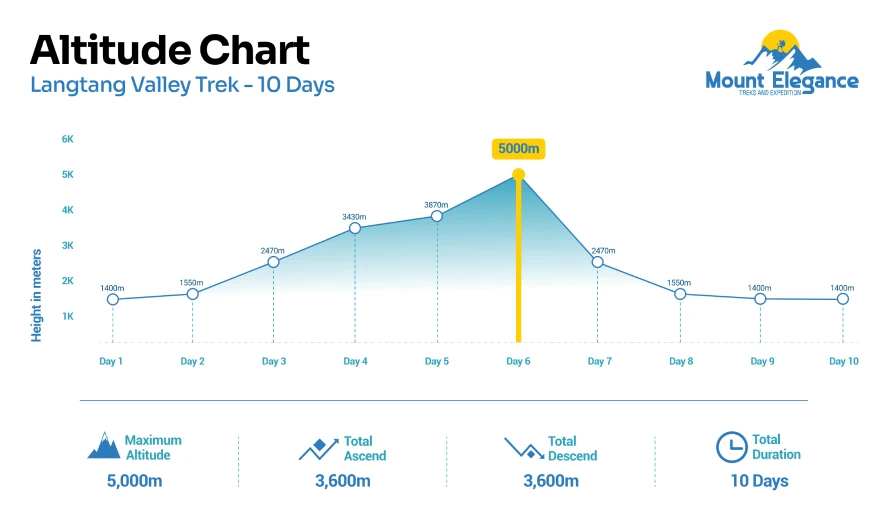
Langtang Valley Trek Route Map & Elevation

Altitude Chart
Packing and Gear List for Trek Langtang in Nepal
Below mentioned are the necessary packing list needed for your Langtang Valley Trek. Services or items provided by Mount elegance Trek are mentioned and other necessary items should be brought by the guest. You can rent or buy these items in Nepal or your host country.
Clothing (Layering System)
- Trekking Shirts: 2–3 lightweight,long-sleeve shirts for sun and dust protection on the ABC trail.
- Base Layer: 1–2 pairs of thermal tops and bottoms (high-grade synthetic).
- Trekking Pants: 2 pairs of stretchable and comfortable trekking pants.
- Insulation Layer: 1 warm fleece jacket or lightweight down sweater.
- Underwear: 4–5 pairs of sports underwear.
- Hard Shell: 1 breathable waterproof jacket and pants for wind, rain, or alpine snow.
Footwear
- Trekking Boots: 1 pair of ankle-supportive and water-resistant hiking boots.
- Socks: 2–3 pairs of thick merino wool trekking socks and 2 pairs of thin liner socks.
- Camp Shoes: 1 pair of lightweight Sports sandals for relaxing in the teahouses.
- Gaiters: 1 pair of breathable, waterproof gaiters to seal out snow.
Backpack and Storage
- Main Duffel Bag: 1 heavy-duty, weather-resistant 90L–120L duffel bag (to be carried by porters/yaks and will be provided by the company).
- Daypack: 1 technical 25L–30L daypack (carried by the guest) for layers, raincoat, water, camera, regular medicine, clothes for a day and snack, will be carried by yourself during trekking.
- Dry Bags: A collection of lightweight waterproof dry sacks to segregate and protect electronics and clothing. (It can be kept at duffel bag)
Technical and Trekking Gear
- Headlamp: 1 headlamp with extra lithium batteries (essential for the midnight and low-light areas).
- Sleeping Bag: 1 Weather four-season sleeping bag rated down to at least -10°C (crucial for comfort at Kyangin Gomba which will be provided by the company).
- Trekking Poles: 1 pair of adjustable trekking poles with snow baskets.
- Water Storage: Insulated 1-liter bottles (must handle boiling water)
- Glasses: 1 pair of high-protection UV Sunglasses.
Health and First Aid
- Altitude & Illness Medication: Diamox (Acetazolamide) for altitude acclimatization, a course of broad-spectrum antibiotics, and anti-diarrheals (Imodium).
- Water Purification: Purification tablets or chlorine dioxide drops to purify your tap water.
- Blister & Wound Care: Comprehensive blister kits (Compeed/Moleskin), athletic tape, sterile gauze, and elastic bandages.
- Personal Pharmacy: Rehydration salts (ORS), Ibuprofen/Paracetamol, and personal prescriptions.
Personal Items and Extras
- Sanitation: Multiple packs of pocket tissues, wet wipes (for camp showers), and high-alcohol hand sanitizer.
- Sun Protection: SPF 50+ broad-spectrum sunscreen and dedicated SPF zinc lip balm.
- Power Bank: 1 high-capacity (20,000mAh) power bank.
- Snacks: Energy gels, protein bars and chocolate, which will be taken as snacks while walking.
Documents and Cash
- Identity & Visas: Original passport valid for 6+ months past travel dates, plus physical paper copies. Visa on arrival and which will be paid in cash.
- Permit: Langtang Valley National park Permits.
- Insurance Certificate: Printed proof of comprehensive travel insurance covering search, rescue, heli-evacuation, and technical climbing up to 5,000 meters.
- Photos: 2 recent passport-sized photos for local permits and regional SIM cards.
- Cash: Carry nepalese rupee during trek while credit card might not be accepted to get some souvenir or other snacks. You can exchange to Nepali Currency after arriving in Kathmandu.
Final Tips
- Strict Weight Limits: Keep your main duffel bag under 15 kg (33 lbs) to strictly comply with the porter. They will also carry 15 kg max per person.
- Freeze Prevention: Store your phone, camera batteries, headlamp, and power banks inside your inner jacket pockets during the day, and at a warm place at night to prevent freezing temperatures from killing the battery life.
What is the Best Time for Nepal trekking Langtang Valley?
The Langtang Valley trek can be enjoyed throughout the year, but spring ( march to may ) and autumn (September to November) offer the most comfortable weather and clearest mountain views.
Autumn (September – November)
Autumn is considered the finest season for trekking in Langtang as the rainy season leaves behind fresh landscapes and clear skies, creating perfect conditions for mountain views with the weather being stable, and the trails are dry, making walking easier and more enjoyable.
Spring (March – May)
Spring brings pleasant temperatures and fresh mountain air. The hillsides are covered with blooming rhododendrons and other flowers, making the trail colorful and lively. Clear weather also provides excellent views of the snow-covered Himalayas.
Preparation For Langtang Trek
Prepare for the Langtang Valley Trek by building your fitness with regular walking or cardio exercises several weeks before the trek. Pack warm, layered clothing with waterproof gear and sturdy trekking boots along with personal essentials. Carry the proper required permits, travel insurance, and enough cash, check the weather forecast, and plan your itinerary with proper acclimatization for a safe and comfortable trek.
Prepare Your Body with Physical Training
Start preparing at least a month before your trek with regular walking, hiking or jogging or even cycling. You can also include stair climbing and leg-strength exercises to improve endurance. Better fitness helps you handle long trekking days, steep climbs, and high-altitude conditions with greater comfort.
Arrange All Required Permits
Before starting the Langtang Valley Trek, obtain the required permits, including the Langtang National Park Entry Permit and TIMS Card (if applicable). Keep your passport, permit copies, and travel documents with you throughout the trek for easy verification at checkpoints.
Pack the Right Trekking Gear
Carry warm layered clothing, a waterproof jacket, trekking boots, gloves, a hat, sunglasses, sunscreen, a reusable water bottle, and a basic first-aid kit. Packing the right equipment keeps you comfortable and prepared for changing mountain weather throughout the journey.
Get Suitable Travel Insurance
Choose travel insurance that covers high-altitude trekking, emergency medical treatment, and helicopter evacuation. Mountain weather and altitude can change quickly, so having proper insurance provides financial protection and peace of mind during your Langtang adventure.
Wear and Test Your Footwear Before the Trek
Wear your trekking boots for several walks before the trip to make sure they fit well and feel comfortable. Well-tested boots help prevent blisters, reduce foot pain, and provide better grip and ankle support on rocky and uneven mountain trails.
Health and Safety Measures for Langtang Valley
Stay healthy and safe during the Langtang Valley Trek by walking at a steady pace, drinking plenty of purified water, eating nutritious meals, and taking time to acclimatize. Carry a basic first-aid kit, wear suitable clothing for changing weather, follow your guide's instructions, and ensure you have travel insurance that covers high-altitude trekking and emergency evacuation.
Take Time to Acclimatize Slowly
Climb gradually and take enough rest to help your body adjust to higher elevations. Avoid gaining altitude too quickly, and never ignore symptoms such as headache, dizziness, or nausea
Hire an Experienced Local Guide
An experienced local guide knows the Langtang trails, weather, and mountain conditions. They help with navigation, monitor your health, and provide quick support during emergencies, making your trek safer and more enjoyable.
Stay Hydrated and Eat Nutritious Meals
Drink plenty of safe water throughout the trek and eat balanced meals to maintain your energy. Proper hydration and nutrition help your body perform better and reduce the risk of altitude sickness.
Carry a Personal First Aid Kit
Bring a basic first-aid kit with personal medicines, bandages, blister care, antiseptic cream, pain relievers, and any prescribed medication. It helps you manage minor injuries and common health problems on the trail.
Check the Weather Conditions Every Day
Mountain weather can change quickly in Langtang. Check the daily weather forecast before starting your hike, and be prepared with warm clothing and rain protection to stay safe in changing conditions.
Things To Know Before The Trek
Before starting the Langtang Valley Trek, check the weather, obtain the required permits, pack suitable trekking gear, carry enough cash, stay physically prepared, and choose the right season for a safe and enjoyable journey.
Guide and Porter
Hiring a local guide improves safety and helps you understand the region's local culture and trails. A porter carries your heavy backpack, allowing you to trek more comfortably and enjoy the journey.
Insurance and Visa
International trekkers need a valid Nepal visa and travel insurance covering high-altitude trekking, medical treatment, and emergency helicopter evacuation for added safety during the trek.
Permits
The Langtang Valley Trek requires a Langtang National Park Entry Permit and, where applicable, a TIMS Card. Carry your permits throughout the trek for verification at checkpoints.
Transportation
The trip starts from Kathmandu on a road trip to Syabrubesi by local bus or private jeep. The return trip follows the same route after completing the trek.
Accommodation
Accommodation is available in comfortable teahouses along the trail. Most provide simple private or shared rooms with basic facilities, warm meals, and a welcoming atmosphere for trekkers.
Personal Expenses
Carry enough cash for drinks, snacks, hot showers, Wi-Fi, battery charging, laundry, tips, and personal purchases, as ATMs are not available along most of the trekking route.


FAQs
General Information
The Langtang Valley Trek is moderately challenging. It involves daily hikes of 5–7 hours with gradual altitude gain, making it suitable for beginners with good fitness and some hiking preparation.
The best time to visit Langtang Valley is during spring (March to May) and autumn (September to November), when the weather is stable, skies are clear, and the mountain views are at their best.
No, you do not need a flight. The Langtang Valley Trek starts with a 6–8 hour drive from Kathmandu to Syabrubesi, the main trailhead for the trek.
Yes, solo trekking is possible on the Langtang Valley Trek. However, hiring a licensed local guide is highly recommended for better safety, navigation, and a richer cultural experience.
Preparation and Fitness
You should have a good level of fitness and be able to walk 5–7 hours a day on mountain trails. Walking at a slow pace can be very helpful.
No, previous high-altitude trekking experience is not required. Beginners with proper preparation can complete the trek successfully.
Focus on cardio exercises, leg-strength training, stair climbing, and regular hiking for a few weeks before the trek.
Ascend gradually, stay hydrated, take acclimatization days, eat nutritious meals, and watch for symptoms like headache or dizziness.
Health and Safety
Yes. AMS is a possible risk on the Langtang Valley Trek, but proper acclimatization and a gradual ascent help reduce the chances.
Carry a basic first-aid kit, personal medications, water purification tablets, sunscreen, lip balm, and hand sanitizer.
Yes. Helicopter evacuation is available in emergencies, weather permitting, and should be covered by your travel insurance.
Stay hydrated, eat nutritious meals, walk at a steady pace, get enough rest, and avoid alcohol while trekking at higher altitudes.
Permits
You need the Langtang National Park Entry Permit and the TIMS (Trekkers' Information Management System) Card.
The permits cost about NPR 3,000 in total for most foreign trekkers.
You can get the permits through a registered trekking agency or at the Nepal Tourism Board office in Kathmandu before starting the trek.
No, a Restricted Area Permit (RAP) is not required for the standard Langtang Valley Trek.
Insurance and Visa
Yes, Travel insurance is highly recommended and should cover high-altitude trekking, medical emergencies, and helicopter evacuation.
Choose a policy that includes high-altitude trekking, emergency helicopter rescue, medical treatment, trip cancellation, and baggage loss.
A Nepal tourist visa costs USD 30 for 15 days, USD 50 for 30 days, and USD 125 for 90 days .
You need a valid passport (with at least six months' validity), a completed arrival form, a passport-sized photo (if required), and the visa fee.
Guides and Support
Yes, hiring a licensed guide is recommended for safety, navigation, and a more enjoyable trekking experience.
A trekking guide typically costs USD 25 per day, depending on experience and the services included.
A porter usually carries 30kg, often shared between two trekkers.
A good guideline is to tip your trekking guide and porter around 7–8% of your total trek package cost if you're satisfied with their service. This amount is usually shared as a token of appreciation for their support, safety, and local expertise throughout the trek.
Accommodation
Accommodation is mainly in traditional teahouses with simple twin rooms, shared bathrooms, and cozy dining areas serving freshly prepared meals.
Yes, Private rooms are available at many teahouses, especially at lower elevations, but they may be limited during peak trekking seasons.
Yes, Most teahouses offer charging facilities and Wi-Fi for an additional fee, though the connection may be slow at higher altitudes.
Yes. Hot showers are available in most teahouses for an extra charge, but availability may be limited in remote villages or during colder months.