A Nepal visa is a required entry document issued by the Department of immigration, Government of Nepal, and can be obtained through three main methods: visa on arrival at Kathmandu airport or major land border, the newer e-Visa system, or an embassy visa arranged before travel. The E-Visa went fully live on August 17, 2026, offering email approval within 24 hours as an alternative to arrival processing. Trekkers can choose between 15, 30, or 90-day durations, with the 30-day option remaining the most popular choice among travelers since it allows enough time for sightseeing plus a full trek. Fees have stayed unchanged in 2026 at USD30 for 15 days, USD50 for 30 days, and USD125 for 90 days. Note that the visa only covers entry into Nepal - trekking permits and the TIMS card are separate requirements needed once you head toward routes like Everest Base Camp.
What Is a Nepal Visa and Who Needs One?
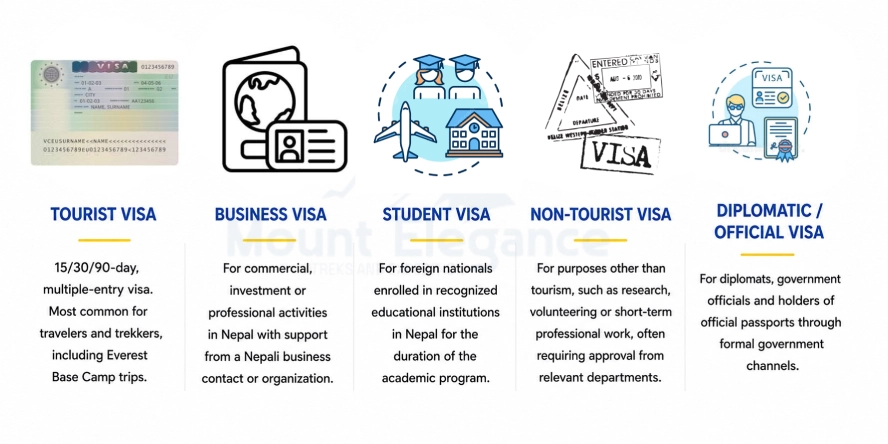
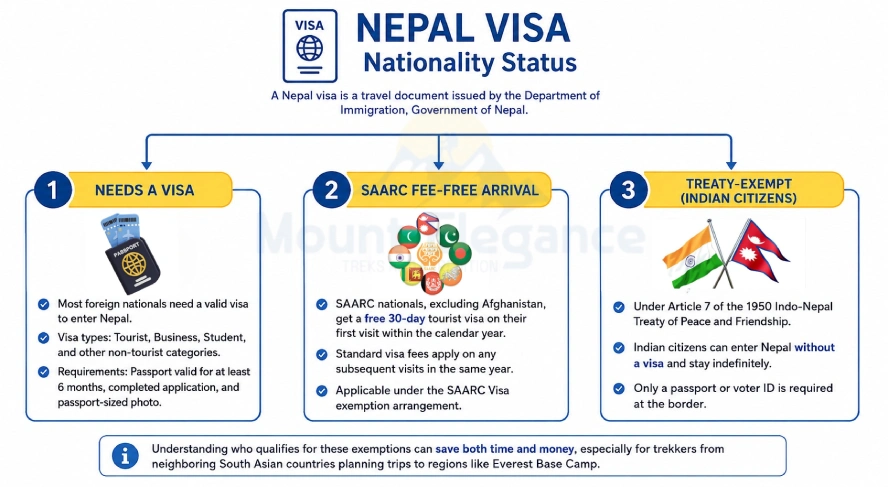
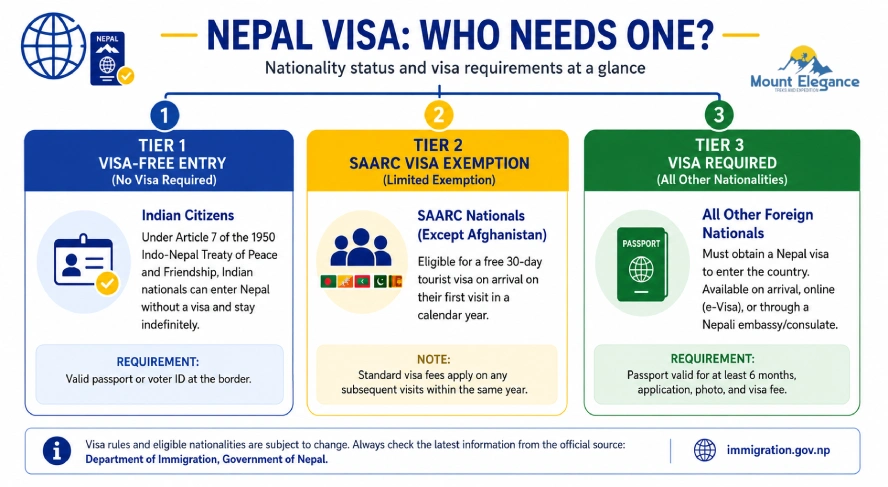
A Nepal visa is a travel document that the Department of Immigration, Government of Nepal, issues to foreign nationals who wish to enter the country, covering tourist, business, student, and other non-tourist visa categories depending on the purpose of travel. Most foreign nationals need a valid visa to enter Nepal, though Indian citizens are a major exception. Under article 7 of 1950 Indo-Nepal Treaty of Peace and Friendship, Indian nationals can enter Nepal without a visa and stay indefinitely, according to Nepal’s official visa policy needing only a passport or voter ID at the border.
SAARC nationals, excluding Afghanistan, receive a free 30-day tourist visa on their first visit within the calendar under the SAARC Visa exemption arrangement; standard fees apply on any subsequent visits that year. Beyond these exceptions, applicants generally need a passport valid for at least six months from their date of arrival in Nepal, along with a completed application and passport-sized photo. Understanding who qualifies for these exemptions can save both time and money, especially for trekkers from neighboring South Asian countries planning trips to regions like Everest Base Camp.
What Types of Nepal Visa Are Available?
Nepal issues several categories of visas, each designed for a different purpose of travel, from short-term tourism to long-term study or diplomatic work.
- Tourist visa (15/30/90-day, multiple -entry) - the most common type for trekkers and travelers, available in three duration options and allowing multiple entries within the visa period, commonly used for trips to regions like Everest Base Camp
- Business visa - issued to foreign nationals traveling to Nepal for commercial purposes, investment activities or professional meetings typically requiring supporting documentation from a Nepali business contact or organization
- Student visa - granted to foreign nationals enrolled in recognized educational institutions within Nepal, valid for the duration of the academic program with appropriate renewal requirements
- Non-tourist visa - covers a range of purposes outside standard tourism, such as - research, volunteering, or short-term professional work, often requiring additional approval from relevant government departments
- Diplomatic and official visa - reserved for diplomats, government officials, and holders of official passports, typically arranged through formal government channels rather than standard visa application processes
How Do You Apply for a Nepal Visa?
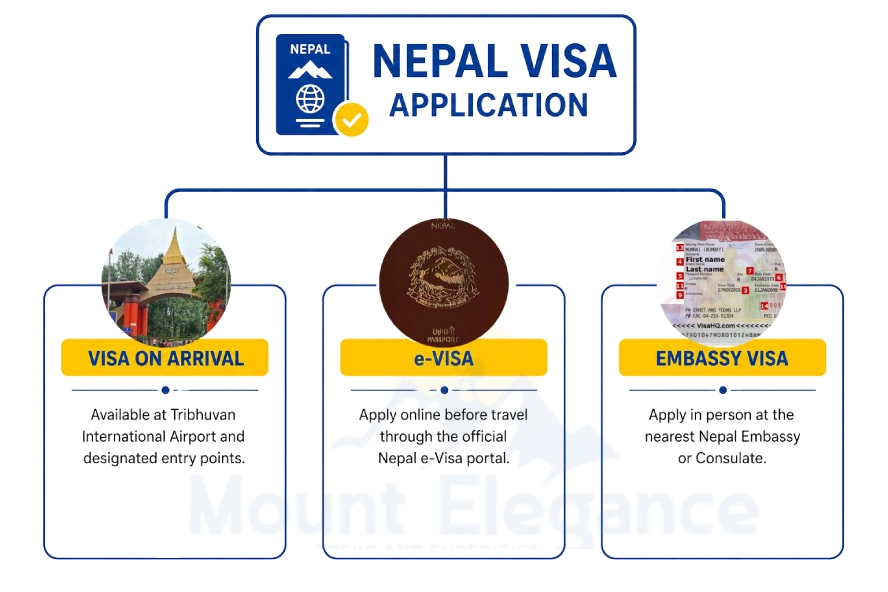
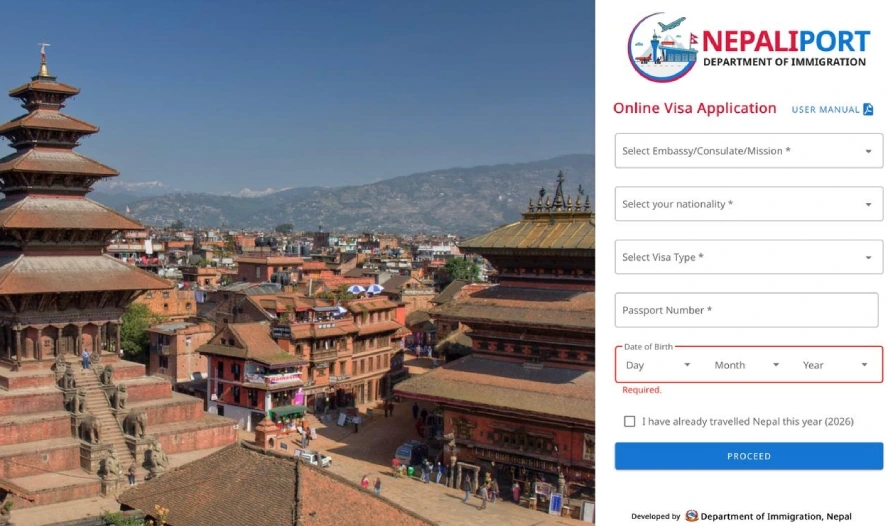
Trekkers and tourists apply for a Nepali visa through three main methods: visa on arrival, the online e-Visa system, or a visa arranged in advance through a Nepali embassy or consulate. According to Wikipedia’s Visa policy of Nepal - foreign citizens may obtain a visa on arrival which is good for multiple entries and allows visitors to stay for no more than 15, 30, or 90 days. This visa-on-arrival (recommended) option is available at Tribhuvan International Airport in Kathmandu as well as several land border crossing for those who prefer to sort things out before departure, the Department of Immigration’s online portal at nepaliport.immigration.gov.np offers a faster alternative to arrival processing. Each method comes with its own process, timing, and requirements, covered in more detail below - from what to expect at the airport counter, to how the e-Visa system works, to when an embassy visa makes more sense than applying on arrival.
How Does Nepal Visa on Arrival Work?
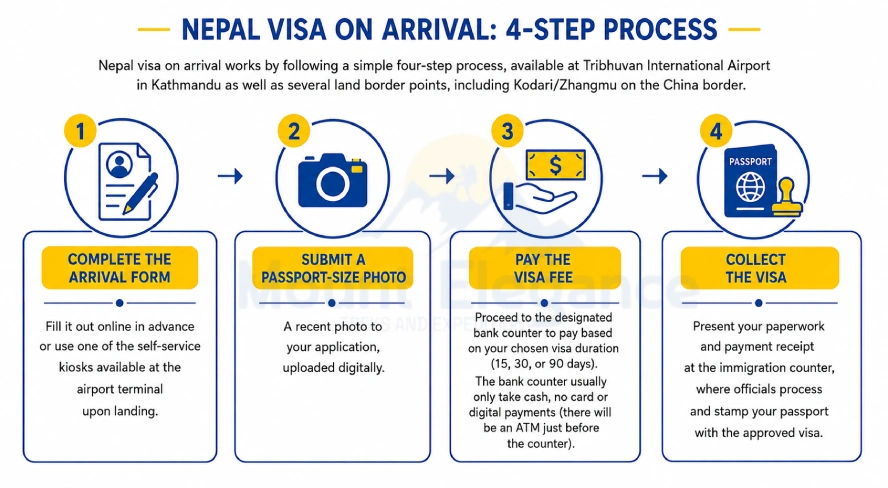
Nepal visa on arrival works by following a simple four-step process, available at Tribhuvan International Airport in Kathmandu as well as several land border points, including Kodari/Zhangmu on the China border.
- Complete the arrival form - fill it out online in advance or use one of the self-service kiosks available at the airport terminal upon landing
- Submit a passport-size photo - a recent photo to your application, uploaded digitally
- Pay the visa fee - proceed to the designated bank counter to pay based on your chosen visa duration, whether 15, 30, or 90 days, the bank counter usually only take cash, no card or digital payments (there will be an ATM just before the counter)
- Collect the visa - present your paperwork and payment receipt at the immigration counter, where officials process and stamp your passport with the approved visa
A Nepal e-Visa application requires trekkers to work through the Department of Immigration's official online portal ahead of their trip, streamlining what used to be a fully in-person process.
- Submit a passport scan and digital photo upload - applicants provide passport details along with a recent digital photo directly through the online form
- Complete the online payment step - fees are paid electronically as part of the application, depending on the chosen visa duration
- Receive a pre-approved barcode receipt - once submitted, the system generates a confirmation barcode, valid for a 15-day window before arrival, which travelers should print or save digitally
- Present confirmation on arrival - trekkers bring their printed or digital barcode receipt to the immigration counter at Tribhuvan International Airport, where an officer verifies the details and issues the physical visa stamp
How Do You Apply for a Nepal Visa at the Embassy?
A Nepal embassy visa application requires trekkers to work through their nearest diplomatic mission before traveling which can be a useful option for those who prefer to sort out their visa well in advance.
- Nearest Nepal embassy or consulate - applicants submit their visa request directly at the closest Nepali diplomatic mission in their home country
- 3-working-day standard processing time - most embassy visa applications take about three business days to process, though this can vary depending on the specific mission and current demand
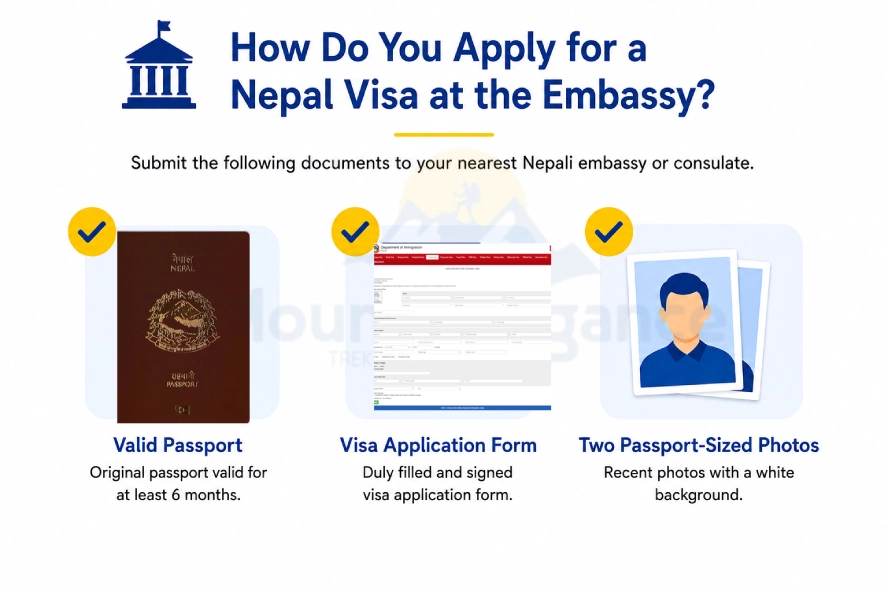
- Required documents - applicants must provide a valid passport, a completed application form, and two passport-sized photographs to complete the submission
- 6-month validity from date of issue - once approved, travelers must enter Nepal within six months of the visa's issue date, since the visa expires if unused beyond this window
What Are the Nepal Visa Fees in 2026?

Visa Type | Fee |
15-day visa | US$30 |
30-day visa | US$50 |
90-day visa | US$125 |
Multiple-entry surcharge | Additional US$25 |
SAARC nationals | Free 30-day visa on arrival |
According to the Department of Immigration’s - Nepal's standard tourist visa fees remain US$30 for 15 days, US$50 for 30 days, and US$125 for 90 days in 2026. While visas issued on arrival are generally multiple-entry by default, travelers arranging side trips through embassies or extensions sometimes face an additional US$25 surcharge to secure multiple-entry status.
Payment is accepted in several major currencies, including USD, EUR, GBP, JPY, CHF, AUD, CAD, HKD, and SGD, along with credit or debit cards at some airport counters, though cash in clean, undamaged bills remains the most reliable option, especially at land border crossings where card payments are less consistently available. SAARC nationals continue to receive a free 30-day visa on arrival for their first visit within a calendar year, making Nepal one of the more accessible countries in the region for regional travelers. Given how often fees and payment rules can shift, it's worth double-checking current rates directly with the Department of Immigration or a trusted travel agency shortly before departure.
How Long Is a Nepal Visa Valid, and Which Duration Should You Choose?
A Nepal visa stays valid for 15, 30, or 90 days, depending on which option a traveler picks when applying - whether that’s on arrival, online or through an embassy beforehand. No matter which you choose, Nepal caps total visa time at 150 days per calendar year, according to Wikipedia so multiple trips or extensions within the same year all have to fit inside that combined limit.
For most people doing a standard Everest Base Camp Trek - typically 12 to 16 days depending on the itinerary and acclimatization schedule - the 30-day visa tends to work best. It leaves enough room for the trek itself, plus a few extra days in Kathmandu before or after for sightseeing, picking up gear or just recovering it also buys a cushion for weather delays which happen a lot in the Everest region, especially with Lukla flights getting pushed back or rerouted thanks to poor visibility.
Going with the shorter 15-day visa is a bit of a gamble here, since even a minor delay could push you right up against expiration. The 90-day option gives plenty of flexibility, sure but it’s usually more than most EBC trekkers actually need unless they’ve got extra travel planned elsewhere in Nepal afterward.
Nepal Visa on Arrival vs e-Visa: Which One Should You Choose?
Nepal visa on arrival and the e-Visa differ in a few key ways, and choosing between them often comes down to how much a traveler values convenience versus flexibility.
Factor | Visa on Arrival | e-Visa |
Application location | Airport or land border counter | Online portal, completed before departure |
Processing time | Immediate, processed on the spot | Pre-approved barcode generated in advance |
Queue time | Can be longer during peak season, especially with multiple flights landing close together | Generally shorter, since paperwork is already submitted |
Best for | Undecided travelers who haven't finalized exact travel dates | Travelers who want to skip most of the airport queue |
Reliability | Depends on how well-staffed the counter is at the time | Depends on the online portal staying functional and accessible |
Both methods ultimately lead to the same result - a valid visa stamp allowing entry into Nepal - but the process leading up to that stamp looks quite different. Travelers who like flexibility or aren’t fully locked into their itinerary may prefer arriving without pre-registeration, while those who want to minimize time spent standing in line often lead toward completing the e-visa process ahead of time instead.
What Documents Do You Need for a Nepal Visa?
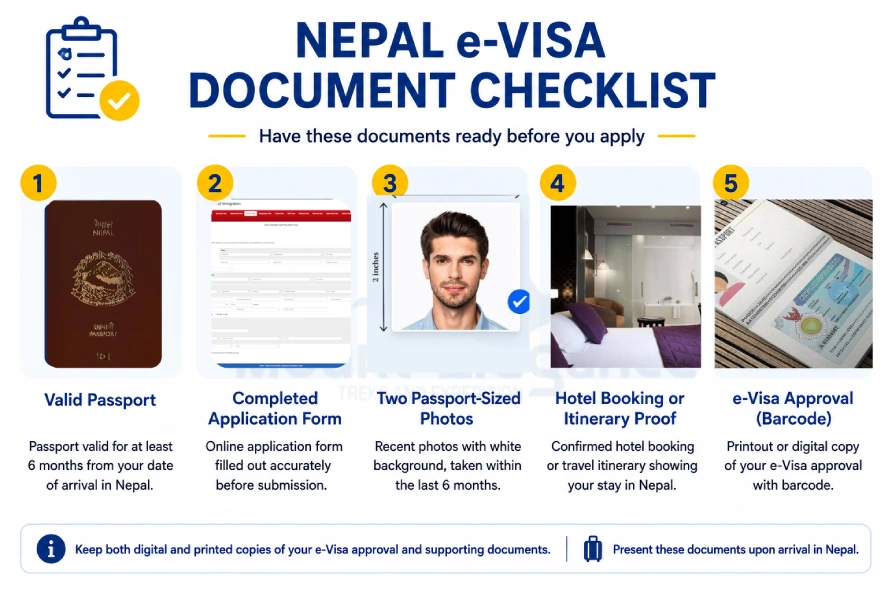
A Nepal visa application requires a set of standard documents, with slight variations depending on whether you're applying on arrival or through the e-Visa system.
- Valid passport with 6+ months validity and 2 blank pages - required for all applicants, ensuring enough space for entry stamps and remaining validity well beyond the visa's duration
- Completed visa application form - filled out either online in advance or on a kiosk at the airport upon arrival
- 2 passport-size photos - standard requirement for most application methods, though some digital processes accept a photo upload instead
- Hotel reservation or itinerary proof - occasionally requested for visa on arrival applicants, particularly during spot checks or when travel plans appear incomplete
- Printed e-Visa barcode confirmation - required specifically for e-Visa applicants, who must present this confirmation at the immigration counter to complete the final stamping process
Which Countries Are Exempt From a Nepal Visa?
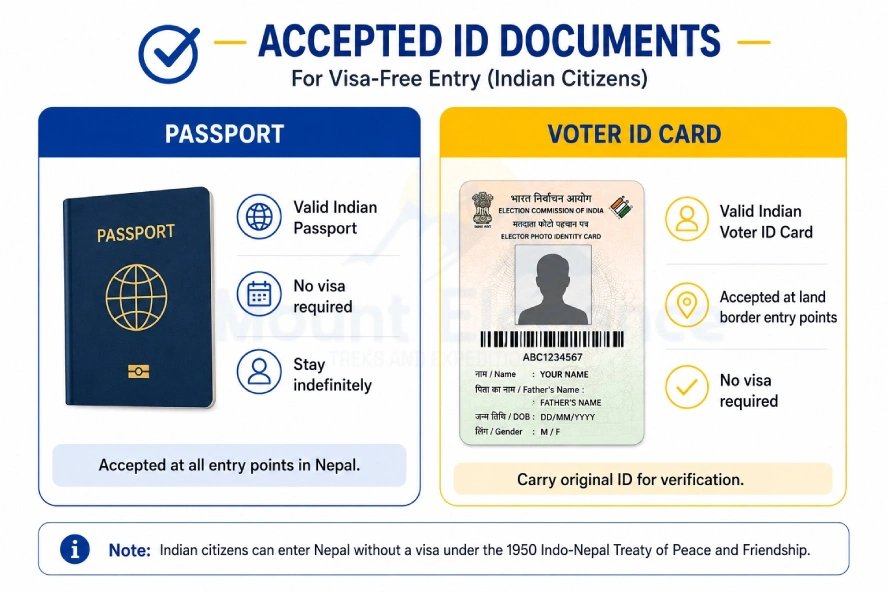
Nepal exempts a handful of traveler categories from the standard visa fee structure, making entry considerably easier for citizens of certain neighboring and diplomatic categories. Indian citizens enjoy full visit-free entry under the 1950 Indo-Nepal Treaty of Peace and Friendship, allowing them to enter and stay in Nepal without any visa requirement at all. SAARC nationals with the notable exception of Afghanistan, receive a free 30-day visa on arrival for their first visit within a calendar year, though standard fees apply on any additional visits afterward. Diplomatic and official passport holders from specified countries also benefit from exemptions, typically allowed to stay up to 90 days without needing to pay standard visa fees provided they meet the relevant diplomatic criteria. Each of these exemption categories comes with its own specific conditions and documentation requirements, covered in more detail below - from exactly how Indian citizens can verify their exemption at the border to which SAARC countries qualify, to how diplomatic passport holders confirm their status upon arrival in Nepal.
Do Indian Citizens Need a Visa for Nepal?
Indian citizens do not need a visa for Nepal because Article 7 of the 1950 treaty guarantees reciprocal free movement between the two countries, according to wikipedia. This long-standing agreement allows citizens of both nations to travel freely across the shared border without needing formal visa documentation, reflecting the close historical and cultural ties between India and Nepal. At entry points, Indian travelers can present either a valid Indian passport or an Election Commission Voter ID card as proof of identity, both of which are accepted in place of a visa. This arrangement makes Nepal one of the most accessible international destinations for Indian citizens, whether traveling for tourism, business or trekking purposes like the Everest Base Camp route since there’s no visa fee, application process or advance approval required before crossing the border.
Do SAARC Nationals Need a Nepal Visa?
SAARC nationals get a free 30-day visa on arrival,SAARC member states - Bangladesh, Bhutan, Maldives, Pakistan, and Sri Lanka - Indian citizens already travel visa-free under separate treaty terms. Afghanistan is excluded from this free scheme, according to the SAARC Visa Exemption arrangement, meaning Afghan nationals must apply and pay standard visa fees like other non-SAARC travelers. Eligible SAARC nationals can access this free visa through the exact same airport and land-border counters used for standard visa on arrival processing, with no separate application system required. It's worth noting this free visa applies once per calendar year; any additional visits within that same year revert to standard paid visa rates.
How Do You Extend a Nepal Visa?
A Nepal visa extension happens at a couple of official locations, and the process is fairly straightforward as long as it's handled before the current visa expires.
- Department of Immigration offices in Kathmandu and Pokhara - both cities host official immigration offices where travelers can submit extension paperwork in person
- US$3 per day for up to 30 additional days - standard daily extension rate applied to short-term extensions requested within this range
- Roughly US$45-50 per month beyond the first extension block - according to competitor extension-fee tables consistent across viewnepaltreks.com and himalayanpartner.com, longer extensions tend to average out to this monthly rate once the initial block is exceeded
- US$5 per day overstay fine beyond the extension window - travelers who let their visa lapse without properly extending face this daily penalty, which can add up quickly if left unresolved
- 150-day maximum stay per calendar year, even after extension - regardless of how many extensions a traveler applies for, total time in Nepal cannot exceed 150 days within a single calendar year
What Are the Most Common Nepal Visa Mistakes to Avoid?
The most common Nepal visa mistakes include a handful of avoidable errors that can slow down or complicate an otherwise smooth arrival process.
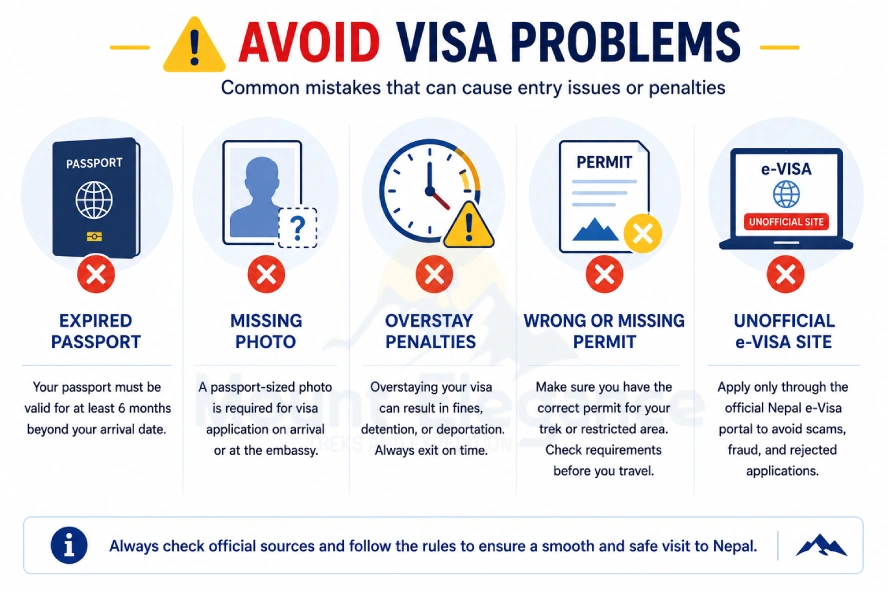
- Carrying insufficient passport validity - arriving with less than six months of remaining validity on a passport can lead to complications or outright denial of entry, so it's worth checking this well before booking flights
- Forgetting passport-size photos - showing up without the required photographs can create delays at the visa counter, since not every location has photo booths readily available
- Overstaying without an extension - letting a visa lapse without formally extending it results in daily overstay fines that accumulate quickly and can complicate future travel
- Confusing trekking permits with visa requirements - applying for the wrong permit alongside the visa, or assuming the visa alone covers trekking access, often catches travelers off guard once they reach regions like Everest Base Camp
- Using an unofficial e-Visa website - relying on third-party sites instead of the official Department of Immigration portal risks scams, overcharging, or invalid documentation that immigration officers won't accept
What Are the Nepal Visa Rules for Children and Minors?
Nepal visa rules for children require a few specific steps, even though the process is simpler in some ways than for adult travelers.
- Individual passport for every child, regardless of age - every child must carry their own valid passport, since Nepal does not permit entry on a parent's passport alone
- Same visa fee structure as adults for children above 10 years - once a child turns 10, standard tourist visa fees apply in full, following the same 15/30/90-day pricing tiers as adults
- Reduced or waived fee for children under 10 - according to the Department of Immigration's official FAQ page, the visa fee for a child under 10 years old is waived, except for United States citizens, so families should confirm current rules based on nationality before travel
- Parental consent documentation for minors traveling without both parents - children traveling with only one parent, a guardian, or independently often need a notarized consent letter from the absent parent or legal guardian to avoid complications at immigration
Which Permits Do You Need Alongside Your Nepal Visa for the Everest Base Camp Trek?
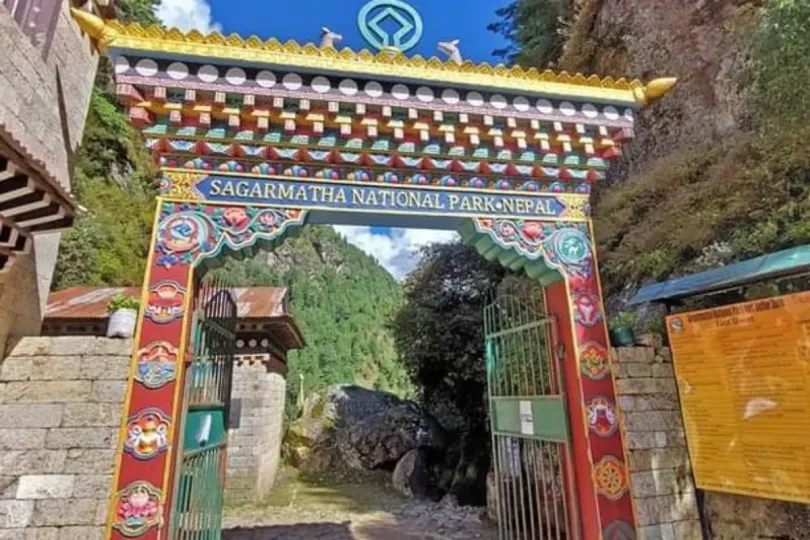
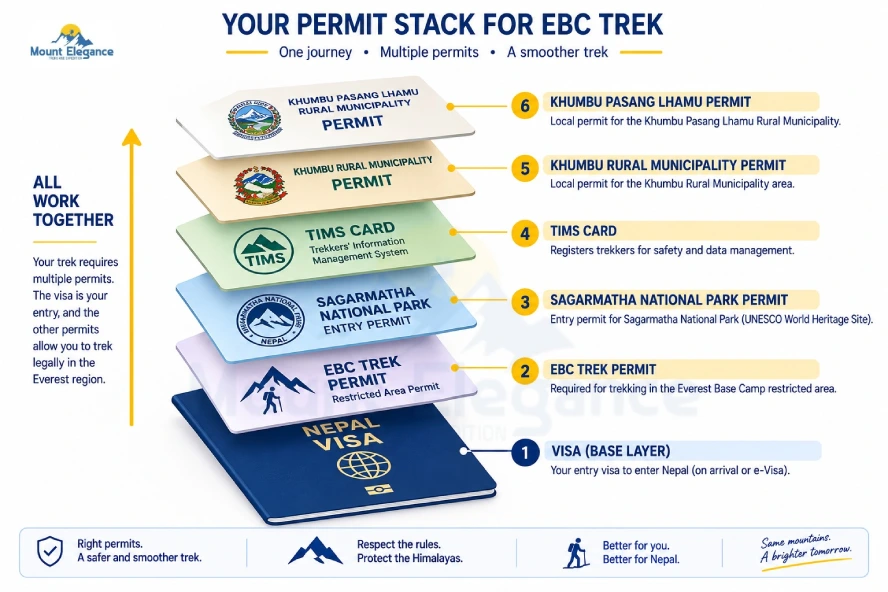
Alongside a Nepal visa, the Everest Base Camp Trek requires two mandatory local permits separate from any national-level visa or TIMS documentation. Trekkers need the Sagarmatha National park Permit, granting entry into this UNESCO-protected region, along with the Khumbu Pasang Lhamu Rural Municipality Permit, which covers local infrastructure and community development costs. Unlike most other trekking regions across Nepal, the Khumbu area doesn’t require a TIMS card, since these two local permits effectively replace it. Together, these documents form the complete permit requirement for any one trekking toward Everest Base Camp.
Do You Need an Everest Base Camp Trek Permit With Your Nepal Visa?
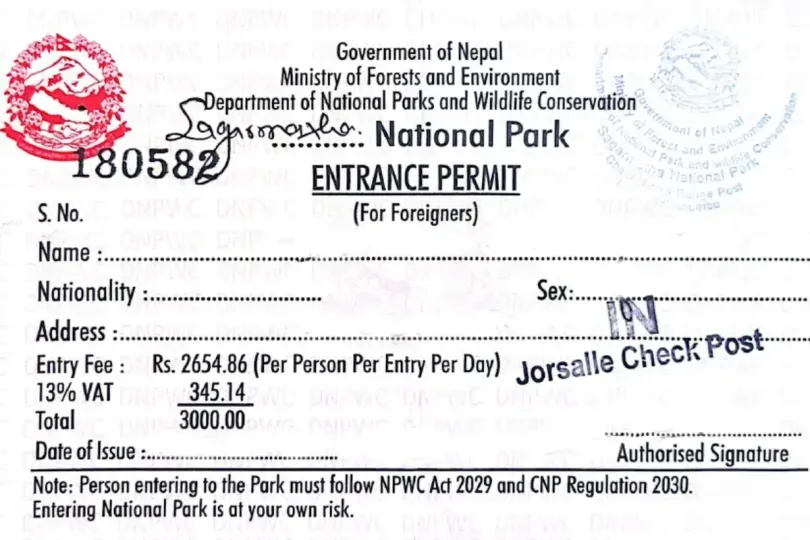
Yes, the Everest Base Camp Trek permit is required separately beyond the standard Nepal visa, since the visa only covers entry into the country, not access to protected trekking regions. This permit is issued at the Monjo checkpoint along the trail. According to the local checkpoint notice, foreign trekkers currently pay NPR 3000 for this entry document.
Do You Need a Sagarmatha National Park Permit for the EBC Trek?
Yes, the Everest Base Camp Trek requires a Sagarmatha National Park Permit, priced at NPR 3000 for foreign trekkers, excluding VAT, according to Nepal Tourism Board
And Sagarmatha National Park office. Trekkers can obtain this permit at the Monjo entry gate. It grants access to the park recognized as a UNESCO world Heritage Site since 1979.
Do You Need a TIMS Card Alongside Your Nepal Visa?
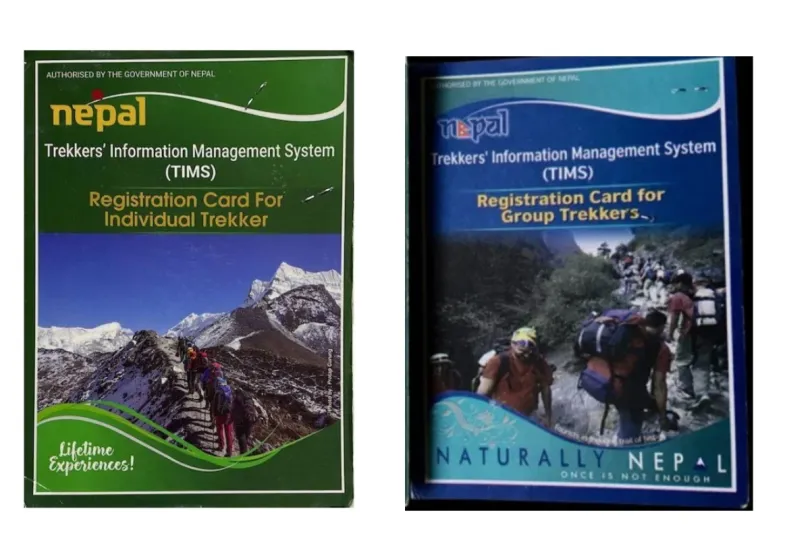
The TIMS card is not required for the Khumbu or Everest region, since local Sagarmatha National Park and Khumbu Pasang Lhamu Rural Municipality permits replaced it, according to the Nepal Tourism Board and (TAAN). This shift took effect in mid-2023. However, TIMS remains mandatory on other major routes, including Annapurna, Langtang, and Manaslu, so trekkers should confirm requirements based on their specific destination.
How Do You Get the Khumbu Rural Municipality Permit?
Trekkers get the Khumbu Rural Municipality Permit at either the Lukla or Monjo checkpoint, since it cannot be arranged in advance in Kathmandu. According to the Khumbu Pasang Lhamu Rural Municipality notice, the fee is NPR 2,000 per person. Applicants need a passport copy to complete the on-the-spot application process at either location.