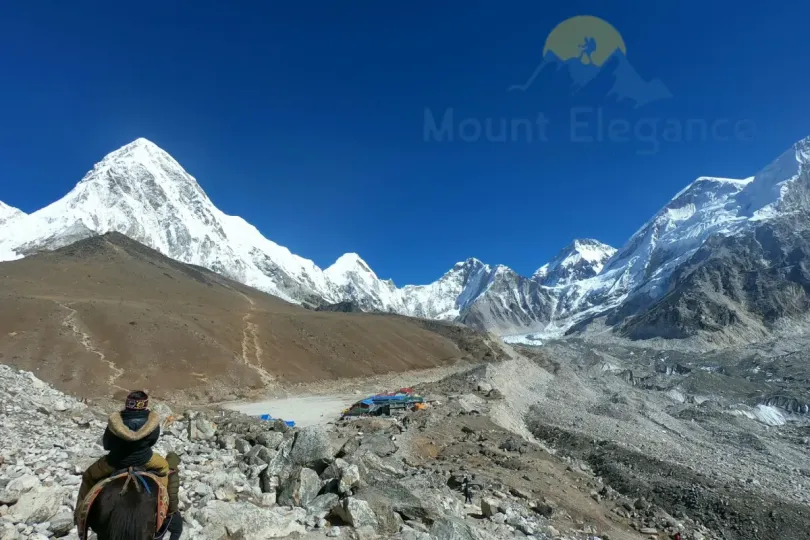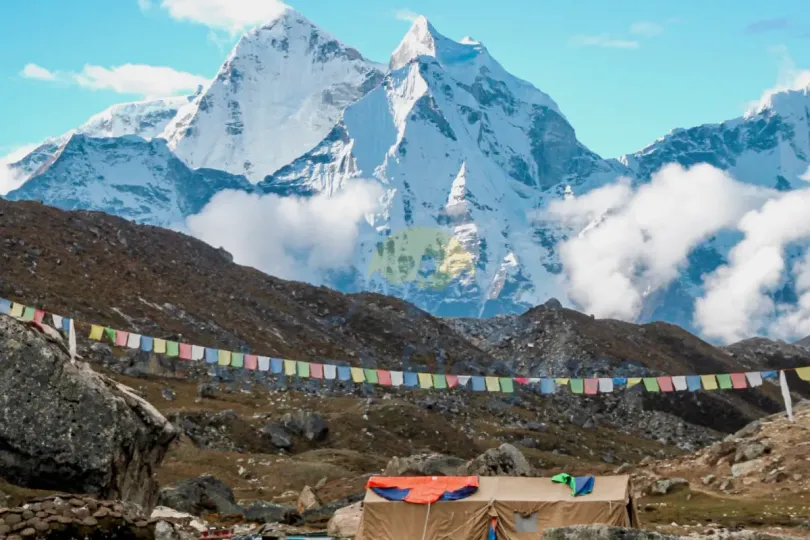
Kala Patthar is a black-rock viewpoint on Pumori’s south ridge in Nepal’s Everest region - it is famous for one thing: the closest unobstructed view of Mount Everest anywhere on the trail. Technically it's not even a proper mountain. With just 10 meters of prominence above Pumori’s shoulder, it’s really a subsidiary bump rather than a standalone peak. That hasn’t stopped it from becoming one of the most photographed spots in the entire Nepal Himalayas.
What makes Kala Patthar special isn't its height, but its angle. Sitting at 5644 meters it opens up a full uninterrupted view straight at Everest’s summit pyramid, something Base Camp cannot offer tucked as it is beneath the Khumbu Icefall. For most trekkers walking up from nearby Gorak Shep, this is also the highest point they’ll reach on the whole trip and worth noting the highest point most people ever reach without needing a formal climbing permit.
That mix, no technical climbing required, no permit beyond standard trekking paperwork, and arguably the best Everest viewpoint on the route, is exactly why Kala Patthar went from a minor bump on Pumori's ridge to a bucket-list stop in its own right.
Where Is Kala Patthar Located?
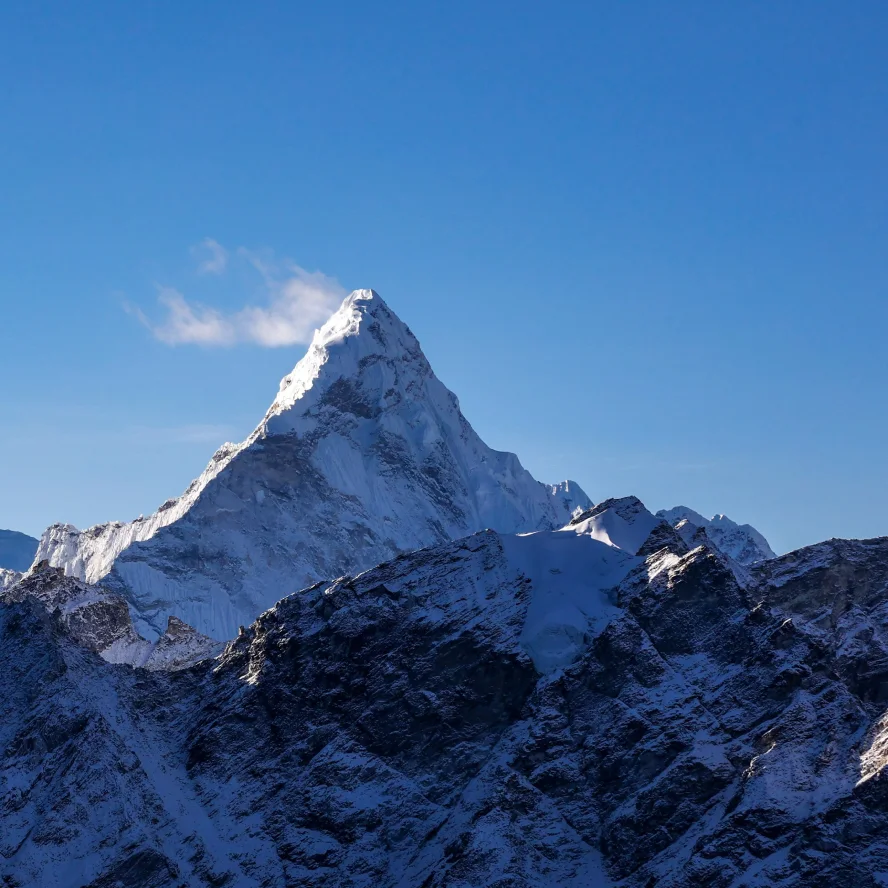
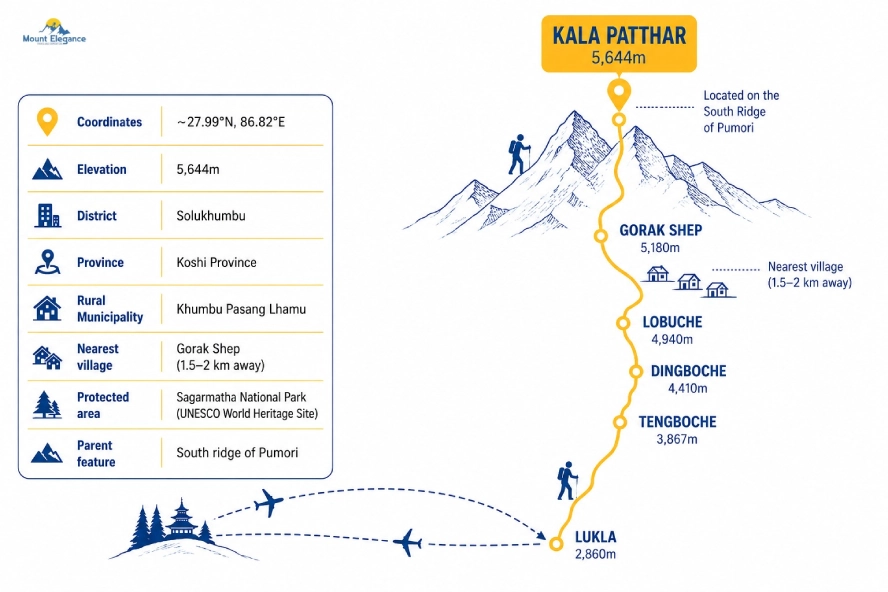
Kala Patthar sits on the south ridge of Pumori, roughly 1.5–2 km above Gorak Shep, inside Sagarmatha National Park in the Khumbu region of Nepal, at approximately 27.99°N, 86.82°E.
Detail | Information |
Coordinates | ~27.99°N, 86.82°E |
Elevation | 5,644m |
District | Solukhumbu |
Province | Koshi Province |
Rural Municipality | Khumbu Pasang Lhamu |
Nearest village | Gorak Shep (1.5–2 km away) |
Protected area | Sagarmatha National Park (UNESCO World Heritage Site) |
Parent feature | South ridge of Pumori |
What Does "Kala Patthar" Mean?
Kala Patthar translates to “Black Rock” in Nepali language, a straightforward name that describes exactly what the trekkers see when they look up at it. The name comes from the dark exposed rock and scree that make up the summit rock that stays black or charcoal-grey even when the surrounding peaks including Pumori - is blanketed in snow.
That contrast is actually what makes Kala Patthar so easy to pick out from a distance. Against the white backdrop of the Khumbu’s snow-capped giants its bare dark dark summit stands out as a clear visual landmark - one that gave rise to its name long before it became a trekking destination in its own right.
How High Is Kala Patthar?
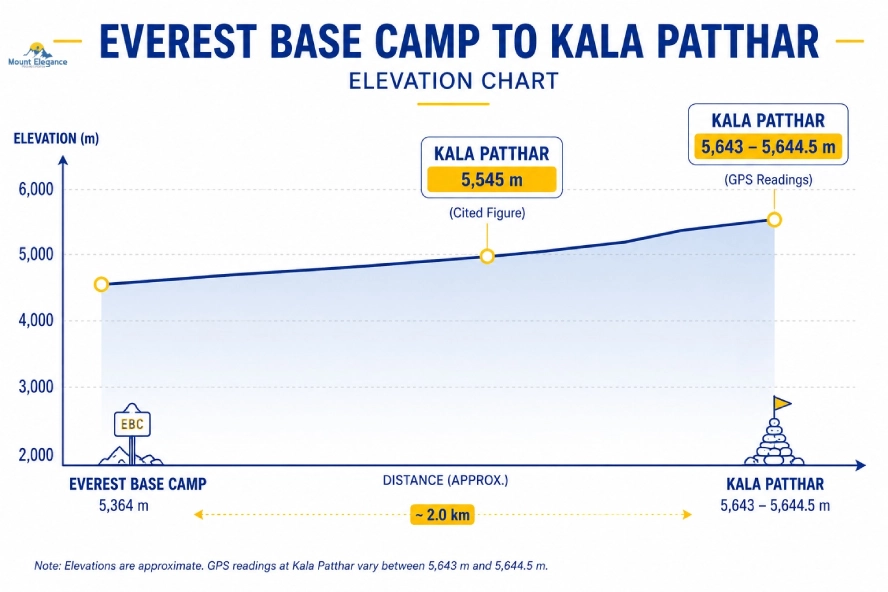
Kala Patthar elevation is commonly listed anywhere between 5545m and 5644m - a range that trips up a lot of trekkers researching the Everest Base Camp. Trek since most sources pick one number and never explain why it differs from the others.
The discrepancy comes down to the measurement method. GPS surveys conducted in December 2006 and October 2008 recorded readings of 5643m and 5644.5m respectively, figures generally considered more accurate given they were taken directly at the summit using modern positioning equipment. The older more commonly cited figure of 5545 predates these surveys and likely relies on older triangulation or mapping data that’s since been superseded.
Either way, Kala Patthar altitude stands roughly 180 to 280 meters above Everest Base Camp, depending on which elevation figure is used, making the short climb from Gorak Shep a meaningful final push in altitude even after days of trekking. Most guidebooks and trek operators simply quote one number without addressing why it doesn’t match others which is part of why so much confusion persists around Kala Patthar height.
Is Kala Patthar a Real Mountain?
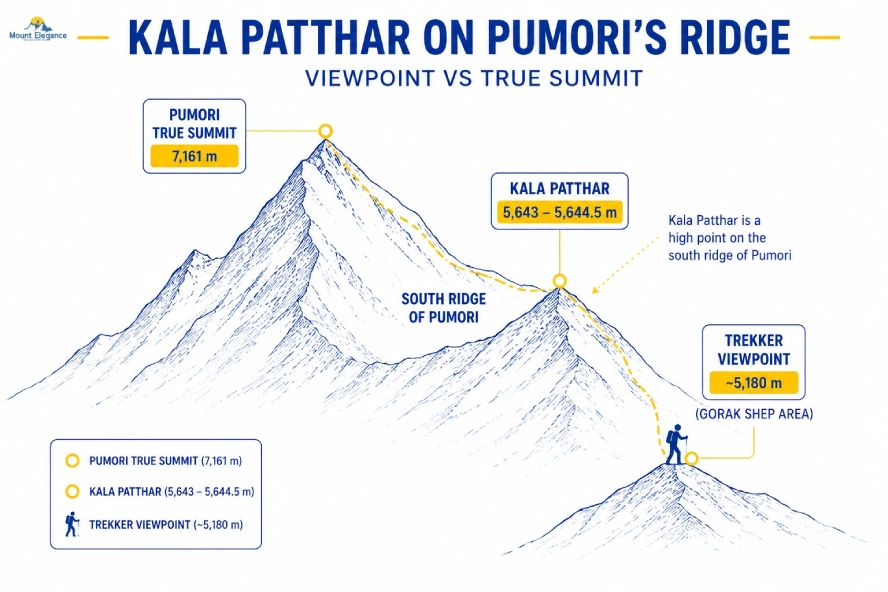
No - Kala Patthar has a topographical prominence of only 10 meters which means it doesn’t qualify as an independent mountain by standard geographic classification. It’s technically a high point on Pumori’s southern ridge rather than a separate peak.
There’s a further wrinkle most sources gloss over: the spot trekkers actually climb to be marked with prayer flags and treated as “ the summit” isn’t necessarily Kala Patthar’s true topographic high point. Because the ridge has multiple similar-looking rocky bumps the trail leads to a local maxima that offers the best accessible viewpoint and photo angle of Everest, rather than the absolute highest point on that stretch of ridge. Summit by tradition and convention even through it may not match the strict geographic definition.
This distinction between the traditionally marked summit and Kala Patthar’s actual topographic point is a detail that gets flattened or ignored across most trekking guides and travel sites which tend to treat the prayer-flag-marked viewpoint as simply “the top” without addressing the underlying prominence issue.
Why Does Kala Patthar Give a Better View of Everest Than Base Camp?
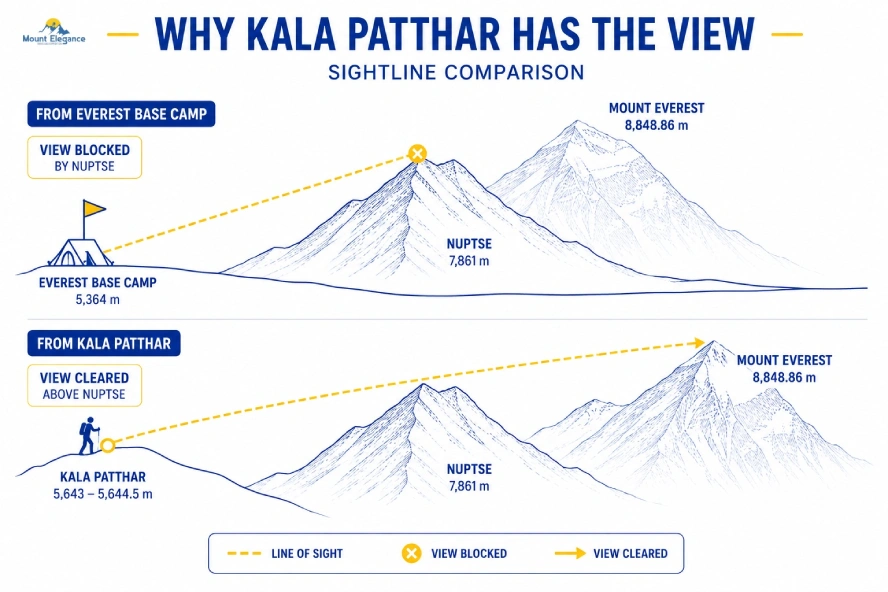
Nuptse blocks Everest's summit from Base Camp while Kala Patthar's higher ridge line clears that obstruction which is exactly why so many trekkers are surprised to learn they can't actually see Everest's peak from Base Camp itself.
Everest sits at the center of a massive surrounding massif, flanked by Nuptse to the southwest and Changtse to the north, and from the valley floor where Base Camp sits, Nuptse's towering wall rises directly in the sightline hiding Everest's summit almost entirely from view. Trekkers standing at Base Camp are technically closer to Everest in straight-line distance, but the angle and elevation simply don't allow a clear look at the top.
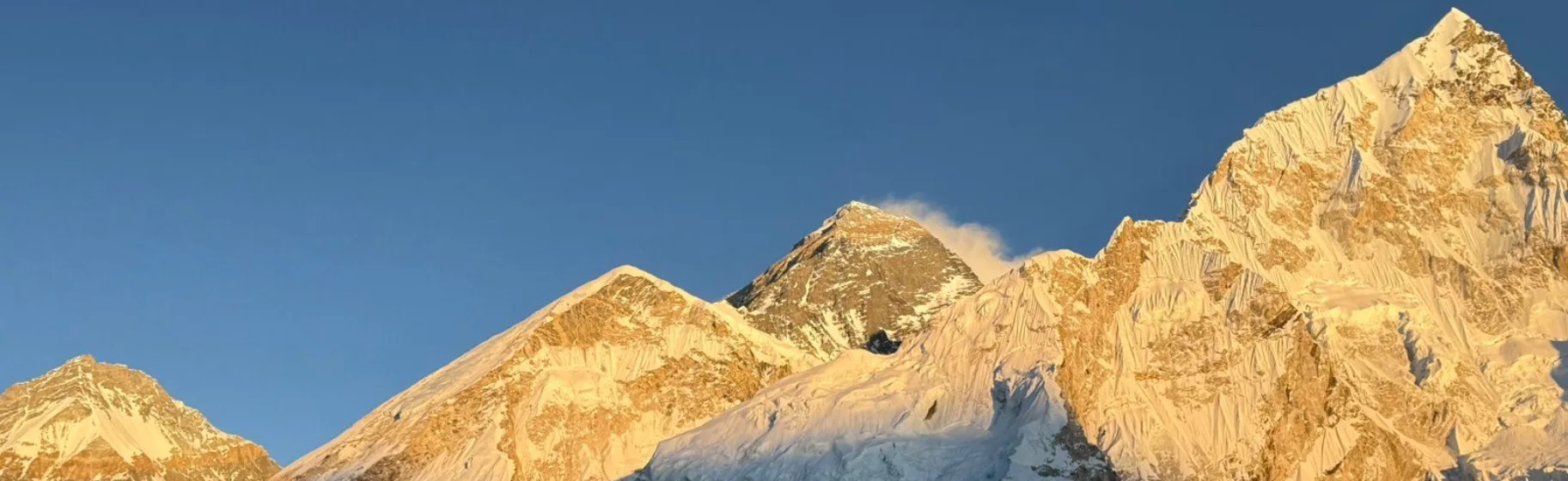
Kala Patthar solves that problem through elevation and positioning. Sitting significantly higher and at a different angle on Pumori's ridge it lifts trekkers above Nuptse's blocking sightline opening up a full unobstructed view straight at Everest's summit pyramid with Changtse visible further behind it. That's the real reason Kala Patthar, despite being farther from Everest than Base Camp in some respects, delivers the view most people actually came to see.
What Can You See From Kala Patthar?
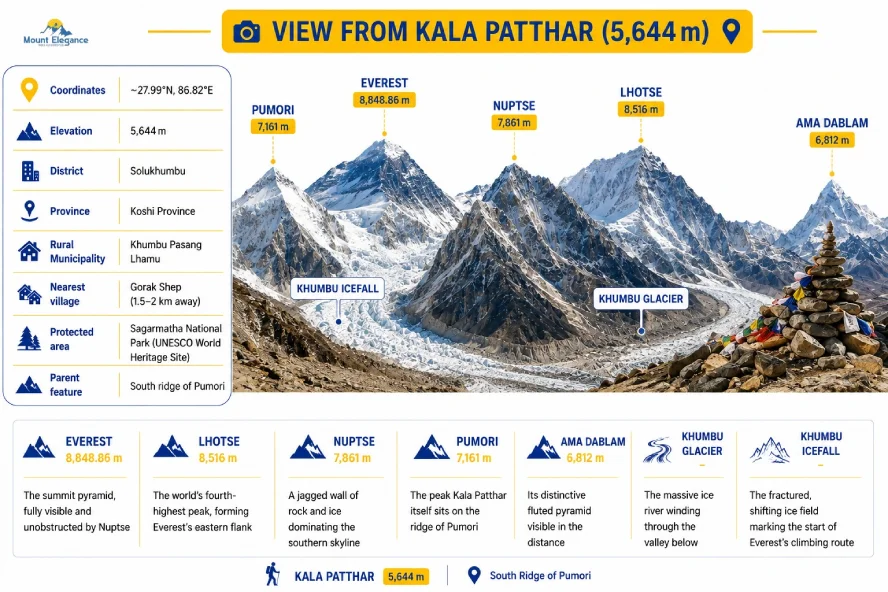
The headline view from Kala Patthar is an unobstructed look at Everest's summit and southwest face, framed by the surrounding giants of Lhotse, Nuptse, and Pumori. On a clear day, it's one of the most complete high-altitude panoramas anywhere on the Everest Base Camp Trek.
Feature | Elevation | What You See |
Everest | 8,848.86 m | The summit pyramid, fully visible and unobstructed by Nuptse |
Lhotse | 8,516 m | The world's fourth-highest peak, forming Everest's eastern flank |
Nuptse | 7,861 m | A jagged wall of rock and ice dominating the southern skyline |
Pumori | 7,161 m | The peak Kala Patthar itself sits on the ridge of |
Ama Dablam | 6,812 m | Its distinctive fluted pyramid visible in the distance |
Khumbu Glacier | — | The massive ice river winding through the valley below |
Khumbu Icefall | — | The fractured, shifting ice field marking the start of Everest's climbing route |
Is Sunrise or Sunset Better at Kala Patthar?
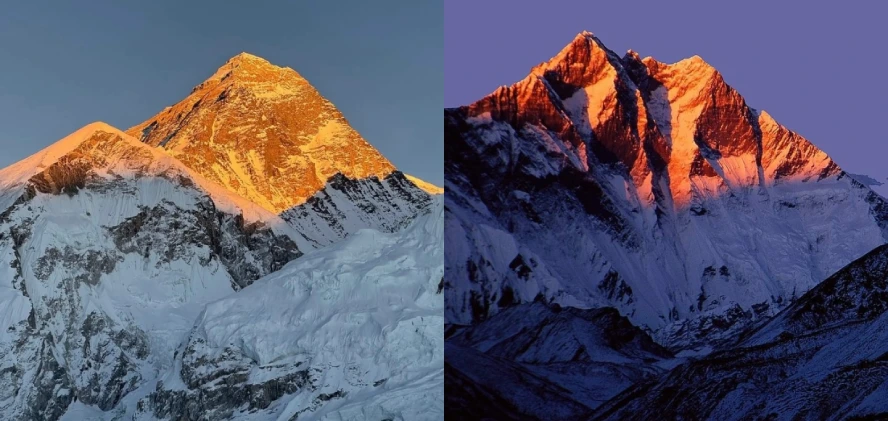
Sunrise is generally the better choice for clearer skies, since mountain weather tends to be calmer and less cloud-prone in the early morning before afternoon convection sets in. Sunset, on the other hand, offers warmer, more dramatic light for photography, though it comes with a higher chance of cloud cover rolling in from the valley. Most trekkers based in Gorak Shep opt for the pre-dawn climb, but the choice ultimately depends on weather conditions on the day and whether clear visibility or golden-hour color matters more to you.
Is Kala Patthar Better at Sunrise?
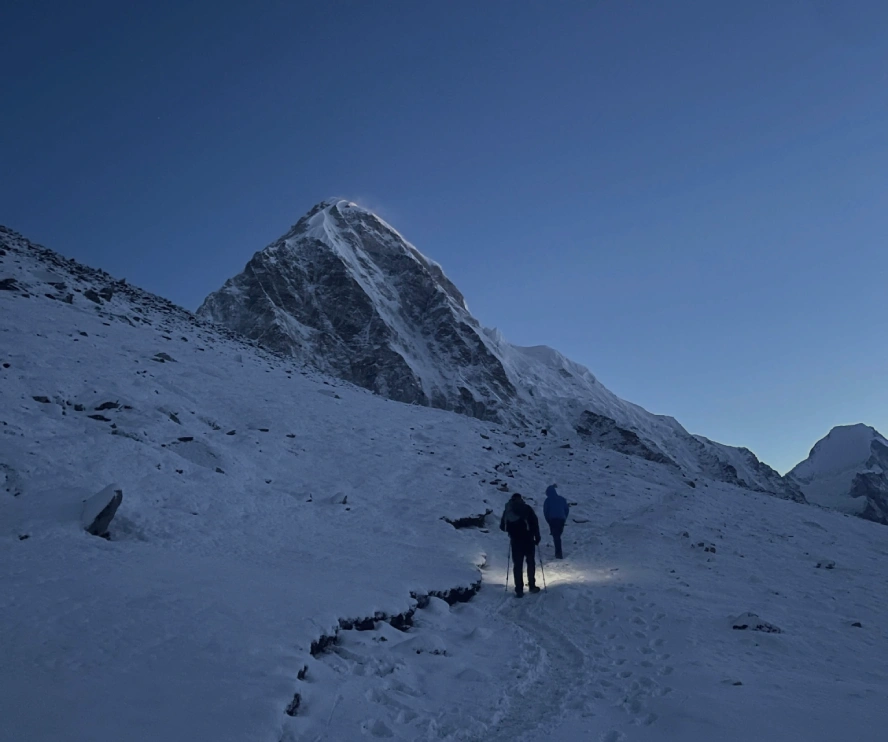
Yes for visibility - trekkers leave Gorak shep early around 4am usually since skies are typically clearest before mid-morning cloud buildup sets in. First light bathes Everest, Lhotse and Nuptse in a warm golden glow. Extreme pre-dawn cold and a headlamp-lit climb in the dark.
Is Kala Patthar Better at Sunset?
Sunset is quieter and better for photography but afternoon cloud buildup makes clear views less reliable than sunrise. Warm, low-angle light casts dramatic shadows across Everest and Nuptse and with fewer trekkers on the ridge it’s a calmer climb. Descending back to Gorak Shep in the dark afterward.
How Difficulty Is the Hike to Kala Patthar?
The hike to Kala Patthar is moderately difficult to challenge. No technical climbing skill is required but the combination of high altitude and a steep, rocky final ridge makes it physically demanding even for otherwise fit trekkers.
The biggest factor isn’t the terrain but the thin air at 5644m oxygen available is roughly half of what it is at sea level, which turns even a short steady climb into a slow breathless slog for many people. Add loose scree, a cold pre-dawn or late-afternoon start and a summit ridge steeper than most of the surrounding trail and it's easy to see why so many trekkers describe this as the hardest few hours of the entire Everest Base Camp Trek.
The main way to manage the risk is proper acclimatization earlier in the itinerary, particularly the built-in rest days at Namche Bazaar and Dingboche which give the body time to adjust before tackling Kala Patthar’s altitude and gradient.
How Long Does the Hike to Kala Patthar Take?
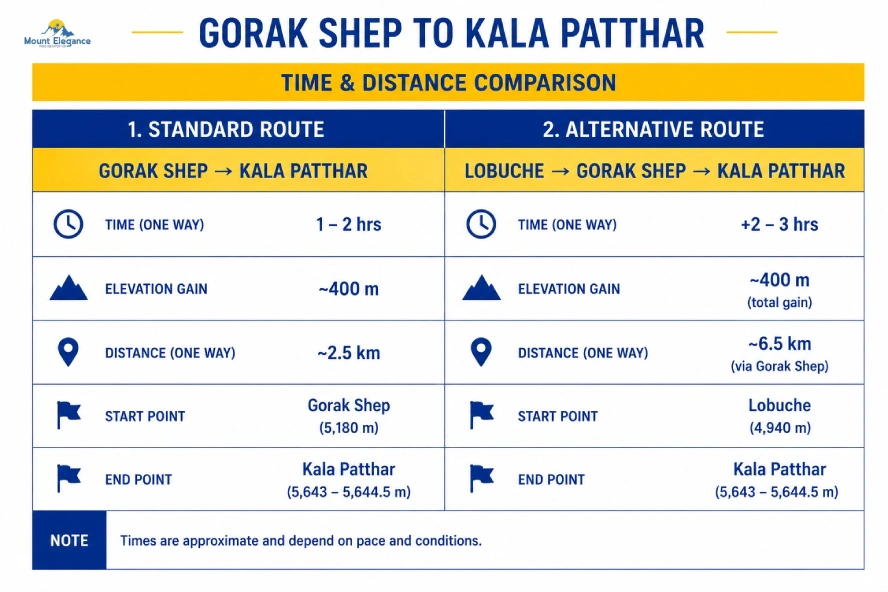
The hike to Kala Patthar takes roughly 1 to 2 hours to ascend from Gorak Shep covering about 400m of elevation gain over roughly 2km of trail. The descent back down is much quicker, typically 30 to 40 minutes thanks to the loose scree and steady downhill grade.
Pace varies a lot here depending on acclimatization and fitness; some trekkers reach the top in under an hour while others feel the altitude take closer to two.
For those starting from Lobuche instead of Gorak Shep - a less common but sometimes-used variant the hike takes considerable longer - add roughly 2 to 3 extra hours one way since Lobuche sits further down the valley and requires covering more distance and elevation before even reaching Gorak Shep’s usual starting point.
Can Helicopters Land at Kala Patthar?
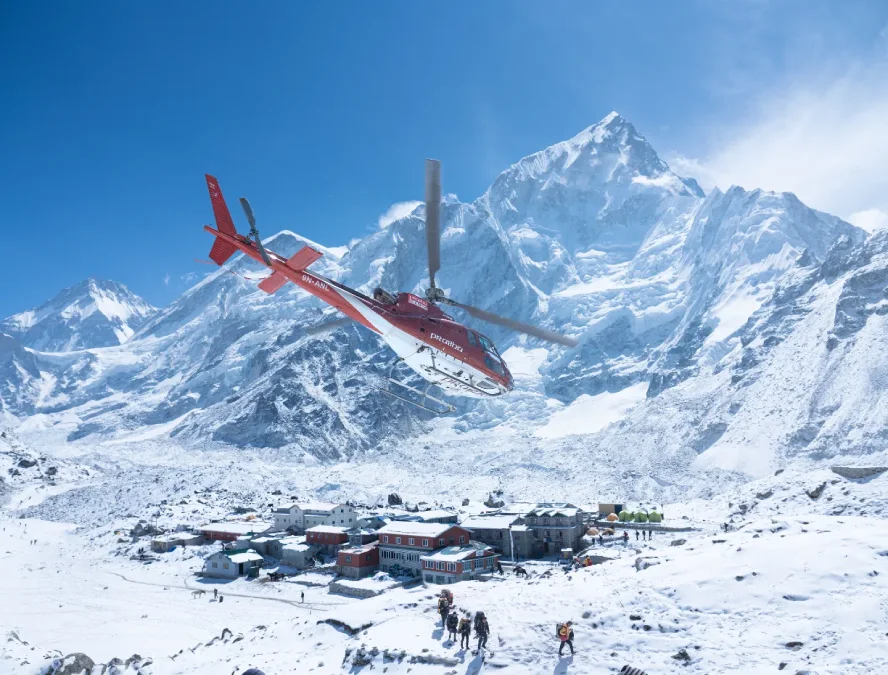
Yes - commercial helicopters may fly over Kala Patthar and Everest Base Camp, offering aerial views and photo passes and they’re able to land from either location.
For travelers hoping to combine helicopter access with an Everest view the usual alternative is Hotel Everest View near Syangboche, a short flight from Kathmandu or Lukla which sits at a lower, permitted landing altitude and offers panoramic Everest views without requiring a Kala Patthar trek. It’s a popular option for those short on time or unable to handle the high-altitude hike themselves.
Do You Need a Permit to Visit Kala Patthar?
Yes - a Sagarmatha National Park entry permit and a Khumbu Pasang Lhamu Rural Municipality Trek-Card are both required to visit Kala Patthar, since the route passes entirely through protected and locally managed areas.
Permit | Fee |
Sagarmatha National Park Entry Permit | NPR 3,000 per person |
Khumbu Pasang Lhamu Rural Municipality Trek-Card | NPR 2,000 per person |
When Is the Best Time to Visit Kala Patthar?
The two best windows to visit Kala Patthar are spring ( march-may ) and autumn ( september-november) both offering stable weather and clear mountain visibility. Conditions change sharply by season, especially at 5644 meters.
Season | Weather | Description | Typical Day–Night Temperature Range |
Spring | Clear and dry | Excellent visibility, mild afternoons, and cold early mornings | -5°C to 8°C day / -15°C to -5°C night |
Summer–Monsoon | Wet and cloudy | Frequent rain, cloud cover, and reduced mountain visibility | 0°C to 10°C day / -5°C to 2°C night |
Autumn | Clear and stable | Crisp skies, dry trails, and excellent Everest views | -5°C to 8°C day / -15°C to -5°C night |
Winter | Cold and dry | Snow, freezing winds, and shorter trekking windows | -10°C to 2°C day / -25°C to -10°C night |
Spring and autumn are generally preferred because skies improve views from the summit, while winter requires stronger cold-weather preparation and monsoon conditions can obscure the mountains.
How Is Kala Patthar Different From Other Everest Region Viewpoints?
Kala Patthar is the closest most direct Everest viewpoint on the classic route, but four other named viewpoints offer real trade-offs worth considering. The comparison below highlights how each option differs in elevation, Everest views and the type of traveler or itinerary it suits.
Viewpoint | Elevation | Everest View | Best For |
Kala Patthar | 5,644 m | Close, dramatic panorama | Classic EBC trekkers |
Everest Base Camp | 5,364 m | Everest is partly obscured | Reaching the iconic destination |
Gokyo Ri | 5,357 m | Broad, distant mountain panorama | Longer, quieter itineraries |
Chhukung Ri | 5,550 m | Different views of Lhotse and Makalu | Three Passes trekkers |
Everest View Hotel | 3,880 m | Distant Everest views | Low-effort or helicopter travelers |
Is Gokyo Ri a Better Alternative to Kala Patthar?
Gokyo ri gives a broader and quieter panorama with the turquoise Gokyo Lake but Everest appears more distant than from Kala Patthar. Gokyo ri sits on a different branch of the Khumbu trekking reaching via the Gokyo route or connected through Cho La Pass so choosing it usually requires an extended itinerary rather than a simple add-on.
Is the Everest View Hotel a Substitute for Kala Patthar?
Only for travelers who want a distant Everest view without high-altitude trekking—the Everest View Hotel near Syangboche sits far lower at around 3,880 m and skips the demanding climb entirely. It is a low-effort alternative rather than a like-for-like substitute making it useful for helicopter-tour travelers who cannot or do not want to trek as far as Gorak Shep and Kala Patthar.
How Does Chhukung Ri Compare to Kala Patthar?
Chhukung Ri offers a different angle on Lhotse and Makalu and suits trekkers following extended Everest-region or Three Passes routes but it is not part of the classic Everest Base Camp itinerary like Kala Patthar. It is a better choice for repeat Everest-region trekkers seeking a new viewpoint and a longer, more challenging route rather than first-time EBC trekkers.
Can Beginners Hike Kala Patthar?
Yes, beginners can hike Kala Patthar with proper acclimatization and a steady pace. No technical climbing skills are required here but the trail is physically demanding because of the high elevation and cold temperature with a steep final ascent. Previous trekking experience is less important if you have a good fitness level allowing your body enough time to adjust. Rest and acclimatization days at Namche Bazaar and and dingboche are important parts of the journey and can make a major difference in how well beginners cope with the increasing altitude. Beginners should train with regular simple exercises like walking - uphill hiking or stair climbing before the trek and avoid rushing the ascent. Listening to your body and descending when symptoms are worse are essential for safe climbing.
What Should You Pack for Kala Patthar?
Layered clothing for a sub-zero pre-dawn climb is the most important essential when preparing for Kala Patthar as temperatures can drop sharply before sunrise and change quickly during the hike because here the weather cannot be predicted so preparing properly is very important.
- Layered clothing to manage cold temperatures while adjusting as your body warms during the climb.
- Warm accessories including gloves, a warm hat and neck protection for exposed hands and face.
- Headlamp with spare batteries because many climbs begin before daylight and cold conditions can drain battery power.
- Trekking poles to provide extra balance and reduce strain on steep or uneven sections.
- UV400 sunglasses and sunblock, to protect against strong high-altitude sunlight and reflected glare.
- Water and snacks to maintain hydration and energy during the demanding climb.
Is Altitude Sickness a Risk at Kala Patthar?
Yes at over 5,500 meters oxygen availability is half of sea-level conditions and altitude sickness can affect fit and inexperienced trekkers alike. Early symptoms include headache, nausea, dizziness, fatigue and loss of appetite Severe warning signs such as - confusion, loss of coordination, coughing pink froth or blue-tinged lips require immediate descent and urgent medical attention.
To reduce the risk:
- Follow a gradual and slow ascent schedule by including planned acclimatization days.
- Drink enough fluids and eat regularly even if your appetite is reduced.
- Avoid alcohol and sleeping pills at high altitude.
- Do not continue climbing if symptoms worsen - descend to a lower altitude instead.
How Do You Reach Kala Patthar?
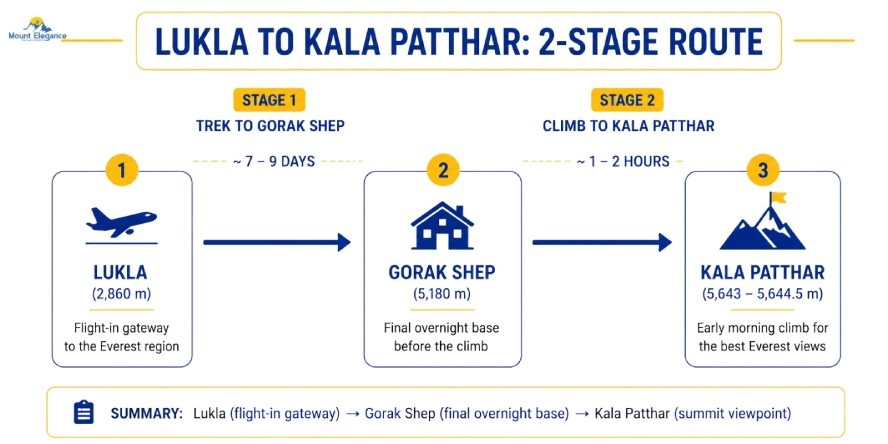
Almost all the trekkers reach Kala Patthar on foot via the classic Everest Base Camp trek route - beginning with a flight into lukla the main gateway to the Everest region - from Lukla trekkers follow the establishment himalayan trail towards Gorak Shep- the final overnight base before the climb. Most hikers stay in Gorak Shep before making the steep ascent to Kala Patthar often starting early in the morning for sunrise or later in the day for sunset views. This final climb is usually completed without any technical climbing equipment but the high altitude and steep trail can make the ascent physically demanding.
What Stops Does the Everest Base Camp Route Pass on the Way to Kala Patthar?
The standard route runs from Lukla to Phakding from here you will continue your journey to Namche Bazaar as your acclimatize stop so that you can be familiar with the elevation gain the next day you will head towards Tengboche here you will stay over night and the next day you will trek towards Dingboche, with an overnight stay here you will again start you trek to Pangboche/Pheriche with no staying and continue towards Lobuche making your next overnight stay at Gorak Shep the early climb next morning for unobstructed view of Everest from Kala Patthar and each stop below has its own role in acclimatization as daily trekking access and preparing trekkers for the higher elevations ahead. This classic Everest Base Camp route follows a gradual progression through Sherpa villages, mountain valleys and high-altitude settlements before reaching Gorak Shep, the final overnight base for the Kala Patthar hike.
Is the Everest Base Camp Route the Only Way to Reach Kala Patthar?
Yes, for trekkers the Everest Base Camp route is the only route to Kala Patthar covering the journey from Lukla through Namche Bazaar, Dingboche, Lobuche and gorak shep. The trail approaches Kala Patthar from Gorak Shep making it the sole practical access point on foot; the only alternative is a non-landing helicopter flyover.
What Role Does Namche Bazaar Play on the Way to Kala Patthar?
Namche Bazaar is the trek's main acclimatization hub, where trekkers spend a mandatory rest day before continuing toward Kala Patthar. It is also the last major town with full services - including banks, gear shops and bakeries before the route enters the higher-altitude stretch of the Everest region.
Why Do Trekkers Stop in Pangboche Before Kala Patthar?
Pangboche is a gradual altitude way-point on the Everest trail, offering trekkers a cultural stop and a chance to rest before continuing towards Dingboche and eventually Kala Patthar. The village is also home to one of the Khumbu region's oldest Buddhist monasteries making it an important cultural highlight of the journey.
How Far Is Lobuche From Kala Patthar?
Lobuche at 4940 meters is the last overnight stop before Gorak Shep and lies roughly 5-6 kilometers from Kala Patthar depending on the routes and trail measurement, if continuing directly from Lobuche, the journey to Kala Patthar passes through Gorak Shep. For the 2 to 3 hour lobuche variant - see the "how long does the hike take" main content H2.