
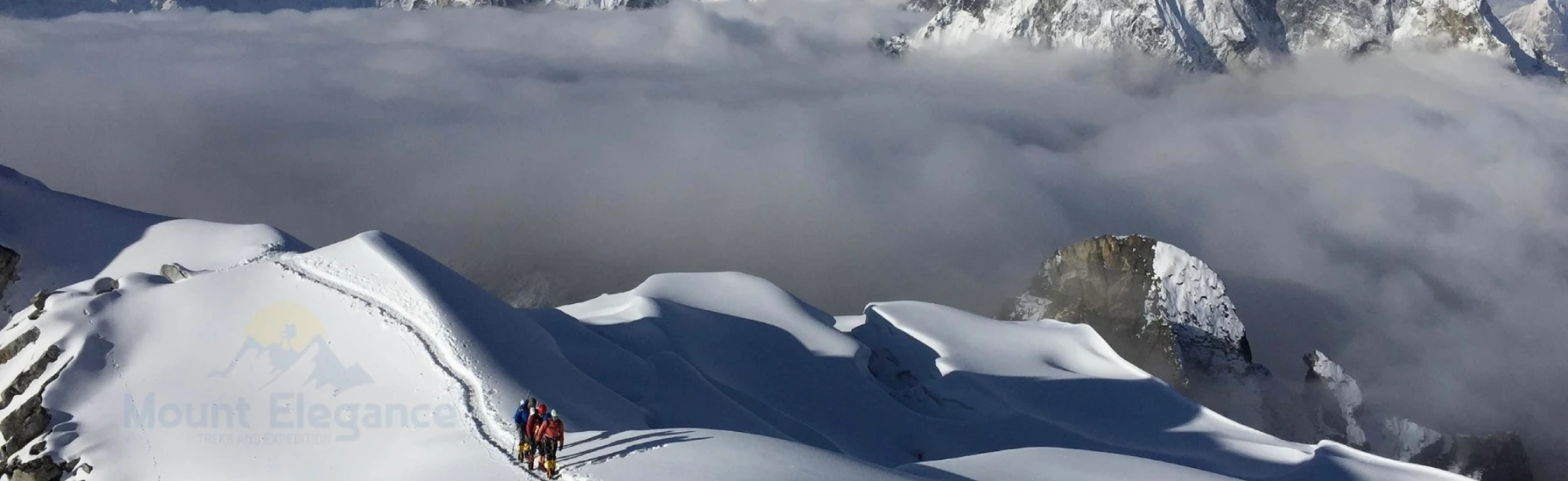
Lobuche Peak is a 6,119-meter trekking peak in Nepal's Khumbu region with two summits East and West and is classified as a trekking peak by the Nepal Mountaineering Association (NMA). Lobuche refers to the mountain as a whole - while Lobuche East is the commonly climbed 6,119-meter summit and Lobuche West is a separate more technical summit. This being the main Everest trail and its substantial altitude it is widely utilized by expedition teams to complete high-altitude rotation before attempting 8000-meter peaks like Mt Everest, Lhotse and Ama Dablam.
It sits near the Khumbu glaciers along the main trail to Everest Base Camp, the climbers choose Lobuche East both as an essential high-altitude acclimatization climb before scaling 8000-meter giants like Everest and as an exciting, standalone Himalayan summit expedition in its own right.
Where Is Lobuche Peak Located?
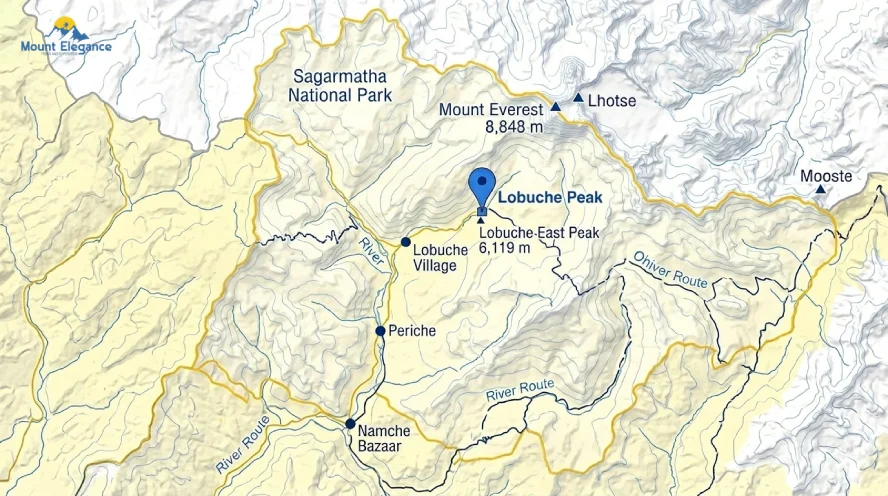
Lobuche Peak sits in the Khumbu region of Solukhumbu District which is in Nepal about 8 kilometers southwest of Mount Everest, inside the protected ecosystem of Sagarmatha National Park boundary as the mountain is a major highlight of the Nepalese Himalayas. It rises directly beside the massive Khumbu glaciers, creating a dramatic backdrop along the main trekking path. The peak is situated just above Lobuche village serving as an essential overnight tea house resting spot for trekkers before heading towards Everest Base Camp
Its prime geographic position offers breathtaking high altitude surroundings while making it easily accessible from the standard trekking trails.
What Are the Two Summits of Lobuche Peak?
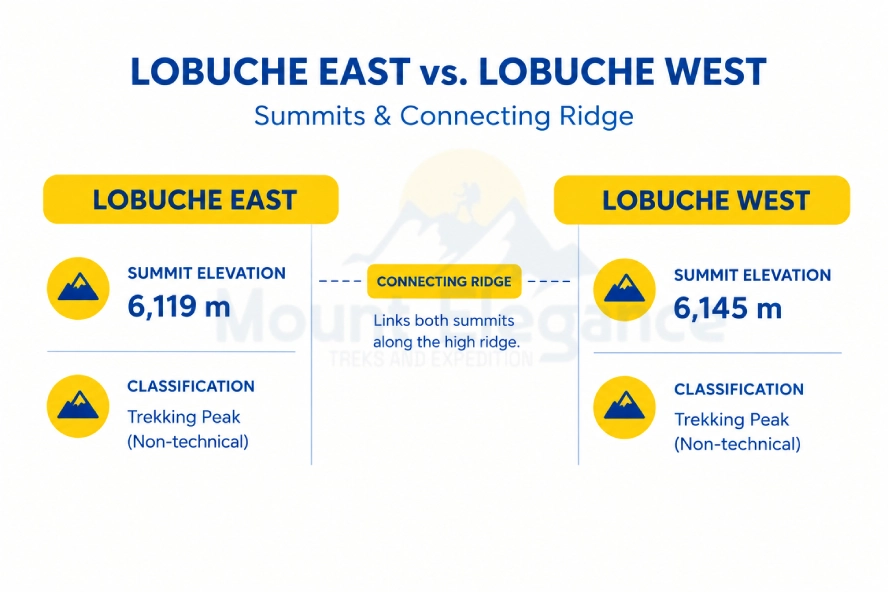
Lobuche East Peak 6,119m is classified a trekking peak and Lobuche West 6,145m is classified an expedition peak by the Nepal Mountaineering Association (NMA) - they are part of the same Lobuche mountain group the NMA classifies them differently because Lobuche West generally involves a more demanding and technical mountaineering objective.

Lobuche East is the summit most climbers attempt through a trekking-peak climbing permit and is a popular choice for people preparing for higher Himalayan climbs. Lobuche West at 6,145m - requires a higher level of technical experience and expedition-style planning. The ridge between the two summits is not normally climbable as a continuous traverse as climbers treat East and West as separate objectives rather than climbing directly from one summit to the other. There can also be some confusion in operator descriptions. What some trekking companies call Lobuche East may be described as Lobuche Far East in older or alternative terminology. For this reason - climbers should confirm the exact summit and permit category with their operator before booking.
How Difficult Is Lobuche Peak Climbing?
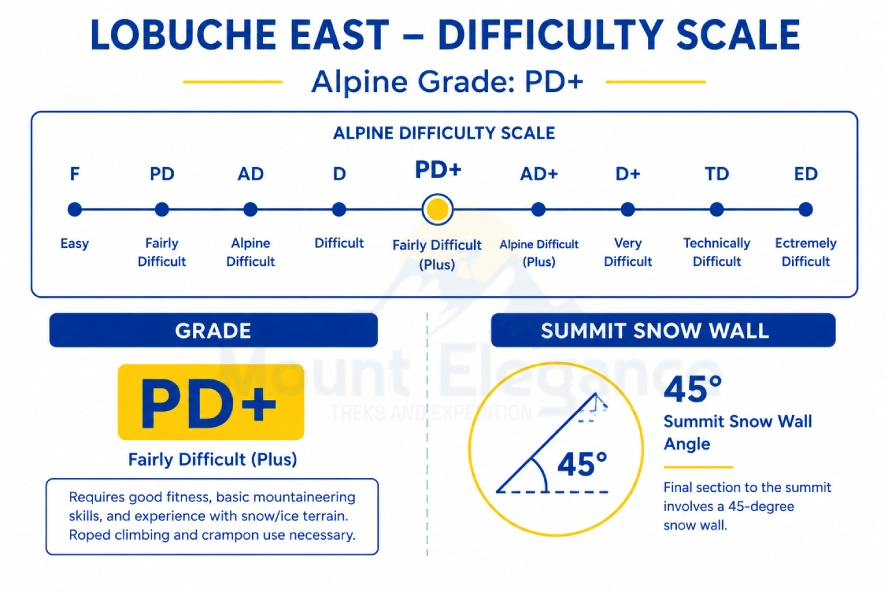
Lobuche East is graded PD+ on the alpine scale, classified as a moderate trekking peak requiring crampon and fixed-rope skills. The climb is physically demanding because it combines high-altitude trekking with basic technical mountaineering.Climbers must travel across glacial terrain and negotiate snow and ice sections before reaching the upper mountain. One of the main challenges is the steep summit snow wall, which can reach around 45 degrees and usually requires climbing on fixed ropes.
A typical summit day takes 8–12 hours - depending on weather, route conditions, fitness and acclimatization. Climbers should be comfortable using crampons, an ice axe - a jumar or ascender and fixed ropes. Lobuche East is achievable for fit trekkers with proper training and guidance. The altitude, long summit day and technical sections make it harder than a standard Everest region trek.
Is Lobuche Peak Harder Than Island Peak?
Yes, Lobuche Peak is technically harder than Island Peak due to steeper summit slopes and more exposed fixed-rope sections. Lobuche East is generally graded PD+, compared with PD for Island Peak and its summit day involves steeper snow and ice terrain. Lobuche also tends to attract climbers seeking a more challenging technical experience - while Island Peak is often considered more suitable for first-time Himalayan climbers with proper preparation and guidance.
Is Lobuche Peak Harder Than Mera Peak?
Yes, Lobuche Peak is more technical than Mera Peak making it a non-technical trekking peak. Although Mera Peak is higher at 6,476m compared with Lobuche East at 6,119m its upper slopes are normally gradual walk-up on snow - Lobuche involves glacier travel, steeper terrain and fixed-rope climbing. Mera is therefore more demanding for altitude and endurance - whereas Lobuche requires greater technical climbing skills.
What Permits Do You Need to Climb Lobuche Peak?
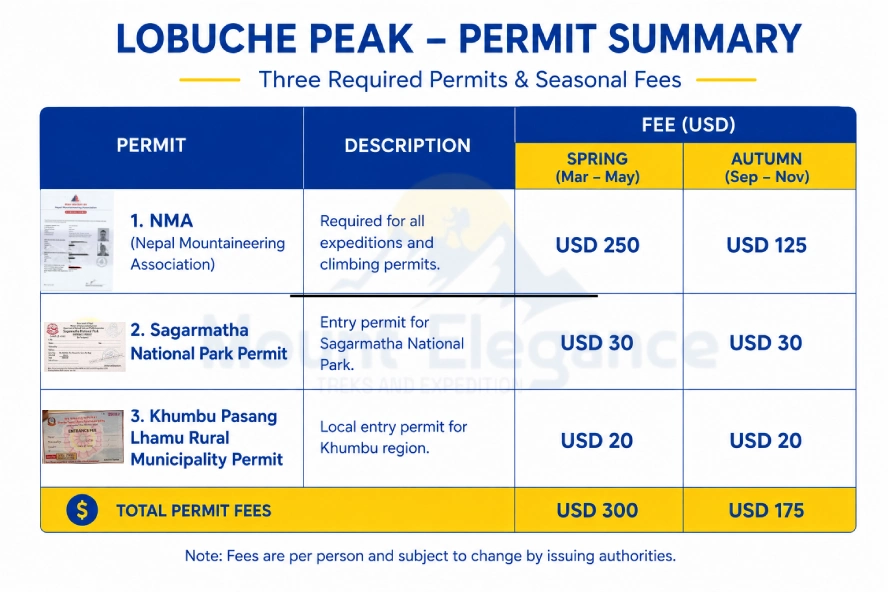
Climbing Lobuche Peak requires three permits: an NMA climbing permit - a Sagarmatha National Park entry permit and a Khumbu Pasang Lhamu Rural Municipality permit. For Lobuche East the NMA climbing permit costs USD 350 per person in spring (March–May) and USD 175 per person in autumn (September–November) winter (December–February) and summer/monsoon (June–August). The Sagarmatha National Park entry permit costs NPR 3000 for foreign visitors - while the Khumbu Pasang Lhamu Rural Municipality permit costs NPR 3000 as a licensed climbing guide is mandatory for the ascent and a registered agency normally arranges the climbing permit. A TIMS card is not required inside Sagarmatha National Park for the standard Lobuche and Everest region route.
How Much Does Lobuche Peak Climbing Cost?
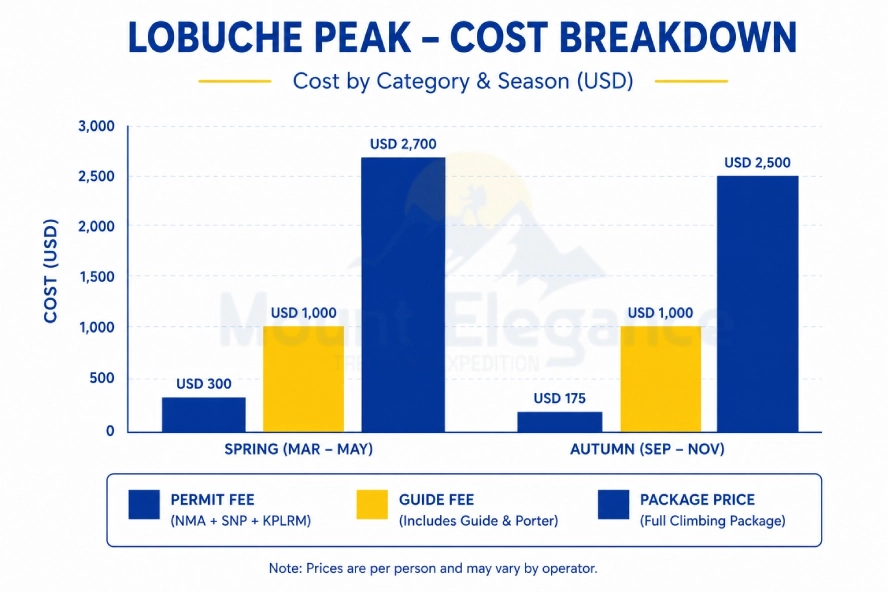
A standard Lobuche Peak climbing package costs between USD 1950 to USD 2500 per person depending on season, group size and trip length. The total usually includes - accommodation, meals, transport, permits and climbing support, while smaller groups and private trips cost more.
The main expenses include the NMA climbing permit which is season-based - with recently published rates commonly listing USD 350 in spring and USD 175 in autumn plus a licensed climbing guide and other trekking staff. Guide fees are usually included in package prices but can increase for private climbs or small groups. Spring packages are often at the higher end because of greater demand and higher permit costs, while autumn trips are commonly slightly cheaper. Winter climbs may have lower permit expenses but can still cost more overall due to difficult conditions - extra equipment and weather-related logistics.
When Is the Best Time to Climb Lobuche Peak?
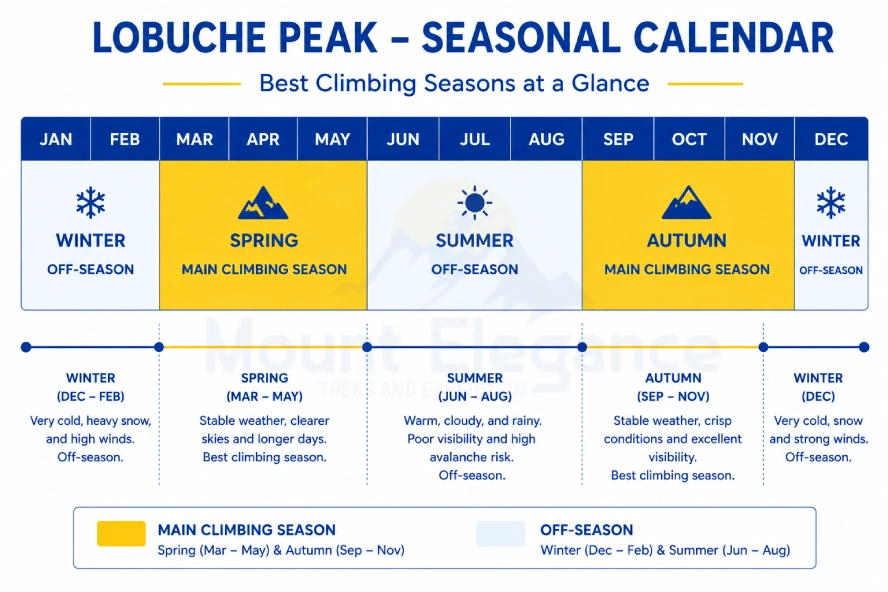
Spring (March-May) and autumn (September-November) are the two climbing seasons for Lobuche Peak. These months usually offer better weather - clearer mountain views and more suitable climbing conditions. Winter and summer are off-season periods with lower permit fees but winter snow and monsoon conditions can increase the risk of trail or High Camp closures. Autumn is often preferred because it generally brings more stable weather and clearer skies after the monsoon.
What Is the Standard Lobuche Peak Climbing Itinerary?
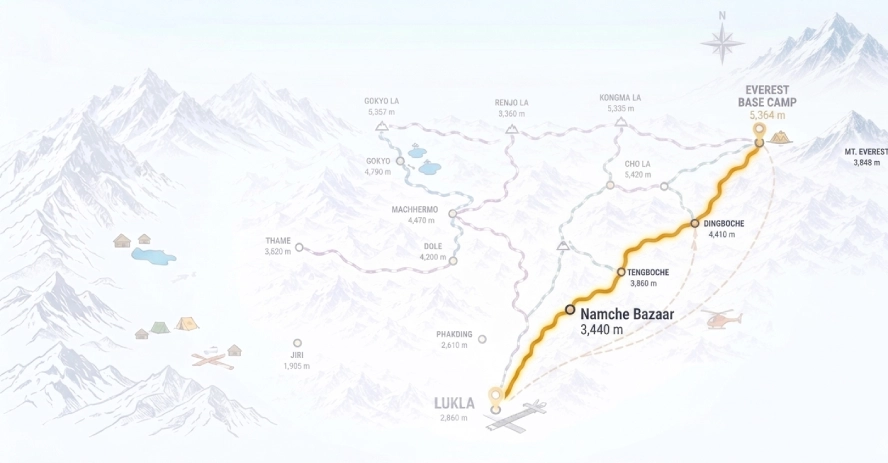
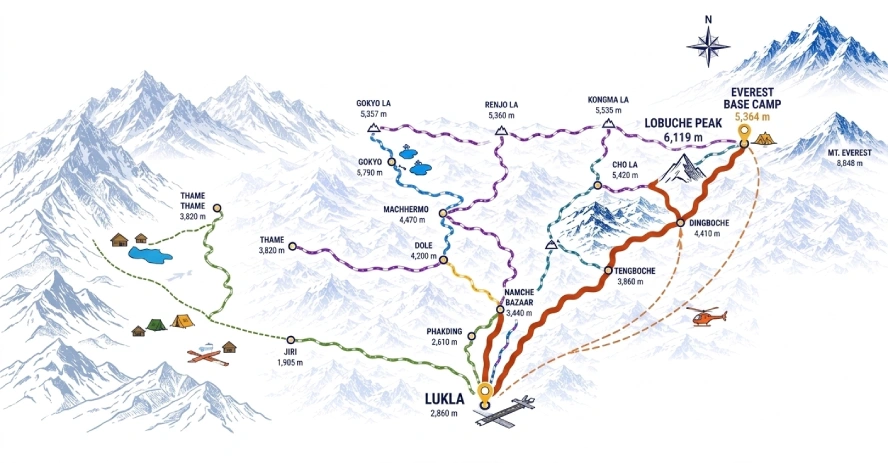
A standard Lobuche Peak itinerary runs 15 -18 days and follows the Everest Base Camp Trek Route as far as Lobuche village before branching to Lobuche Base Camp - High Camp and the summit. The route usually follows this order:
- Lukla – Start the trek and hike toward Namche.
- Namche Bazaar – Acclimatization and preparation.
- Tengboche – Continue through the Khumbu Valley.
- Dingboche – Another important acclimatization stop.
- Lobuche – Join the upper Everest Base Camp Trek route.
- Lobuche Base Camp – Begin the climbing phase.
- High Camp – Prepare for the summit attempt push.
- Lobuche Peak Summit – Summit attempt and descent to lower elevation.
- Return to Lukla – Retrace the trail through the Everest region.
The exact 15 -18 day itinerary depends on acclimatization days with weather conditions and whether the trip also includes Everest Base Camp or Kala Patthar.
How Do You Train for Lobuche Peak Climbing?
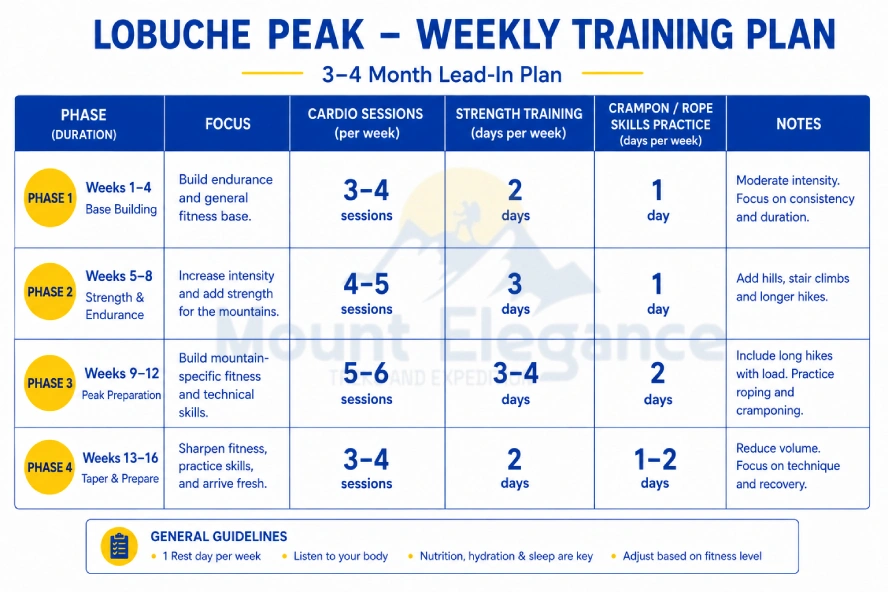
Training for Lobuche Peak should combine cardiovascular endurance, strength training and prior crampon/rope practice for 3–4 months before departure. Aim for 4–5 cardio sessions per week, including long hikes, uphill walking - stair climbing or running to build endurance for long days at altitude.
Add 2–3 strength sessions each week by focusing on legs, core and overall stability. Before the climb - rehearse key technical skills such as crampon walking, jumar ascent and fixed-rope descent. No technical climbing background is mandatory but previous experience with these skills is a clear advantage and can make the climbing section more comfortable.
What Gear Do You Need for Lobuche Peak Climbing?
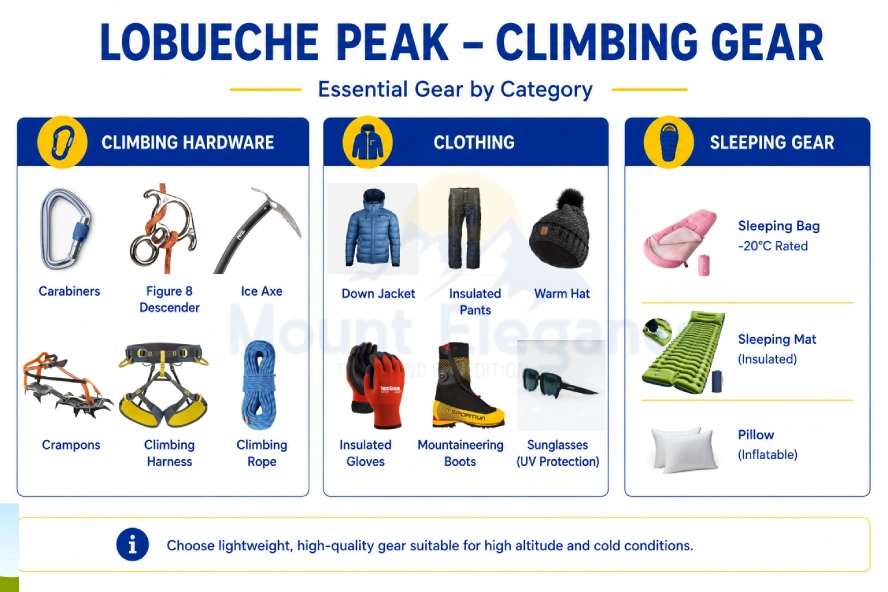
Lobuche Peak climbing requires personal mountaineering gear like ( crampons, ice axe, harness, ascender) in addition to standard high altitude trekking clothing.
climbing hardware
- crampons
- ice axe
- climbing harness
- jumar or mechanical ascender
- climbing helmets
- carabiners and safety slings
clothing
- insulated down jacket
- waterproof jacket and trousers
- thermal base layers
- warm gloves and insulated
- mittens
- mountaineering boots
sleeping gears
- sleeping bag suitable for -20 degrees
- sleeping bag liner
What Are the Main Risks on Lobuche Peak?
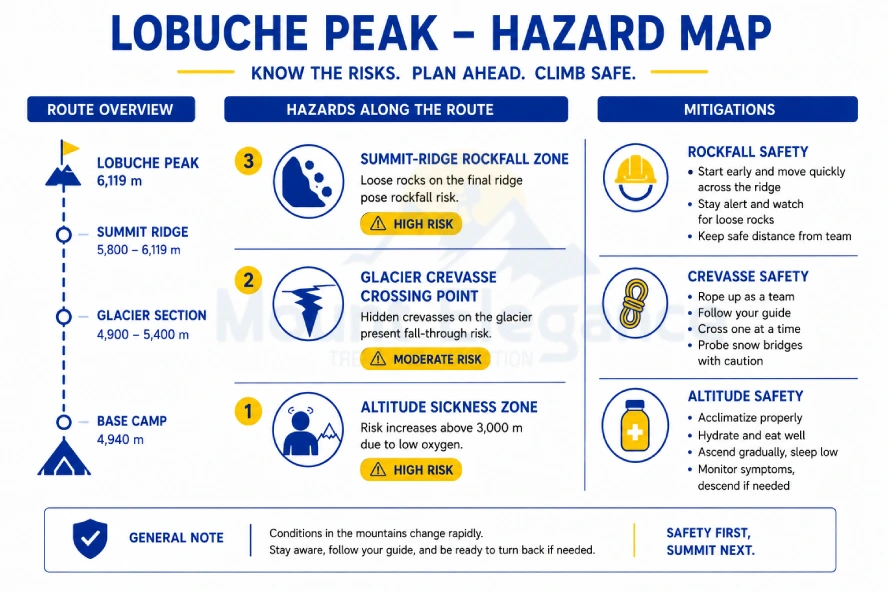
The main risks on Lobuche Peak are altitude sickness, crevasse falls on the glacier approach and rockfall on the summit ridge.
Altitude sickness:
The risk increases rapidly at high altitude so scheduling proper acclimatization days and a gradual ascent at a slow pace are important for reducing the danger.
Cervasse Falls:
Hidden crevasses can be present on the glacier approach making roped glacier travel with an experienced climbing team an important safety measure.
Rockfall:
Loose rocks and falling rubble may affect sections of the summit ridge, so wearing a climbing helmet is essential to protect yourself from falling icy stones.
Emergency evacuation options may include helicopter rescue from Lobuche Base Camp, depending on weather conditions and helicopter availability - With proper acclimatization, experienced guides and suitable safety equipment help in reducing the main Lobuche Peak risks.
Everest Base Camp Trek Route
The Everest Base Camp trek Route is the connecting trail that every Lobuche Peak itinerary follows from Lukla to Lobuche Village before the climb continues. The route passes through Sherpa villages and acclimatization stops, including Lukla, Namche Bazaar - Tengboche, Dingboche and Lobuche. From Lobuche Village - climbers leave the main Everest Base Camp trail and continue towards Lobuche Base Camp and high camp for the summit attempt.
What Role Does Dingboche Play on the Route?
Dingboche is a 4410-meter Sherpa village where trekkers spend a mandatory acclimatization day before continuing towards Lobuche, as this sits in the Imja Khola valley and provides an important opportunity for the body to adjust to the increasing elevation. On Lobuche Peak itineraries, this stop is especially valuable because an extra or spare acclimatization day can be used here before moving higher toward Lobuche and the climbing section.
What Is Pangboche Known For?
Pangboche is a 3,985 sherpa village known for its monastery and as the base camp village for Ama Dablam. Pangboche monastery is also known for its disputed yeti evidence which has made it a unique point of interest for trekkers as this village lies on the main trail between Tengboche and Dingboche making it an important stop on the Everest trekking route.
How Do You Reach Kala Patthar From Lobuche?
Kala Patthar is reached by a side trek from gorak shep time taken is around 1.5 to 2-hours climb from the Lobuche Peak trekking trail. at 5,644 meters this is the highest point most trekkers reach without a climbing permit. The viewpoint offers wide views of Everest - Pumori and the surrounding Himalayan peaks. Lobuche Peak climbers often add Kala Patthar as an acclimatization and viewpoint side trip before continuing with their climbing plans.


